P0443 – EVAP Purge Control Valve Circuit Malfunction
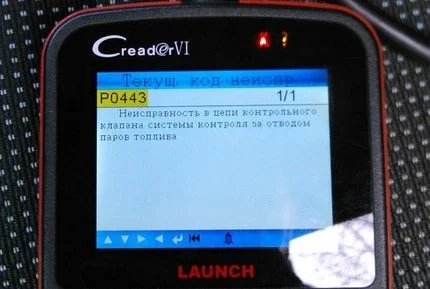
Error P0443 indicates a malfunction in the Evaporative Emission Control System (EVAP) purge control valve circuit. Most frequently, code P0443 appears on vehicles with high mileage (age) and is caused by issues with the wiring or the electrical component of the valve itself. The error is not critical, and the vehicle can still be driven, but it is advisable to resolve it at the earliest opportunity. In most cases, it will require checking the electrical circuits or replacing the valve.
What is the EVAP system?
Before describing error P0443, it is worth briefly explaining the operation of the Evaporative Emission Control (EVAP) system. Its main task is to prevent petrol vapours from escaping into the atmosphere. These vapours form in the fuel tank at high ambient temperatures or, more rarely, when atmospheric pressure drops. The petrol vapours accumulate in the system and, when the engine is started, are diverted into the intake manifold and burnt in the engine along with the air-fuel mixture. EVAP is used on almost all modern vehicle engines.
The system includes an adsorption canister (filled with charcoal granules designed to store petrol fumes), a solenoid purge valve, and connecting hoses. Error code P0443 specifically indicates a fault with this solenoid valve, which is why it is sometimes referred to as a fuel vapour valve error.
In engines equipped with a turbocharger, the system is supplemented by a two-way valve designed to direct fuel vapours to the intake manifold (if there is no boost pressure) or to the compressor inlet (if boost pressure is present) during canister purging. A two-way valve is necessary because turbocharged engines do not create a vacuum in the intake manifold under boost.
A feature of the system is that it has a built-in self-diagnostic module. This means that when the engine is started, the system automatically checks for functionality, particularly for leaks and the correct operation of its individual elements. This is done to minimise the likelihood of petrol vapours entering the atmosphere, strictly for environmental reasons. This is dictated by stringent legislation in force in the EU, the USA, and other regions.
External signs of error P0443
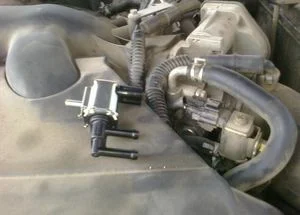
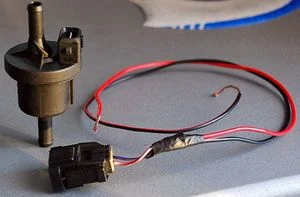
EVAP Valve
In most cases, there are no external symptoms of error P0443, apart from the illuminated Check Engine light on the dashboard. In rarer cases, a smell of petrol may appear in the cabin, caused by a significant amount of petrol vapours escaping from the vehicle's fuel system into the atmosphere or its ventilation system.
Occasionally, unstable engine operation at idle, fluctuating RPMs, and even engine stalling may occur. While driving, a decrease in the vehicle's dynamic performance may be observed; it accelerates poorly or feels sluggish. However, such symptoms can indicate various other faults, so additional diagnostics are required to identify the root cause.
Rare cases are noted where error P0443 occurs when the air conditioning or climate control system is switched on. Since the engine consumes more fuel when these systems are active, there are more petrol fumes in the system. If their value exceeds the permissible norm, this leads to the conditions for error formation, provided the system's solenoid purge valve is in a fault state.
Conditions for formation
Error code P0443 is generated when the ignition key is turned to the ON position (ignition on, engine not running), and the ECU diagnoses an open circuit or short circuit in the electrical winding of the EVAP purge valve. This also triggers the warning light.
Some vehicles have additional requirements for generating code P0443. For example, on the Chevrolet Captiva, these conditions include the ignition being on and the battery/system voltage being between 11 and 18 Volts DC. Furthermore, the ECU diagnoses the error after these conditions have been met for 6 seconds. On other cars, the values may differ, but the logic remains the same.
Possible causes of error code P0443
There are several typical reasons why this so-called canister error arises. Among them are:
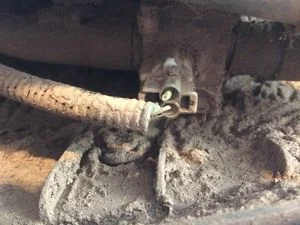
Open valve circuit
- Total or partial failure of the EVAP solenoid valve (open solenoid winding).
- Open circuit or short circuit (to positive or earth) in the wire connecting the valve terminals and the Engine Control Unit (ECU).
- Open circuit (or damaged insulation) in the wire between the control unit and earth, responsible for transmitting the signal to the solenoid valve.
- Open circuit (or damaged insulation) in the wire between the main relay and the terminal on the EVAP solenoid valve.
- Mechanical damage to the purge valve. For example, it is stuck in a fully open or fully closed position.
- Damage to the connectors. While these differ by car model, it is necessary to check the contacts responsible for controlling both the EVAP system in general and its solenoid valve specifically.
- Incorrect ECU operation. This is a fairly rare cause, but there have been cases where glitches occurred after remapping or mechanical damage (e.g., damaged circuit tracks). However, usually, this results in multiple unrelated errors rather than just one.
It is worth noting that errors related to the incorrect operation of the fuel vapour recovery system (including P0443) can occur due to clogged filters and tubes. For instance, a common cause is the foam inside the canister rotting and crumbling over time, causing charcoal to enter the system and block it. The valve also gets clogged, causing it to stop working correctly. Often, with a clogged EVAP valve, a distinct smell of petrol can be felt in the cabin when the front windows are open.
There are known cases where the cause of error P0443 is a missing fuse in the valve control circuit. Another scenario is using a fuse with a lower current rating than required. For example, on the Chevrolet Aveo, issues were observed when a 10 Amp fuse was installed instead of the required 15 Amp one. Replacing it solved the problem.
Also, EVAP codes can be triggered by a loss of seal in the fuel filler cap (or hose system). However, in the case of P0443 (electrical circuit malfunction), checking the cap for tightness is secondary; the primary focus should be on the wiring and the valve itself.
Fixing error P0443
The methods for eliminating error P0443 depend on the causes. First, check if the error is simply a software glitch. To do this, you need to clear the error information from the ECU memory. This can be done in different ways. The first, more professional method, is to use a diagnostic tool (scanner) and appropriate software to delete the information.
The other method is simpler. Disconnect the negative terminal from the battery for 5–10 seconds, then reconnect it. The ECU will restart and perform diagnostics on all vehicle systems again. If it was a false alarm, the error will not return. If the conditions for formation persist, further diagnostics are required.
To do this, perform one or more of the following actions:
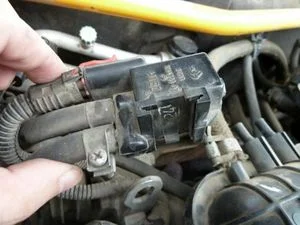
Replacing the EVAP valve
- Check the condition of the canister. Remove the EVAP solenoid valve and check if there is charcoal in its housing. If so, the canister's foam separator needs replacing. If the housing is very rusty or damaged, consider replacing the entire canister.
- Check the operation of the vacuum purge valve. This can be done in two ways. The first is using a special diagnostic tool. Start the engine and activate the valve via the scanner. To check it manually: remove the valve and try to blow through it. A working valve should be closed and airtight when de-energised. If air passes through freely without voltage applied, the valve is stuck open and requires replacement.
- If the check reveals the valve itself is in working order (airtight without power and opens when 12V is applied), you need to inspect its wiring. First, disconnect the valve connector. Then, using a multimeter, measure the voltage supplied to the solenoid valve with the ignition on. This value should be between 11 and 14 Volts.
- To check the integrity of the wire connecting the ECU and the solenoid valve, disconnect them at both ends (remove connectors from the valve and the ECU). Then, use a multimeter in resistance mode to check the wire. Important: The normal resistance of an intact wire should be close to zero (usually less than 1 Ohm). If the device shows infinity or high values (kilo-ohms), there is a break or severe oxidation in the wire.
- Check the condition of the wire between the solenoid valve and the integrated relay or fuse (supply wire). The actions are similar to the previous point. Disconnect the wire at both ends and measure its resistance. It should also be close to zero (up to 1-2 Ohms). If the value is significantly higher, the wire is damaged.
Workshop technicians can check the purge valve using a diagnostic tool. With the ignition on and the engine off, connect the device to the ECU and send commands to the valve via the software. You should clearly hear clicking sounds characteristic of its operation.
If the problem is mechanical damage to the valve, you can try to 'revive' it using carburettor cleaner. The standard design of this valve includes an electromagnetic coil and a needle with a spring. Over time, the needle can become clogged with resinous deposits. However, if the problem is in the winding (an internal break in the coil), cleaning will not help — the valve must be changed.
Additional errors
Often, the canister error is accompanied by other parallel codes indicating faults with adjacent system elements. Common 'companions' to this fault include:
P0444. This error indicates a short to power or an open circuit in the purge valve control circuit. For code P0444 to form, the following mandatory conditions usually need to be met (varying by model):
- intact electrical wiring (not broken or damaged);
- battery voltage within the normal range (from 10.7 to 16 Volts);
- activation of the Check Engine light occurs after three drive cycles.
On the Hyundai Accent (known as Solaris in some markets), the resistance of a working EVAP valve winding is approximately 16 Ohms at +20°C.
P0447. This code indicates that the EVAP vent control circuit is open. Typically, the cause of this error is rotting of the control wiring leading to the solenoid valve. This problem frequently occurs on cars where the valve is located at the rear, for example, near one of the rear wheels. In this case, the wiring is exposed to moisture, dirt, and road salts. All this can damage the protective insulation over time and cause the error. The recommended repair is replacing the wiring or potentially the entire valve.
Conclusion
Error code P0443 is not critical for the engine mechanics, and the vehicle can still be used. However, a faulty EVAP system has a negative impact on the environment, and petrol fumes may enter the cabin. Therefore, it is better to eliminate error P0443 at the earliest opportunity by repairing the circuit or replacing the valve.
Was this article useful?
Your feedback helps us improve our content.
Related Materials
Discussion (0)
No comments yet!