P0300 - Engine Misfire Detected. Causes, Symptoms, and Fixes

Error code P0300 indicates a firing order violation, which is deciphered as random multiple cylinder misfires. In English, the diagnostic tool displays: «Random cylinder misfire detection system». If misfires are detected in a specific cylinder, the last digit of «P030x» changes to 1, 2, 3, 4, up to 6 or even 12, depending on which specific cylinder has the fault. Thus, error P0300 is the root cause of errors such as P0301, P0302, P0303, P0304. Most often, they arise due to a lack of spark, fuel delivery issues, or exhaust gas problems.
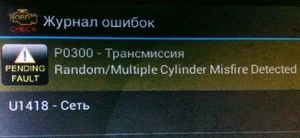
Error P0300
Let's look in more detail at the list of possible reasons for misfires, why errors P0301, P0302, P0303, P0304 or similar codes appear, their consequences, and methods of elimination.
Consequences of Error P0300
When a misfire occurs in the engine, the toxicity level of exhaust gases increases in the exhaust pipe. This, in turn, can lead to a temperature rise in the catalytic converter, causing damage (the honeycomb structure melts as the temperature exceeds 800 °C). On some cars, to reduce fuel burning in the catalytic converter and consequently the toxicity level, the ECM monitors misfire frequency using crankshaft and camshaft sensors. Besides registering error P0300 and illuminating the Check Engine light, it may also disable the injectors of the specific cylinder where the misfire was detected. It is worth noting that owners of cars such as Opel, Nissan, Kia, and various other petrol injection vehicles frequently encounter this issue.
When does error code P0300 appear?
Note that error code P0300 is recorded by the control unit only when misfires are detected in several cylinders simultaneously, as a misfire in one of them is recorded after two consecutive repetitions, with the crankshaft speed being a factor. At idle, the error is stored in memory after 3.5 minutes of engine operation, and at speeds above 2,000 rpm — after just over one minute. The threshold value for DTC registration in the ECM memory is more than 3.25% missed flashes per 1,000 revolutions. If misfires are found only in a certain cylinder, error P0300 is not generated, but rather a code with the sequential number of the combustion chamber.
How to identify cylinder misfires?
It is not difficult to understand that the yellow warning light came on due to an ignition disorder because, as a result of misfires, the engine runs roughly at low speeds, there are jerks and hesitation during acceleration, as well as a loss of power and increased fuel consumption.
Causes of errors P0300, P0301, P0302, P0303 and P0304
Unfortunately, the diagnostic tool cannot yet identify the specific cause of the failure and cylinder misfire, but fortunately, the most probable faults fall into two categories – either nothing to burn or impossible to ignite. Although rejoicing at a quick fix for error P0300 might be premature, as it could be:
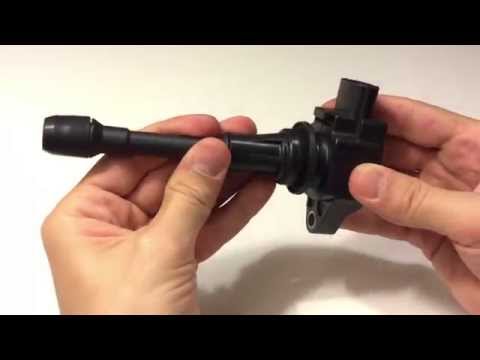
Cylinder misfires. How to diagnose the cause.
- In the ignition system
- spark plug failure;
- HT lead (high tension wire) breakdown;
- faulty ignition coil (or module);
- other causes related to wiring and connectors in the ignition system.
- poor quality fuel (petrol);
- clogged injectors;
- heavily soiled fuel filter;
- low fuel pressure.
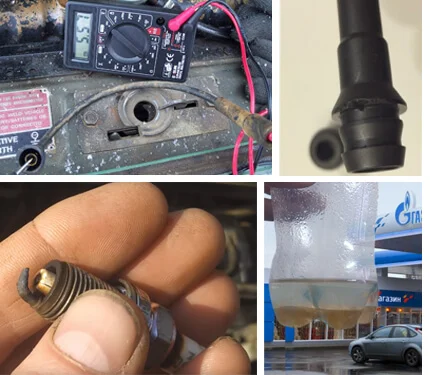
Main causes for error P0300
- tight or sticking valves;
- air leak (vacuum leak);
- low compression;
- clogged catalytic converter;
- timing mechanism faults.
- crankshaft (CKP) and camshaft (CMP) sensor failure;
- knock sensor failure;
- MAF (Mass Air Flow) and IAT (Intake Air Temperature) sensor failure;
- ECU failure.
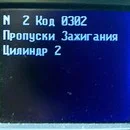
If the issue is not a general multiple misfire problem, but specific to a cylinder (P0301, P0302, P0303, P0304 etc.), the situation is simpler and likely lies in the ignition system. In such cases, error P0363 may also be displayed, which indicates fuel delivery cutoff to that cylinder.
Recommendations for checking and troubleshooting
The first things to check during misfires are the HT leads and ignition coils (module); they often have broken insulation, internal breaks, or an oily surface. We measure the leads with a multimeter (normal resistance is around 4 – 10 kOhm) in resistance mode. To check individual ignition coils, simply swap them with a known working cylinder and rescan for errors. If the code changes to another cylinder number, the coil is faulty. An ignition module is more complex and requires testing with a multimeter.
Next in line are the spark plugs – a damaged electrode, incorrect gap, or oil fouling can lead to failure or unstable plug operation.
After removing the spark plug for inspection, the next step is to measure compression in the cylinder. Low or absent compression leads to insufficient pressure and, consequently, creates problems with mixture ignition.
Clogged fuel injectors cause interruptions in fuel delivery to the combustion chamber, but unfortunately, they cannot be quickly tested without a test stand. The only advice in such a situation is to fill up with higher octane petrol and drive the car for a while at higher revs (4-5k rpm).
A long-unchanged fuel filter or bad petrol often causes unstable injector operation. Recall when the filter was last changed and at which petrol station you filled up.
A stuck EGR valve or leaks through the intake manifold gasket, which can also cause random misfires, are sometimes difficult to identify yourself. Therefore, during computer diagnostics, pay attention to the Long Term Fuel Trim parameter. It shows how much the ECU is compensating for the air/fuel imbalance. When this parameter differs by more than 10% on a specific cylinder, it may indicate a vacuum leak.
Rarer cases that cause firing order violations, such as incorrect valve timing or exhaust gas restrictions, are monitored by the control unit. In addition to code P030X, other errors regarding the catalytic converter, lambda probe (oxygen sensor), or camshafts will appear.
Hopefully, these tips will help you not only understand the cause of the fault but also fix it yourself, without outside help, saving money by only paying for the specific part needed rather than replacing everything that could possibly be causing the failure.
Was this article useful?
Your feedback helps us improve our content.
Related Materials
Discussion (0)
No comments yet!