Car Battery Discharge Time Calculator
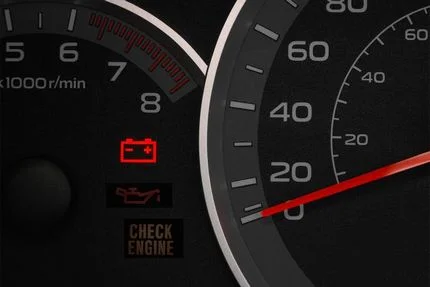
Many car owners are interested in battery discharge time. Especially if you discover in the morning that you forgot to switch off the lights, and when trying to start the engine, it turns out the battery is completely flat. That is when the question arises: "Could the interior light or sidelights have drained the battery, or is it a fault?" The short answer is yes, absolutely, especially if it is winter and the battery wasn't 100% charged.
To fail to start the car after just a day, a parasitic drain (leakage current) of 100 milliamps or more is sufficient, let alone a power consumption of 400-700 mA. You can verify this by calculating the nominal discharge time of the car battery. The calculation formula looks like this:
T = Capacity (Ah) / Load Current (A)
Our online calculator allows you to calculate how long the battery will last with a power consumer switched on, whether forgotten accidentally or left running intentionally. The calculation will be made taking into account the nominal battery capacity, the power of the consumer, and the natural parasitic drain in the resting state.
With low current consumption, a high-capacity battery can provide a longer operating time. Naturally, the greater the battery capacity, the longer the operating time, but the alternator will also take longer to charge it. This means a short journey may not allow it to recover quickly. In winter, this can lead to the starter motor failing to turn the engine over.
Battery Discharge Time
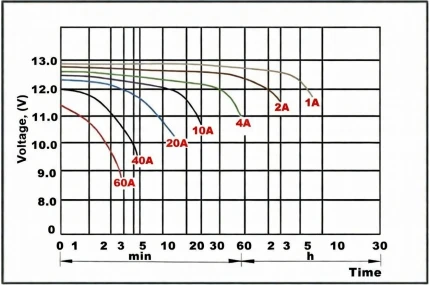
Discharge characteristics (25°C)
To understand how to calculate battery discharge time, let's look at a specific example. Suppose a consumer with a power of 120 Watts is switched on in the car's electrical system. According to Ohm's law, we can calculate that it draws 10A from the battery per hour. That is, if the car has a 55 Ah battery, full discharge will occur in no more than 5.5 hours. But this is only an approximate calculation, as there are other factors that will affect current consumption. Note that for the car not to start, 15-25% remaining charge is sufficient to fail, which is about 4 hours in this scenario.
Table of battery discharge time with minimal consumption:
| Discharge Percentage (%) | 10 | 20 | 30 | 40 | 50 | 60 | 70 | 80 | 90 | 100 |
| Discharge Time (h)* | 7 | 14 | 20 | 26 | 32 | 39 | 45 | 52 | 58 | 64 |
*For the calculation, minimal values of parasitic drain at 20 mA and a 10W car bulb power were taken from a battery with a capacity of 55Ah.
The data regarding 20 hours of battery operation often indicated on the label is based on a calculation for a current equal to 0.05 of its capacity.
| Battery Capacity | Load 100 W | Load 200 W | Load 300 W | Load 400 W | Load 480 W | Load 500 W | Load 600 W |
|---|---|---|---|---|---|---|---|
| 12V/50 Ah | 3.41 h | 1.70 h | 1.13 h | 0.85 h | 0.71 h | 0.68 h | 0.57 h |
| 12V/75 Ah | 5.11 h | 2.55 h | 1.70 h | 1.28 h | 1.06 h | 1.02 h | 0.85 h |
| 12V/100 Ah | 6.82 h | 3.41 h | 2.27 h | 1.71 h | 1.42 h | 1.36 h | 1.14 h |
| 12V/150 Ah | 10.23 h | 5.11 h | 3.41 h | 2.56 h | 2.13 h | 2.05 h | 1.71 h |
| 12V/200 Ah | 13.65 h | 6.82 h | 4.55 h | 3.41 h | 2.84 h | 2.73 h | 2.28 h |
Permissible Battery Discharge
The permissible discharge of a car battery is down to 30% of the initial capacity (voltage not lower than 11.8V). Note that at this level, you can only start the engine in temperatures above freezing. In winter, do not allow even 50% discharge (12.1V).
How to use the discharge time calculator
Using a basic formula, you can calculate how long the battery will last on a standard calculator, but you need to know the exact power consumption value and add the leakage current to it. Therefore, it is much faster to find out the battery discharge time depending on the load current by ticking the necessary consumers. To calculate, you need to:
- Enter the battery rating in the 'Battery Capacity' field.
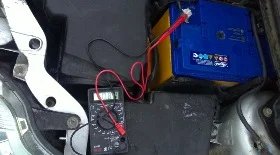
- In the 'Current leakage' cell, you can specify an average of 25-35 mA, or a value verified with a multimeter. To calculate the permissible value, use our online calculator. Depending on what consumers you have, it will show the estimated normal leakage value in the resting state.
- Tick the boxes (select from the list) for the necessary consumers, the switching on of which caused the discharge (or if there is a need to calculate the battery operating time). The power of the lamps is calculated based on standard ratings.
- In the 'Consumer Power' field, the figure will change depending on the selected sources. Alternatively, you can manually enter a known number in Watts or the current strength in Amperes.
- By clicking the 'Calculate' button, you will receive the time result in hours.
This battery discharge calculation is approximate, as chemical and electrical processes in the battery do not lend themselves to strict mathematical analysis.
For reference regarding the power of a specific consumer, you can take data from the table below.
Table of current consumers in a car
| Consumer | Power (W) | Required Current (A) |
|---|---|---|
| Front sidelights | 5 x2 | 1-2 |
| High/Low beam headlights | 55 x2 | 7-10 |
| Fog lights | 55 x2 | 7-10 |
| Rear fog light | 21 x2 | 2–3.5 |
| Parking lights | 5 x2 | 1-2 |
| Rear tail lights | 5 x2 | 1-2 |
| Number plate light | 2 | 0.17 |
| Brake light | 5 x2 | 1-2 |
| Audio system / Stereo | 5-25 | 0.5-2 |
| Windscreen wipers | 60 | 5 |
| Heated windscreen/rear window | 120 | 5-10 |
| Heated seats | 85-160 | 7-14 |
| Heater blower fan | 80-200 | 6-16 |
| Auxiliary heater | 60-120 | 5-10 |
| Ignition system | 20 | 2-4 |
| Engine Control Unit (ECU) | 10 | 1-2 |
Frequently Asked Questions
How long will a 60Ah battery last with a 60W discharge?
Assuming the 60Ah battery was fully charged and the parasitic drain in the car's network does not exceed the norm, with a consumer discharge of 60 Watts, the battery will last no more than 12 hours.
How long will a 7Ah 12V battery last?
To calculate how long a 7Ah 12V battery will last (often used for alarms or LED strip lighting during power cuts at night): with a power source consumption of 0.7A it will last for 10 hours of operation, or 15 hours if consumption is 5W.
What is the formula for battery discharge time?
The formula for battery discharge time is: power source capacity (Battery) expressed in Ah divided by the consumer current in Amperes (A). That is t = C / I. However, this is only an absolute value; the actual time is slightly less. A battery is considered flat when its voltage drops to 11.8 Volts, and the discharge occurs exponentially.
What is the minimum battery discharge voltage?
The available capacity of a battery depends on the discharge mode and temperature. Therefore, the higher the load and the lower the temperature, the lower the minimum voltage to which the battery can be drained. On average, the minimum voltage of a discharged 12-volt battery in warm weather is 11.5V, while in winter, the minimum voltage allowed for a car battery is 11.75V, which corresponds to 30 percent of its remaining capacity.
Was this tool useful?
Your feedback helps us improve our content.
Related Materials



Discussion (0)
No comments yet!