Pressure Conversion Calculator: Bar to MPa, kgf/cm², and PSI
Pressure is a physical quantity equal to the force acting strictly perpendicularly on a unit of surface area. It is calculated using the formula: P = F/S. The International System of Units (SI) measures this quantity in Pascals (1 Pa equals a force of 1 Newton per 1 square metre, N/m²). However, since this represents a very small amount of pressure, measurements are more commonly expressed in kPa or MPa. Different industries use their own systems of measurement; in the automotive sector, pressure may be measured in bars, atmospheres, kilograms-force per cm² (technical atmosphere), megapascals, or pounds per square inch (PSI).
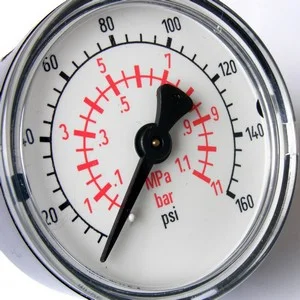
For quick conversion of measurement units, refer to the following relationships:
1 MPa = 10 bar;
100 kPa = 1 bar;
1 bar ≈ 1 atm;
3 atm = 44 PSI;
1 PSI ≈ 0.07 kgf/cm²;
1 kgf/cm² = 1 at.
| Pressure Unit Conversion Table | ||||||
|---|---|---|---|---|---|---|
| Unit | MPa | bar | atm | kgf/cm² | PSI | at |
| 1 MPa | 1 | 10 | 9.8692 | 10.197 | 145.04 | 10.19716 |
| 1 bar | 0.1 | 1 | 0.9869 | 1.0197 | 14.504 | 1.019716 |
| 1 atm (physical atmosphere) | 0.10133 | 1.0133 | 1 | 1.0333 | 14.696 | 1.033227 |
| 1 kgf/cm² | 0.098066 | 0.98066 | 0.96784 | 1 | 14.223 | 1 |
| 1 PSI (lb/in²) | 0.006894 | 0.06894 | 0.068045 | 0.070307 | 1 | 0.070308 |
| 1 at (technical atmosphere) | 0.098066 | 0.980665 | 0.96784 | 1 | 14.223 | 1 |
Why use a pressure unit converter?
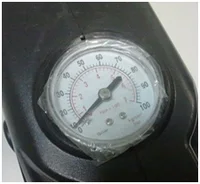
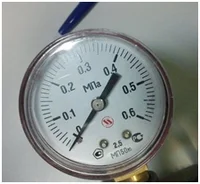
This online calculator allows you to quickly and accurately convert values from one pressure unit to another. Such conversion is useful for vehicle owners when measuring engine compression, checking fuel rail pressure, inflating tyres to the required specification (it is often necessary to convert PSI to atmospheres or MPa to bar during checks), or recharging air conditioning systems with refrigerant. Since a pressure gauge scale might use one system of measurement while the manual uses another, the need to convert bars to kilograms, megapascals, kilograms-force per square centimetre, or technical/physical atmospheres arises frequently. Furthermore, if you need a result in the Imperial system, you can convert to pounds-force per square inch (lbf·in²) to comply exactly with the required specifications.
How to use the online calculator
To use the instant pressure converter and find out how many bar are in MPa, kgf/cm², atm, or PSI, follow these steps:
- Select the unit of measurement you wish to convert from in the left-hand list;
- Select the target unit for conversion in the right-hand list;
- Immediately after entering a number in either field, the "result" appears. You can convert from one value to another and vice versa.
For example, if you enter the number 25 in the first field, depending on the selected unit, you will calculate how many bars, atmospheres, megapascals, kilograms-force per cm², or pounds-force per square inch that represents. If that same value is entered into the other (right) field, the calculator will compute the reverse ratio of the selected physical pressure quantities.
Frequently Asked Questions
-
How many atmospheres are in 1 bar?
To get an approximate result of how many atmospheres are in one bar, divide the pressure value by the coefficient 1.013. Thus, 1 bar is 0.98 atmospheres. Therefore, when converting small pressure units (up to 10 bar), it is common practice to assume that 1 bar ≈ 1 atm. Such a ratio yields an error of no more than 2% in calculations.
-
How many bar are in 1 MPa?
To find out how many bar are in one megapascal, simply multiply the pressure value expressed in MPa by 10. That is, 1 MPa = 10 bar.
-
How many kgf/cm² are in 1 MPa?
To convert one Megapascal into pressure expressed in kilograms-force per square centimetre, simply multiply the MPa value by 10.197. Thus, 1 MPa = 10.197 kgf/cm².
-
How many atmospheres are in a kgf?
When converting kgf/cm² to atm, divide the pressure value expressed in kgf/cm² by 1.033. Using this ratio, you can convert any pressure value expressed in kilograms-force to atmospheres.
Was this tool useful?
Your feedback helps us improve our content.
Related Materials
Discussion (0)
No comments yet!