Service Life of Car Tyres
A car tyre is a resilient rubber casing mounted on a wheel rim. It ensures contact with the road, absorbs minor shocks, and compensates for wheel trajectory errors. During operation, the rubber is subjected to heavy loads, which limits its lifespan depending on several factors.
Tyre Shelf Life Standards
Shelf life is the period during which the manufacturer guarantees the product is fit for purpose and accepts liability for manufacturing defects.
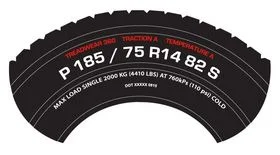
When purchasing tyres, it is preferable that no more than three years have passed since production. The manufacturing date can be found in the marking on the sidewall (usually 4 digits in an oval: week and year of manufacture).
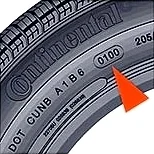
Tyre production date
According to general industry standards, the guaranteed shelf life of tyres is typically 5 years from the date of manufacture. It is important to understand: speed ratings (ZR, H, S) indicate the maximum permissible speed, not the lifespan of the tyre in years. Regardless of the speed rating, rubber is subject to ageing.
Specialists recommend replacing tyres before the critical deadline. The opinion that "aged stock" (5–6 years old) is fit for use if it looks new is mistaken. Due to oxidation and micro-cracking, such a tyre may fail at a critical moment.
Tyre Storage Period
Storage period is the time during which the product retains its properties if rules are followed. The expiration of the storage period does not always mean total unsuitability, but the technical characteristics of the rubber may degrade.
Tyres age due to physical and chemical processes, even if not used. To slow this down, antioxidants and stabilisers are added to the rubber compound. With proper storage, a tyre can be considered 'new' for several years after manufacture.
Western experts often limit the total life span (including storage) to 10 years. German motoring organisations recommend limiting the service life to 6 years. This also applies to the spare wheel.
Key storage rules (based on manufacturer recommendations and ISO standards):
- The storage area must be protected from direct sunlight, ozone, organic solvents, oils, fuels, acids, and alkalis.
- Tyres must not come into contact with copper or corrosive materials, nor be subjected to deformation (bending, pressure from heavy objects).
- Optimal conditions: a dry, dark, and cool room. High humidity and temperature fluctuations accelerate ageing.
- Tyres should be washed and dried before storage.
- Temperature range: from -30 to +35 °C (optimally +10...+25 °C). Distance from heating appliances — at least 1 metre.
- When storing outdoors (permitted for no more than a month), tyres must be covered with opaque waterproof material and raised above the ground.
- Storage on surfaces contaminated with oils or lubricants is prohibited.
- Do not store tyres next to electric motors, transformers, and other sources of ozone (concentration not exceeding 0.08 ppm).
For more details on methods (on rims or off), refer to our guide on "How to Store Car Tyres".
Major manufacturers (Bridgestone, Michelin, Continental) usually state that the maximum service life of tyres is 10 years from the date of manufacture. However, after 5 years of use, it is recommended to have tyres thoroughly inspected by a specialist at least once a year.
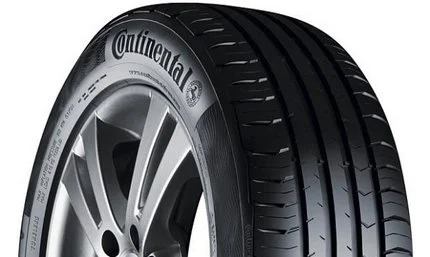
There is no strict legislative ban on selling "old" new tyres, but specialists believe that a tyre sitting in a warehouse for more than 5 years loses some properties of a new one.
Service Life and Operation
Service life is the actual period of tyre use until critical wear or the appearance of defects. Manufacturers design for a resource of up to 10 years, but in practice, replacement is often required every 3–6 years depending on mileage and conditions.
Factors Affecting Wear
The main causes for reduced rubber life are:
- Load and pressure. Exceeding the load index and driving with incorrect pressure destroys the tyre structure. Overloading the car by 20% reduces tyre life by approximately 30%.
- Profile size. Low-profile tyres are more vulnerable to impacts from road irregularities.
- Driving style. Sharp starts and braking, as well as aggressive cornering, significantly accelerate tread wear.
- Road conditions. Potholes, gravel, and abrasive surfaces shorten the life of the tyre.
- Mileage. Natural abrasive wear.
- Product quality. Premium brand tyres generally have a more durable compound and stronger casing than budget alternatives.
- Mechanical damage. Cuts, bulges, and rim geometry issues.
Signs of End of Life
The need for replacement is indicated not only by mileage figures but also by actual condition:
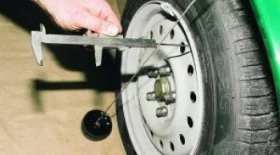
- Tread wear. Replacement is necessary when the tread depth reaches the wear indicators (bars). The legal minimum residual depth is typically 1.6 mm for summer tyres, though 4 mm is often recommended for winter tyres.
- Cracks and ageing. A fine network of cracks on the sidewall indicates that the rubber has "dried out" and lost elasticity.
- Bulges and blisters. These indicate broken cord threads. Using such tyres is dangerous; immediate replacement is required.
- Uneven wear. Points to suspension problems (wheel alignment) or incorrect pressure.

How to Extend Tyre Life
Following simple rules will help save on frequent tyre purchases:
- Check tyre pressure every 2–3 weeks. Under-inflation by 10% reduces service life by 10–15% and increases fuel consumption. Over-inflation leads to wear in the centre of the tread.
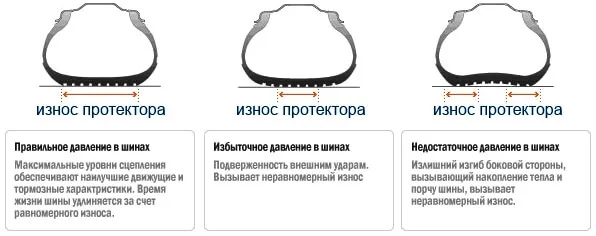
Perform wheel rotation (swapping tyres) every 10–15,000 km, as the driven axle wears faster.
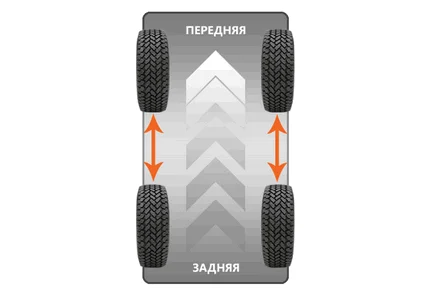
Moving front tyres to the rear
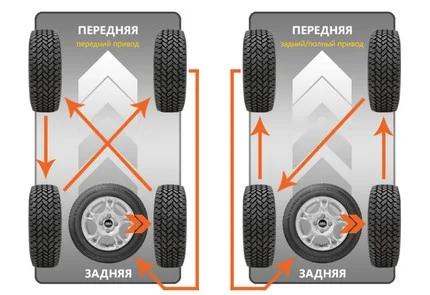
5-wheel rotation diagram
Important: for tyres with a directional tread pattern, the direction of rotation cannot be changed — they are swapped only from front to rear on the same side. Asymmetric non-directional tyres can be swapped diagonally (according to the vehicle manual).Ensure correct installation (Inside/Outside marks and Rotation direction). Installing a tyre "backwards" impairs handling and accelerates wear.
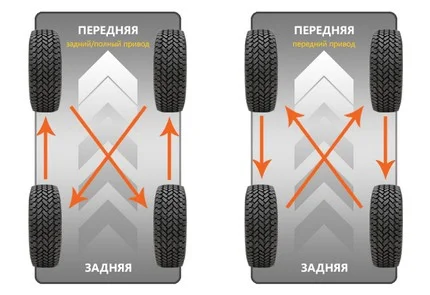
Rotation scheme for non-directional tyres
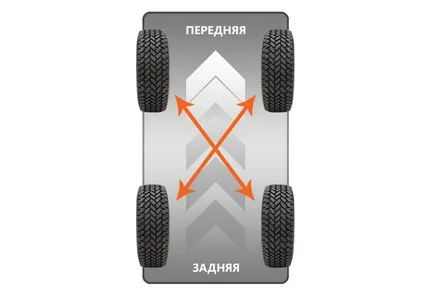
Rotation scheme for AWD vehicles
- New studded tyres require a running-in period for the first 500 km without sharp manoeuvres or braking to ensure the studs seat correctly.
- Install identical tyres on all wheels (model, size, wear level).
- Observe seasonal storage conditions.
- Regularly clean tyres from dirt and road salts; use special rubber conditioners to protect against drying out.
- Avoid rubbing against kerbs when parking — this is the main cause of sidewall damage.
- Once a year, or after hitting large potholes, check the wheel alignment.
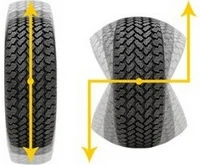
- Monitor wheel balancing. Imbalance causes vibration and uneven patch wear.
Regular diagnosis of tyre condition is not only a saving on buying new rubber but also a guarantee of your safety on the road.
Was this article useful?
Your feedback helps us improve our content.


Discussion (0)
No comments yet!