Knocking noise when pulling away

Certain vehicle faults become most apparent when starting to move, as damaged components are subjected to increased load. A knocking sound when pulling away most often indicates critical wear of suspension or drivetrain elements, or simply loose fasteners.
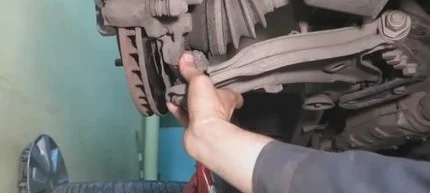
In this article, we will discuss what might be the source of extraneous sounds from the front and rear when moving off, what malfunctions typically occur in specific models, and whether it is safe to drive if a knock appears during a sharp start.
Causes of knocking when the car starts moving
What can knock in a car when moving off: video
At the beginning of movement, the clutch, gearbox, drivetrain shafts, suspension working elements, joints, and mounts are subjected to increased loads. As parts wear, they acquire excessive freedom of movement and make contact with mating surfaces.
Insufficient wear is the main reason why the knock is heard when pulling away, but not constantly. In some cases, the symptom may also appear during sharp braking and stopping, when similar loads occur in the opposite direction.
A cause of knocking when moving off that is not identified in time can develop into more serious problems and even present a danger if operation continues. For instance, failure of steering mechanism elements and the braking system is fraught with sudden loss of control. Below we will examine in detail why knocking occurs when the car starts moving, analyse all the reasons for its appearance, and list options for their diagnosis.
Knocking in the front of the car when starting
Knocking in the front suspension when pulling away most often arises from the wear of rubber-metal bushes (silent blocks and engine or gearbox mounts), steering elements, and suspension strut mounts. Sometimes its cause can be a more exotic fault, such as severe wheel imbalance.
Main causes of knocking in the front of the car when starting:
What knocks in the suspension and how to diagnose it: video
- Track rod ends. If there is a knock in the steering wheel when pulling away, you must first inspect the steering components. Worn ball joints on the rod ends, as well as loose nuts securing them to the steering arms, lead to a shock in the steering mechanism when starting. When driving, the car may wander, and vibration may occur. To detect play, jack up the wheel and rock it in the horizontal plane while observing the rod end joint – it should sit firmly in the steering arm hole and not move relative to the rod.
- Ball joints. The joints that secure the movable part of the suspension at the bottom will emit a knock in the suspension when pulling away if there is play, caused by the ball stud hitting the outer housing. For diagnosis, jack up the wheel and attempt to rock it in the vertical plane. A worn ball joint will reveal itself with knocks, but a worn wheel bearing can also be a source of play. Bearing wear is usually accompanied by a grinding noise when spinning the wheel and a drone when driving.
- Control arm bushes. Rubber-metal joints (silent blocks) acquire excessive freedom of movement in the event of wear or damage. Their inner sleeves may contact the metal of the housing, thereby generating a knock from the front when pulling away. Wear is checked by visual inspection (the rubber should be intact, the sleeve centered in the rubber) and by rocking relative to the mating part using a pry bar.
- Tie bar bushes. The rubber mounts of the tie bars (reaction rods) in MacPherson suspension limit its longitudinal movement. When they are worn or perished, the wheel begins to move forward earlier than the body, and a knock occurs at the moment the rubber compresses. For diagnosis, inspect the rubber elements for damage and check the tightness of their fasteners. Often, overly worn (or loose) tie bar mounts not only emit a single knock when the car starts but are also accompanied by the tyre rubbing against the wheel arch liner when braking.
Finding knocks on Lada family cars: video
- Strut top mounts. The upper mounts holding the spring and shock absorber lose elasticity due to wear. As a result, the bearings strike the outer part of the mount in the turret. You can assess the condition of the mounts by inspecting them visually and checking movement by rocking the front of the car up and down and sideways.
- Engine mounts. Motor mounts with defects in the rubber damping section compress sharply at the moment of starting. Because of this, the shock load is transmitted from the internal combustion engine to the car body. The condition of the mounts can be checked by inspecting their rubber part and applying force to them using a pry bar.
- Sump guard / Undertray. The engine protection plate may touch the motor, gearbox, and other elements, causing knocking sounds. To check, rock the engine by hand, listen for sounds, and see if there is contact with the shield. If the deformations are small and you cannot achieve contact by hand, inspect the shape of the shield and its fasteners, and check the tightness of the bolts. You can remove the guard for inspection: scuff marks will be visible at the points of contact with the motor or gearbox.
Sometimes the source of knocks can be the anti-roll bar, shock absorbers, and springs, but faults in these parts manifest themselves not only through extraneous sounds when starting. An anti-roll bar that has lost its stiffness leads to body roll in corners and swaying, its bushes squeak when moving, and struts knock constantly on rough roads.
Main causes of knocking when pulling away (Front and/or Rear)
When a number of parts fail or fasteners loosen, a knock when pulling away occurs at the front, rear, or on both sides simultaneously, depending on where the faulty unit is located.
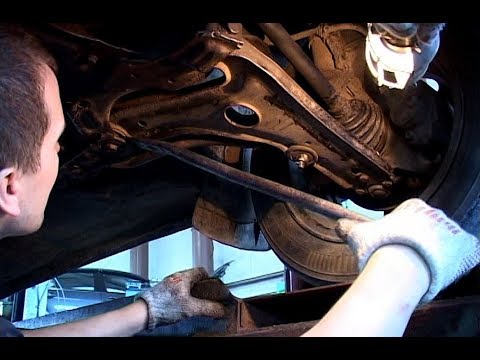
Identifying the source of a knock on a VW Golf 3: video
- Brake pads/shoes. If the friction lining separates from the metal base of the brake pad, a knock may occur in the wheel when pulling away. You can check the brakes for this problem by removing the wheel and brake drum (if applicable) and inspecting the shoes. This problem is most common on drum brake mechanisms, so the knock when pulling away is heard from the rear.
- Wheel bearings. A loose wheel bearing nut often causes a knock at the front of the car during a sharp start. A knock on the rear axle is also possible. A worn bearing sometimes behaves similarly. To check it, rock the jacked-up wheel in the vertical and horizontal planes.
- Exhaust system hangers. When the exhaust pipe mountings loosen, its elements may touch other parts when moving off, generating knocks. To check, drive the car over an inspection pit and inspect its hangers, or lift it and rock the exhaust pipe by hand.
- Loose fasteners. Bolts and nuts on wheels, control arms, struts, tie bars, anti-roll bars, and other suspension elements that have come undone manifest as knocking. For diagnosis, lift the car or place it over a pit and check the tightness of the fasteners.
Among other sources of extraneous sounds in the rear, rubber mounts and spring seats can be mentioned. If they tear or wear through and metal-to-metal contact occurs, a knock or grinding noise is possible.
What can knock in the gearbox or transmission when pulling away
Knocking when pulling away and at the moment of gear changes often appears due to transmission faults. On front-wheel-drive cars, sounds come from the front, whilst on rear-wheel-drive and all-wheel-drive vehicles, knocks from the rear are possible when moving off.

All possible causes of knocking in the gearbox and transmission when moving off: video
- Clutch disc. Clutch knock when pulling away arises due to wear of the damper springs which transfer force from the splined hub to the outer friction part of the disc. Normally, they should compress smoothly, smoothing out shocks, but if the springs are weak or broken, torque is transmitted abruptly, and a dull thud occurs when pulling away and changing gears. Since the disc is hidden by the gearbox bell housing, you will have to remove the gearbox to diagnose it.
- Gearbox mount. At the moment torque is transferred to it from the engine, the gearbox is subjected to increased load, which is also transmitted to the casing. If the rubber part of the mount has sagged or has tears, it does not dampen these shock loads, and the central part contacts the outer part. The shock then travels to the body, which is felt as a knock in the gearbox when pulling away. On cars with rigid gear linkages, the problem is accompanied by jerking of the gear lever.
- Propeller shaft U-joint. Play in the propshaft arises due to wear of its moving parts: yokes, U-joint cups, or their bearings. Because of this, torque is transmitted to the drive axle with a jerk rather than smoothly, which manifests as a ringing knock from the propshaft when pulling away. For diagnosis, whilst over a pit or on a ramp with the transmission in neutral, rotate the shaft by hand, listening to its sounds and checking for play. A completely failed U-joint reveals itself with a drone and vibration of the shaft whilst driving; if symptoms are confirmed, it must be replaced.
- Propshaft flexible coupling (Guibo). The damping coupling, designed to ensure smooth torque transmission and additional flexibility of the drive shaft, does not dampen shock loads if the rubber part is worn or torn. The bolt sleeves may contact each other, generating a knock when starting. To check, inspect the coupling, paying attention to its rubber part: there should be no tears or separation, and the entire part should be straight and retain its factory shape.
- Drive shaft CV joints. Knocking from a CV joint when pulling away on front-wheel-drive cars arises due to wear of the moving parts of the inner joints (located closer to the gearbox), whilst outer joints usually begin to click when turning. Knocks are also possible when changing gears and during engine braking and/or accelerating afterwards. CV joints should be inspected for boot integrity and the presence of grease. Try rotating the drive shafts back and forth by hand with the car over a pit or ramp.
- Differential. Wear on the axis holding the spider gears and/or the gears themselves causes differential play. In this case, a knock appears in the gearbox when starting on front-wheel drive, and a knock in the axle bridge when pulling away on rear-wheel drive. To check the pin and spider gears without disassembly, lift the axle first on one side, then on both. When one wheel is lifted, try to rotate it. Resistance to rotation should be uniform, and no grinding or other extraneous sounds should come from the differential. On a fully lifted axle, the problem is indicated by knocks from the differential when spinning the wheels in both directions. When rotating one wheel by hand, the other should normally rotate freely in the opposite direction.
- CVT. Knocking in a CVT when pulling away may occur due to wear of the pulleys, belt, or chain. The problem can only be reliably identified by disassembling and inspecting the gearbox.
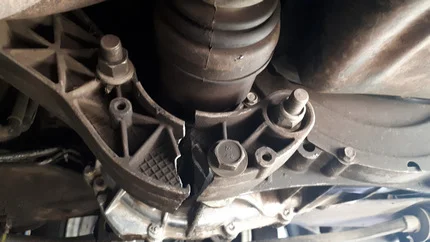
Cracked gearbox mount
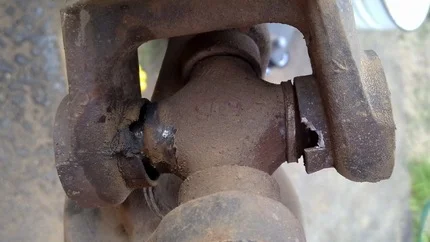
Severe wear of the propeller shaft transmission
Knocking when pulling away on an automatic transmission may be a consequence of overheating, low oil level, or the use of incorrect fluid. This disrupts the operation of the friction clutches, and gears engage too harshly. If the problem does not go away after changing the oil, and the automatic gearbox knocks, a thorough inspection is required.
Sometimes similar symptoms are observed with different faults. For example, a knock when reversing can be a consequence of worn drive shafts, the rear engine mount, or the gearbox. If the location of the extraneous sound cannot be clearly traced, the entire chassis and transmission must be inspected carefully.
Is it safe to drive a car that knocks when pulling away?
Since a single knock when pulling away from a standstill can be the result of various causes, the possible consequences of ignoring the problem also differ. The nature of the sound is also important. If a knock is heard during a sharp start, but not during a smooth one, the component wear is likely minimal, and urgent repair is not required. When the sound is distinct and constant, you must find and eliminate the cause promptly.
In the table below, the causes of a single knock when pulling away are sorted into groups depending on the danger of the consequences of operating the car with faults in the corresponding units.
| Vehicle must not be driven until the problem is fixed | Urgent repair or unit replacement needed | Advisable to fix in the near future |
|---|---|---|
| Broken engine mount (bush torn off, bracket broken) | Worn gearbox or engine mount (without fracture of bracket or rubber bush) | Sump guard knocking |
| Play in steering track rod joints | Wear of the propshaft coupling or U-joint (without tears or metal destruction) | Drive shaft knocking |
| Worn ball joints | Differential or reduction gear knocking | Exhaust knocking |
| Brake pad lining separation | Clicking or knocking in CV joints | Worn clutch disc springs |
| Torn propshaft coupling, destroyed U-joint bearings | Worn control arm bushes | |
| Loose wheel fasteners | Worn strut top mount | |
| Loose hub nut |
Weak points that often knock when starting on popular cars
Some car models have design features and flaws that often become the cause of knocking when starting. The most probable causes of knocks when pulling away on popular cars are collected in the table.
| Car | Probable cause of knocking when starting | How to diagnose |
|---|---|---|
| Lada Niva, Chevrolet Niva | Worn propshaft or axle components. Wear on differential spider gear pins is also possible. Another reason is torn rubber exhaust mounts. | Check for play by rotating. |
| Dacia / Renault Duster | On cars with ABS and ESP, a few light knocks when pulling away are a consequence of the system self-test and are normal. Knocks also often occur due to a loose or deformed sump guard. | Inspect the engine sump guard and check the tightness of its fasteners. |
| Dacia / Renault Logan | On the Logan, knocking when starting often manifests due to worn CV joints. Wear on control arm bushes and engine mounts is also possible. | Inspect control arm bushes and CV joints. Check drive shafts for play by rocking and rotating in different directions. Check bushes by rocking the suspension or prying them with a pry bar. The condition of engine mounts is checked by levering with a pry bar. |
| Ford Focus | A vulnerable spot on the Ford Focus is the drive shaft attachment to the hub. | Check the tightening of the bolt holding the drive shaft in the hub. To solve the problem, you can secure the splines of the half-shaft in the hub with thread locker, then tighten the bolt to the specified torque (e.g., 35 Nm for FF2) and tighten a further 90 degrees. |
| Nissan Almera | A knock caused by the ABS and ESP self-test, appearing after parking, is normal. Wear on CV joints is also possible. | Inspect CV joints, check them for play by trying to rotate and rock them. |
| Audi A6 (C6) / A5 | The main culprit for knocking when starting is worn engine and gearbox mounts. | Inspect the mounts, check the extent of their sagging. |
| Mitsubishi Outlander | Knocking when starting on the Outlander may be the sound of the all-wheel-drive coupling engaging; in this case, it is normal. Self-diagnosis of ABS and ESP is also possible (occurs once after parking), which is not a malfunction. Of the knocks caused by breakdowns, worn engine and gearbox mounts are encountered. | Inspect the power unit mounts, check their movement by applying force with a tool. |
| Lada Largus (Dacia Logan MCV) | Vulnerable spots of the Largus are ball joints, CV joints, and the lower engine mount (dog bone). | Ball joints are checked by rocking the wheels in the vertical plane (normally there is no play), CV joints by rotating. Engine mounts need to be inspected and checked for play using a pry bar. |
| Daewoo / Chevrolet Lanos | On the Lanos and its variants, a frequent problem is the loosening of the hub nut. | Rock the jacked-up wheel in the vertical and horizontal planes, wiggle the half-shaft by the CV joint. Check the hub nut tightness. |
| Front-wheel drive Lada (Samara, Priora, Kalina, Granta) | The main sources of knocks at the start are internal CV joints, and with high mileage, the differential spider gear pin. | Check CV joints by rotating and rocking on a jacked-up axle. To diagnose the differential, rotate the wheels on the jacked-up front axle in the same and different directions, listening to gearbox sounds. |
Frequently Asked Questions
-
Why does the knock in the car occur only when pulling away?
Knocks occur when starting the car because at the moment rotation is transferred from the engine to the wheels, many units are subjected to increased loads.
-
Why might new suspension knock when starting the car?
New car suspension can emit knocks when pulling away due to violation of assembly rules. Often sounds are generated by under-tightened fasteners and tightening silent blocks (bushes) in the wrong position, on relaxed suspension (with wheels hanging freely).
-
Why do transmission knocks appear after an oil change?
If knocks and transmission noises occur after changing the oil in the gearbox, the cause is usually underfilling of lubricant, or the use of low-quality oil or oil that does not meet the manufacturer's specifications.
-
Where do knocks come from when starting after visiting a tyre shop, when alignment and balancing are normal?
If knocks appear when pulling away after tyre fitting, stop and check the tightness of the wheel bolts or nuts immediately.
Was this article useful?
Your feedback helps us improve our content.
Discussion (0)
No comments yet!