Blue Smoke from the Exhaust Pipe
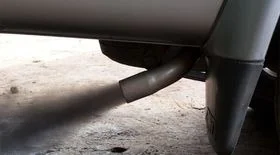
Seeing blue smoke coming from the exhaust pipe comes as a complete surprise to many drivers. This is a direct consequence of engine oil entering the engine cylinders. What are the causes and what steps should be taken to eliminate the problem?
Why does the exhaust smoke blue?
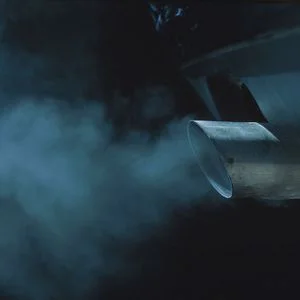
Before diagnosing a fault, it is important to remember that the visibility of the smoke depends on:
- engine temperature;
- quality of the engine oil;
- engine RPM;
- air temperature and humidity.
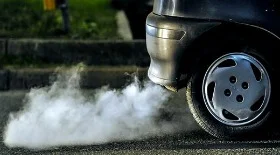
The colour of 'oil' smoke can vary from bluish to thick blue. A characteristic feature is its oily nature. Such smoke does not dissipate easily in the air, and it contains greasy droplets. Unlike white vapour (condensation or antifreeze), blue smoke clearly indicates oil combustion.
Indirect signs indicating oil entering the cylinders:
- the engine misfires (runs unstably);
- oil consumption increases significantly (can reach 1 litre per 1000 km or more);
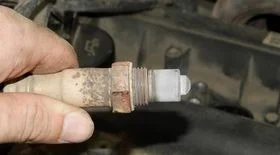
- spark plugs fail quickly (oiling up);
- changes in compression;
- difficulty starting the car in cold weather;
- a smell of burning.
How oil gets into the cylinders
Oil enters the combustion chamber via the following paths:
- through worn piston rings;
- through the gap between valve stems and guide bushes (worn valve stem seals);
- due to a turbocharger fault (on turbocharged engines);
- through the crankcase ventilation system.
Main faults
Blue smoke is most often caused by:
- wear or hardening of valve stem seals;
- scoring on the cylinder surface;
- stuck or worn piston rings;
- wear of valve guide bushes.
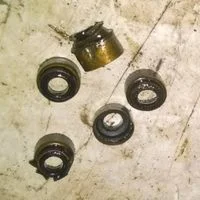
Valve stem seals
To distinguish between problems with the valves and the piston group, compression must be measured. If it is low, a simple test is performed: add a small amount of oil to the cylinder and measure again. A sharp increase in compression indicates a problem with the rings. If there is no change, the problem lies in the cylinder head (valves, seals).
Wear of valve stem seals
When the seals lose their elasticity, the amount of oil entering the cylinders increases at idle and during engine braking (high vacuum in the intake manifold). A characteristic sign: a puff of blue smoke when revving after prolonged idling or when starting the engine.
Defects in cylinder condition
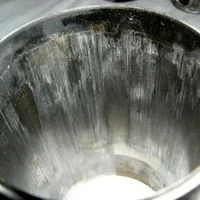
Surface of a worn cylinder
Scoring and scratches on the cylinder wall (mirror) cause oil to be retained in the depressions and burn. Causes of defects:
- Presence of abrasive particles in the oil (dirty oil, poor quality filter).
- Corrosion (during long storage without preservation).
- Engine overheating or poor quality repairs.
Change in cylinder geometry
Natural wear, where the cylinder acquires an elliptical shape. Diagnosis is carried out with a bore gauge. If the deviations exceed tolerances, the block requires reboring to a repair size.
Stuck rings
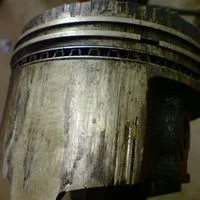
Coked piston
Oil control rings can become 'stuck' (coked) due to carbon deposits, losing mobility. The cause is poor quality oil, overheating, or infrequent oil changes. The rings stop scraping oil from the walls, and it burns. A decarbonising procedure often helps if component wear is not yet critical.
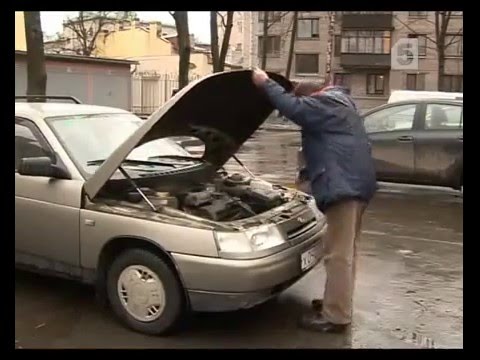
Causes of blue smoke
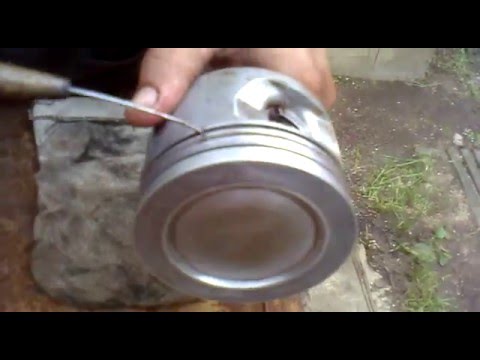
Possible causes of blue smoke
Non-standard causes and diagnostics
Sometimes owners notice blue smoke on new cars. Contrary to popular belief, this is not normal for a modern engine in good working order. If a new car emits blue smoke, it is grounds for a warranty claim (possible factory assembly defect or cylinder head defect).
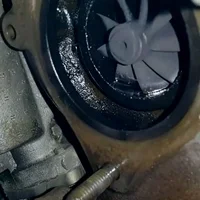
Cause of smoke in diesel and turbo engines
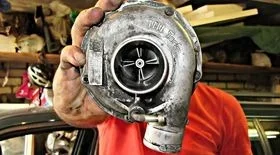
If the engine is equipped with a turbocharger, the cause often lies in worn rotor seals within the turbo. Oil enters the intake tract and then the cylinders. To diagnose, remove the intercooler or intake pipe: a pool of oil inside indicates a turbo fault.
If the car is an older model with an automatic gearbox and vacuum modulator, smoke may arise due to a damaged modulator membrane. In this case, transmission fluid is sucked into the intake manifold. This is diagnosed by a drop in the gearbox oil level and a specific smell from the exhaust.
Serious mechanical failures:
- Broken piston ring lands (often due to detonation).
- Deformation of piston skirts or connecting rods (after hydrolock).
Conclusions
Driving with blue smoke is not recommended. It leads to increased carbon build-up on valves, failure of the catalytic converter and lambda sensors, as well as the risk of missing a drop in oil level below the minimum. Timely replacement of valve stem seals is much cheaper than a complete engine rebuild, which will be required if the problem is ignored.
Was this article useful?
Your feedback helps us improve our content.
Related Materials

Discussion (0)
No comments yet!