White Smoke from the Exhaust Pipe
White smoke from the exhaust pipe is a common occurrence in winter, so few people pay attention to it. However, in summer, thick white exhaust fumes are alarming for owners of both diesel and petrol cars. Let's figure out why white smoke appears, whether the causes are dangerous, and how to identify its origin.
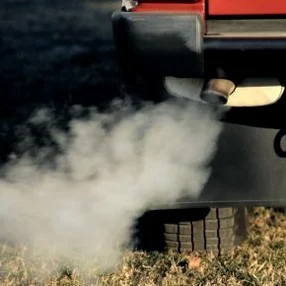
Harmless smoke, or rather steam, which is white, should not have a distinct smell, as it forms due to the evaporation of accumulated condensation in the exhaust system pipes and the engine itself at air temperatures below +10°C. Therefore, do not confuse it with smoke that indicates problems within the cooling system or the engine itself.
White smoke is a sign of high humidity in the exhaust system. After the engine warms up, the steam and condensation disappear, but if smoke continues to billow from the exhaust, it is a sign of an engine fault.
Causes of White Smoke from the Exhaust
Most faults that cause white smoke from the tailpipe arise from engine overheating or fuel supply issues. By paying attention to the shade of the smoke, its smell, and the general behaviour of the car, you can accurately determine the origin of the fumes. The most common causes are:
- Presence of moisture.
- Presence of water in the fuel.
- Incorrect operation of the injection system.
- Incomplete fuel combustion.
- Coolant leaking into the cylinders.
It is worth noting that some reasons why dangerous white smoke appears in diesel engines versus petrol engines may have different origins, so let's deal with everything in order and separately.
White Smoke from a Diesel Engine Exhaust
White exhaust during the warm-up mode of a healthy diesel engine is a completely normal phenomenon. However, if the engine has reached operating temperature and the smoking continues, it may indicate:
- Condensation in the diesel fuel.
- Incomplete combustion of diesel fuel.
- Over-fuelling due to faulty injectors.
- Coolant leaking into the manifold.
- Low compression.
To diagnose the specific cause, you need to perform a few simple checks:
- Firstly, clarify the smoke colour; is it pure white or does it have a tint (a bluish tint indicates burning oil).
- Secondly, check the coolant level for the presence of exhaust gases and the presence of oil in the cooling system.
Whitish-grey exhaust during warm-up may indicate incorrect ignition timing. This smoke colour suggests that gases which should have pushed the piston in the cylinder ended up in the exhaust pipe. Like moisture evaporation, this smoke clears up after warming up if the car's ignition timing is correct.
Symptoms of a blown head gasket
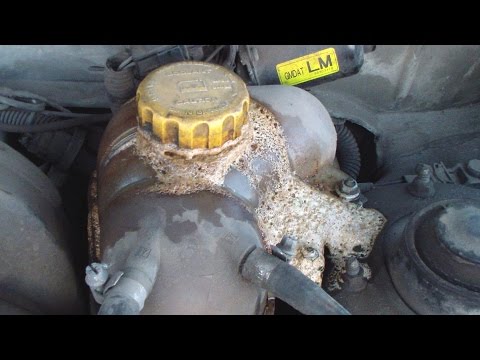
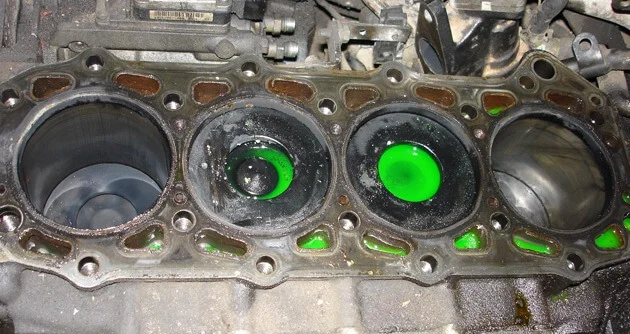
The presence of thick white smoke even after warming up indicates coolant entering the engine cylinder. The entry point for the liquid can be either a blown head gasket or a crack. You can verify the theory of coolant entering from the cooling system as follows:
- by opening the expansion tank or radiator cap, you may see an oily film;
- there may be a smell of exhaust gases coming from the tank;
- bubbles appearing in the expansion tank;
- the fluid level rises after starting the engine and drops after stopping it;
- pressure increases in the cooling system (check by trying to squeeze the upper radiator hose when the engine is running).
If you notice signs of coolant entering the cylinders, further operation of the faulty engine is not recommended, as the situation can deteriorate quickly due to the reduced lubricating properties of the oil, which gradually mixes with the coolant.
Coolant in engine cylinders
White Smoke from a Petrol Engine Exhaust
As mentioned earlier, white steam coming from the exhaust in cold and damp weather is a perfectly natural phenomenon; before the engine warms up, you might even see water dripping from the silencer. However, if the engine is at optimal temperature and steam continues to escape, you can be sure there are faults in the engine.
The main reasons why white smoke comes from the exhaust of a petrol engine are:
- Coolant leaking into a cylinder.
- Injector malfunction.
- Low-quality petrol with impurities.
- Burning oil due to stuck piston rings (smoke with a tint).
The reasons why white smoke may appear in a petrol car differ only partially from those concerning a diesel one, so let's focus more on how to check exactly why the smoke started billowing.
How to diagnose the cause of white smoke?
Checking why white smoke is coming from the exhaust
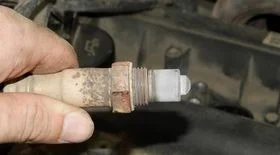
The first thing to check when white smoke is constant is to pull out the oil dipstick and ensure that neither the oil level nor its condition has changed (look for a milky colour or emulsion), as the consequences of water in the oil are the worst for the engine. Also, the exhaust will not be pure white, but will have a bluish-grey tint. Such characteristic oily smoke from the exhaust pipe hangs behind the car like a fog for a long time. Opening the expansion tank cap, you may notice an oil film on the surface of the coolant and smell exhaust gases. The colour of the deposit on the spark plug (or lack thereof) can also reveal problems. If a plug looks brand new or is completely wet, this indicates water entering the cylinder (steam cleaning).

Principle of checking exhaust gases with a white sheet of paper
A white paper napkin or tissue will help verify the smoke's origin. Hold it against the exhaust for a couple of minutes while the engine is running. If the smoke is due to ordinary moisture, the paper will remain clean. If oil is entering the cylinders, characteristic greasy spots will remain. If antifreeze is leaking through, the spots will be bluish or yellow with a sour smell. When indirect signs point to the cause of the white smoke, you will need to open up the engine to find the obvious defect.
Fluid can enter the cylinders either through a damaged gasket or a crack in the block or cylinder head. It is worth noting that with a blown gasket, engine misfiring will also occur.
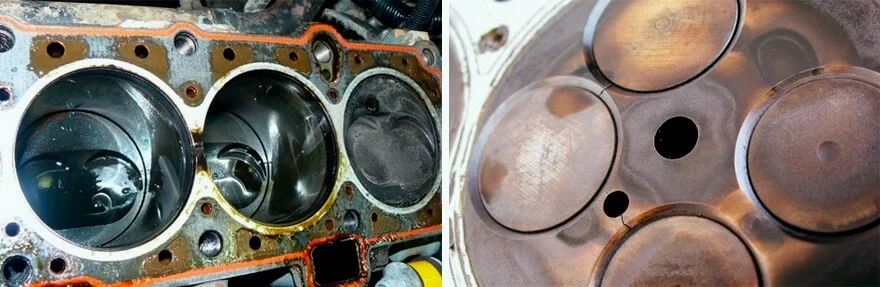
When searching for cracks, pay special attention to the entire surface of the cylinder head and the block itself, as well as the inside of the cylinder and the area of the intake and exhaust valves. It will be difficult to find a leak with a microcrack; a special pressure test will be needed. However, if the crack is significant, continuing to drive such a car can lead to a hydrolock, as liquid can accumulate in the space above the piston.
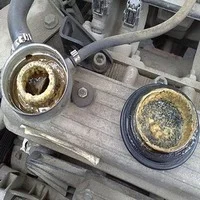
Emulsion on the filler cap
It may happen that you do not smell exhaust fumes in the radiator, pressure does not rise sharply, but there is clear evidence of white smoke and emulsion instead of oil, and the fluid level drops rapidly. This indicates fluid entering the cylinders via the intake system. To determine the causes of water entering the cylinders, it is sufficient to inspect the intake manifold without removing the cylinder head.
Note that all defects leading to the formation of white smoke require more than just eliminating the direct causes. These faults are caused by engine overheating, so it is essential to check and repair any breakdowns in the cooling system.
Was this article useful?
Your feedback helps us improve our content.
Related Materials

Discussion (0)
No comments yet!