Treadwear Tyre Mileage Calculator

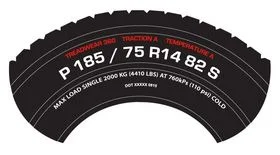
When choosing tyres, almost every car owner asks the same question: "How long will they last?" The ability to determine the service life of a tyre before it reaches its wear limit is defined by the certification standards for tyres sold in the USA. The Uniform Tire Quality Grading (UTQG) performance data is indicated on the sidewall, with the wear resistance rating encrypted in the Treadwear index.
The three-digit Treadwear number characterises the wear resistance of a specific tyre. It is this index that allows the driver to calculate the mileage the tyres are designed for, taking into account individual vehicle usage. You can calculate this tyre wear manually using a formula or use our calculator, which can estimate the approximate service mileage.
How to Determine Service Life
To calculate tyre durability and wear resistance, it is necessary to convert the indicated Treadwear index into reference mileage data. For instance, a figure of 200 corresponds to 96,600 km of mileage compared to a reference tyre when tested on a track under ideal conditions of humidity, temperature, road surface, and speed. Consequently, this figure differs significantly from real-world performance.
To determine how many kilometres tyres are designed to last before critical wear, a correction factor is needed to account for driving style and road conditions.
Tyre Wear Conversion Formula
The formula for tyre wear resistance in ideal conditions is as follows:
Mileage = Treadwear * 483,
where 1 unit = 483 km (reference mileage).
Taking into account the correction for real-world driving conditions, the tyre service life is calculated as:
Real Mileage = (Treadwear * 483)/k,
where k = the operational wear coefficient.
What should the coefficient be?
It is generally accepted that for good driving conditions with careful handling, the actual mileage will be at least half the reference value. However, when there are flaws in the road surface and speed varies frequently (dynamic city driving), the correction coefficient can rise to 5. Each driver selects the appropriate value depending on their driving style, travel conditions, etc. Terrible road surfaces with numerous potholes and abrasive materials, combined with heavy city traffic, will reduce tyre life by approximately 5 times!
Treadwear Tyre Durability Table
| Tyre Wear Index (Treadwear) | Average Tyre Life (thousands of km) |
|---|---|
| Sports Tyres | |
| 150 | 18 |
| 200 | 24 |
| Standard Tyres (Comfort) | |
| 240 | 38 |
| 300 | 48 |
| 320 | 51 |
| 380 | 61 |
| Eco Tyres | |
| 400 | 64 |
| 420 | 67 |
| 500 | 80 |
| 570 | 91 |
However, it is worth noting that a higher index does not necessarily mean a better or more durable tyre. You should not consider the index as a standalone indicator, but also look at parameters such as:

- Traction (A, B, C, D) – the tyre's grip on wet roads;
- TEMPERATURE (A, B, C) – heat resistance at high speeds.
In both cases, "A" is the best rating. All three indicators are linked; if the Treadwear is high, such a tyre may have poorer grip and wear out faster when heated.
The "sweet spot" is a rating of 240-280, as these tyres will perform much more effectively at high speeds (acceleration, road holding, braking). This is the figure premium brands aim for. Such tyres have an average mileage of 40,000–45,000 km, which is sufficient for the entire service life of the tyre.
How to use the online mileage calculator
Calculating how long tyres with a specific treadwear index will last is quite simple. You just need to define the specifics of your vehicle usage to select the wear correction coefficient. The greater the load on the tyres (overloaded vehicle, speed, road quality, ambient temperature), the higher the coefficient. Typically, this is 3, 4, or 5. Then enter the Treadwear number indicated on the tyre sidewall. Specifically:
- Select the percentage of vehicle usage in city conditions (the higher the percentage, the greater the wear);
- Enter the number found on the tyre into the "Wear Index" field;
- The approximate mileage resource will be displayed in the "Tyres calculated for mileage" field.
Was this tool useful?
Your feedback helps us improve our content.




Discussion (0)
No comments yet!