Car Battery Leakage Current Calculator
Exceeding the normal leakage current in a car will contribute to battery discharge during parking. The causes and verification of leakage should be dealt with separately. Initially, it is essential to understand what constitutes permissible leakage and how many milliamperes are normal for a specific car, as losses will depend on the number and type of energy consumers. The online calculator, using the formula 'Battery Capacity (Ah) * k factor', will help you quickly calculate the permissible leakage current.
Current leakage should be checked as often as possible, especially in damp weather!
What is Normal Leakage Current
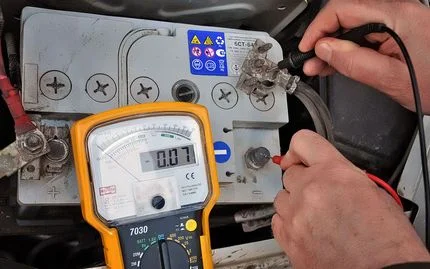
Permissible car battery current leakage
A car has a minimum leakage current of about 30–50 mA (for modern cars with electronics). This figure depends on many factors: the condition of the wiring, the age of the battery and the cleanliness of its terminals, as well as air temperature. Battery self-discharge in an open circuit is allowed at no more than 1% per day, but considering it is constantly connected to the onboard network, this figure may be higher. Permissible leakage is calculated based on capacity multiplied by a coefficient of 0.4 (for example, for 60 Ah, the norm would be about 24 mA plus alarm consumption).
Even at rest, devices such as the alarm and immobiliser (20–25 mA), audio system (3 mA), central locking unit and ECU controller (5 mA each) consume current. In total, a normal leakage current is considered to be in the 40–70 mA range, with a maximum permissible value of 80 mA.
High current can arise due to: old wiring, short circuits caused by oxidation, damaged wire insulation, and incorrectly connected alarms or stereos. Although small current consumption by the alarm is permissible, as it is an active device requiring power for the radio module, volume/shock sensors, and LED.
Our online calculator for normal (natural) car battery quiescent current leakage will help you calculate leakage current depending on battery self-discharge (0.5–1.0% loss for new, 1–1.7% for used) and the number of consumers using energy even in standby mode.
How to Use the Leakage Current Calculator
To calculate what the permissible leakage should be, you must:
- Tick the boxes for the standard consumers you have. Note that tuning of multimedia and audio systems, as well as autonomous engine management systems, is not taken into account, as there is no single current consumption value for non-standard equipment.
- Specify the capacity of the installed battery.
- Select the relative age of the battery (self-discharge will depend on this, since besides provoked and operational discharge, there is also electrolyte and natural discharge).
- By pressing the 'Calculate' button, you will receive the result for permissible quiescent current in the 'Permissible leakage current' field.
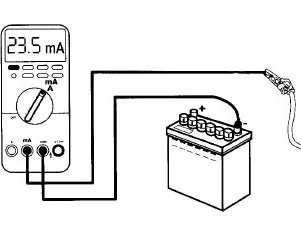
After switching off the ignition, current consumption should either stop completely or be minimal. Serviceable cars can stand parked for 2–3 weeks and start without problems. If the car does not start after 3–5 days of downtime, it suffers from excessive quiescent current.
Permissible Leakage Current
After you have calculated the consumption at rest, you can determine from the table whether the value is normal. It notes at what level of loss you will be able to start the car.
| Leakage current to consumers (mA) | Time until car won't start |
|---|---|
| ≤ 30–40 | Normal. The car can stand parked for several weeks without moving and start without problems afterwards. |
| 50–80 | Acceptable. Tolerable if there is an advanced aftermarket audio system or satellite alarm. However, a car with an old battery might not start after a week. |
| ≥ 100 | Critical. A sign of electrical equipment malfunction or installation of low-quality gadgets. In winter, leaving the car for 1–2 days will be enough to require jump-starting. |
Knowing the leakage current in the car, you can calculate how long the battery will last (discharge time) assuming long-term parking in a resting state.
Frequently Asked Questions
-
What is normal leakage current in a car?
Current leakage exists in almost every car, and the norm will depend on the amount of additionally installed electronics that may consume energy even in standby mode, as well as the features of the onboard network power supply. Therefore, 0.03–0.05 Amps (30–50 mA) is normal for a modern car. In some cases (lots of electronics), up to 70–80 mA is also acceptable.
-
What is the leakage current through the alarm?
In operating mode, the security device consumes energy depending on its complexity, number of sensors, and connection method. A leakage current through the alarm of 20–30 mA is normal. The main thing is that consumption drops to this figure 5–10 minutes after arming. Problem areas include door, bonnet, and boot switches, as well as the communication module (oxidation appears on the board).
-
What is the leakage current through the stereo?
On a car with a correctly connected 1 DIN stereo, leakage does not exceed 0.01 A (or 0.02 A if 2 DIN is installed). The main problem lies in connecting the power wire (red) and the wire responsible for saving settings (yellow) into one bundle directly to the battery. Only the yellow 'memory' wire should receive constant power. The red one should be de-energised when the ignition is switched off.
-
How to measure leakage current?
Leakage current can be measured with a multimeter or current clamp (allows non-contact measurement), after arming the car alarm and waiting 10–15 minutes, as some ECUs do not go into sleep mode immediately.
To measure leakage current with a multimeter, you must connect in series to the onboard power circuit, in the break of the negative terminal on the battery. First, set the tester to the 10A DC measurement mode. Then, removing the 'minus' terminal from the battery, connect one multimeter probe to the car terminal and the second to the negative post of the battery itself. The display will show the current leakage.
When measuring leakage current with a clamp, set the device to measure direct current (DC) amperage. The conductor being measured (common ground wire or from individual consumers) is placed inside the clamp ring with the ignition off. The current consumption will be immediately visible on the display.
Was this tool useful?
Your feedback helps us improve our content.
Related Materials




Discussion (0)
No comments yet!