Engine Oil Consumption Calculator
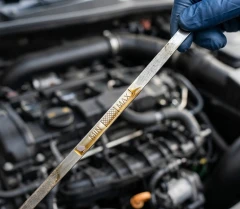
Engine oil consumption is defined by the amount of lubricant burnt in the engine during operation. Excessive consumption may indicate poor quality lubricants (excessive burn-off) or engine faults (leaking seals, worn rings). Assessing engine health depends on comparing actual consumption against permissible limits.
How Engine Oil Consumption is Calculated
For commercial vehicles and heavy machinery, norms are often linked to fuel consumption rather than mileage. This method is considered more accurate for equipment that operates extensively at idle or under load.
The generally accepted oil consumption standard for heavy machinery is often calculated as a percentage of fuel consumed.
For passenger cars, it is more common to measure consumption in litres (or grams) per 1000 km of mileage.
Calculation Formulas
The simplest way to determine actual oil burn-off is the top-up method:
Q = V / (S / 1000),
Where Q is consumption per 1000 km; V is the volume of topped-up oil (l); S is the distance covered (km) between measurements.
Engine Oil Burn-off Standards
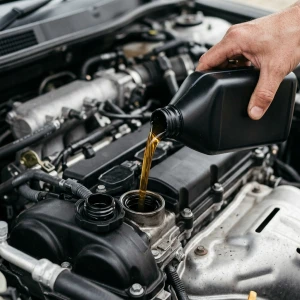
For passenger vehicles, an ideal figure is considered to be consumption up to 0.025% of the volume of burnt fuel (about 25 g of oil per 100 litres of petrol). However, modern realities differ from theoretical calculations.
Many manufacturers (BMW, VAG and others) state in their owner's manuals a permissible consumption of up to 0.5 – 1 litre per 1000 km (especially for turbocharged engines and during the running-in period). Although in practice, a sound naturally aspirated engine consumes significantly less — from 100 to 300 g per 1000 km.
For goods vehicles, standards are usually higher, amounting to 0.3 — 0.4% of fuel consumption.
Guideline consumption table (theoretical values):
| Engine Type | Permissible Burn-off | |||
|---|---|---|---|---|
| As % of Fuel Consumption | In Grams per 1000 km | |||
| New | Worn | New | Worn | |
| Petrol | 0.005 – 0.025 | up to 0.1 | 5 to 25 | up to 100 |
| Turbocharged | 0.05 – 0.08 | up to 1 | up to 100 | 100 – 1000* |
| Diesel | 0.035 – 0.25 | up to 0.8 | 30 – 55 | up to 200 |
*For many modern turbo engines, consumption up to 1000 g is not considered a failure according to the manual, although it is a reason for diagnostics.
Bear in mind that oil consumption standards increase for vehicles following an engine rebuild and those in service for more than five years.
Methodology for Determining Oil Consumption
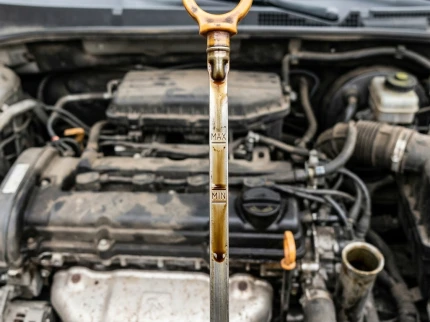
Oil level by dipstick
To obtain reliable data, it is not recommended to use methods involving fully draining and weighing the oil in a garage environment — this is labour-intensive and unsafe (handling hot oil). Use the control top-up method:
- Park the vehicle on a flat, horizontal surface.
- Warm up the engine to operating temperature, switch off and wait 10–15 minutes for the oil to drain into the sump.
- Check the level with the dipstick. If it is below maximum, top up the oil exactly to the MAX mark.
- Reset the trip meter (odometer).
- Use the vehicle in your normal driving mode. Recommended distance for measurement is 1000 km (or less if consumption is high).
- Park the car on a flat surface again and wait 15 minutes after stopping.
- Using a measuring container, top up the oil exactly to the MAX mark.
The volume of topped-up oil is your actual consumption for the distance covered.
How to Use the Calculator
The online calculator helps compare your figures with calculated norms (close to standard industry practices).
The following data is required for calculation:
- In the 'Fuel' field — enter your car's average fuel consumption per 100 km.
- In the 'Oil' field — the lubrication system capacity (how many litres you pour in during a change).
- Select the engine type and tick the box if the car is older than 5 years (this increases the permissible norm).
- Click 'Calculate'.
This service is useful for understanding whether your engine's appetite is within reasonable technical tolerances or if the problem requires immediate intervention by an engine specialist.
The Conclusion
If the engine is fully serviceable, the oil level drops from the MAX mark towards MIN between changes (7,000–10,000 km) but does not require emergency topping up. The exception is the design features of certain engines prone to oil consumption.
It is important to understand: the higher the RPM and the more aggressive the driving style, the more oil is burnt. Do not neglect engine oil specifications and avoid using poor-quality materials.
Frequently Asked Questions
-
How do I calculate oil consumption?
The simplest formula for a driver: top up the oil to the maximum, drive 1000 km and measure with a graduated cylinder how much you need to add to return the level to maximum. This is your consumption (L/1000 km). Fleet management uses formulas linked to fuel consumption (Q = fuel consumption * coefficient).
-
What oil consumption is considered normal?
For modern naturally aspirated engines, consumption of 0.1–0.3 L per 1000 km is considered normal. For turbocharged and high-revving engines, manufacturers often permit up to 0.8–1.0 L per 1000 km. If you are topping up more than a litre per thousand, the engine requires diagnostics.
-
Calculating oil consumption per 100 L of fuel
For passenger cars, the average burn-off norm is 0.005–0.025% of the volume of burnt fuel. For trucks, it is up to 0.4%. To calculate this for your car, divide the volume of topped-up oil by the volume of fuel used and multiply by 100.
Was this tool useful?
Your feedback helps us improve our content.


Discussion (0)
No comments yet!