High Oil Consumption: Causes and Acceptable Limits
Excessive oil consumption can stem from both serious and minor issues. The first category includes faults such as worn piston oil control rings, a blocked crankcase ventilation system (breather), worn valve stem seals, or leaks through gaskets and oil seals. Simpler causes include using the wrong oil, a leaking oil filter, or a leak from the rocker cover gasket.
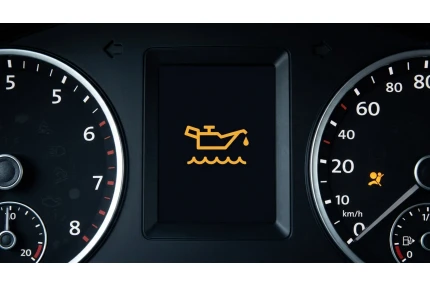
Do not forget that every internal combustion engine has a concept known as 'natural burn-off'. During operation, oil evaporates and burns (this is especially true for mineral oils). Therefore, monitoring the oil level and topping it up periodically is normal practice, provided the consumption does not exceed the manufacturer's tolerances.
What is normal oil consumption?
Before searching for a fault, it is worth understanding what level of burn-off is considered normal and when the engine has truly started 'drinking' oil.
The standard for burn-off depends on the engine type and condition. For naturally aspirated petrol engines, the situation is as follows. For new engines, the norm is about 25…100 ml per 1000 km (or roughly 0.005%...0.025% of fuel consumption). For some high-performance engines (e.g., V6 or V8), the factory standard can reach up to 300-500 ml per 1000 km.
For engines with mileage, natural consumption is considered to be up to 0.1% of fuel consumption (approximately up to 100-200 ml per 1000 km). If the engine is heavily worn, consumption rises to 400...600 ml per 1000 km. A critical point is often considered to be around 800 ml — 1 litre per 1000 km. In this case, the engine likely requires a major overhaul.
Now regarding turbocharged petrol engines. A new motor might consume about 80 ml per 100 litres of fuel (roughly per 1000 km). For worn units, a consumption of more than 1-1.5 litres of oil per 1000 km is considered critical.
For diesel engines, burn-off is often higher than in atmospheric petrol ones. A value of around 300...500 ml of oil per 1000 km (or 0.05-0.5% of fuel consumption) can be normal. The critical value is more than 2 litres per 100 litres of diesel burned. In such a case, urgent repair is necessary.
Reasons for increased lubricant burn-off
There are two operational reasons why burn-off increases:
- Incorrectly selected or poor quality (counterfeit) oil. You must fill the engine with oil possessing the viscosity and approvals recommended by the vehicle manufacturer.
- Harsh driving conditions. Operating at high RPM significantly raises the temperature, causing the oil to thin out and burn off faster. Also, more oil may be consumed in winter due to frequent warm-ups and idling.
Some engines consume oil by design. This includes, for example, certain BMW engine series, where consumption of up to 700 ml per 1000 km may be stated in the manual as permissible.
A decrease in oil level occurs in two ways — burn-off (combustion in the cylinders) and leakage. If the correct oil is used and there are no external leaks, you need to look for internal faults.
Causes of high oil consumption and how to fix them
We can broadly divide the causes into simple (solved by replacing consumables or gaskets) and complex (requiring engine repair). Diagnostics should always start with the simple things.
Simple faults
Oil filter issues. A common cause. Diagnosed by an oil patch under the car after parking. Reasons:
- the filter is not tightened properly;
- defect in the filter housing or rubber seal;
- the rubber seal has hardened in the cold.
The solution is to replace the filter and top up the oil.
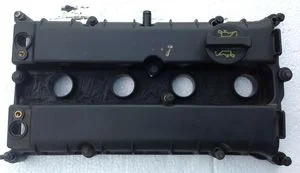
Rocker cover
Rocker cover gasket leak. The gasket ages due to time and temperature fluctuations. Leaks are usually visible to the naked eye on the top part of the engine. You can try carefully tightening the bolts with a torque wrench, but it is better to replace the gasket.
Sump gasket leak. A similar situation: the gasket material loses elasticity. The sump becomes wet, and oil drops appear. Solution — tightening the bolts or replacing the gasket (sometimes sealant is used).
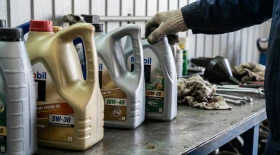
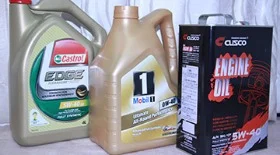
Incorrect oil viscosity. If you put oil that is too thick into a modern engine designed for low-viscosity oils, the piston rings may not be able to scrape the film off the cylinder walls in time. Conversely, if you put oil that is too thin into an old, worn engine, it will seep through the increased clearances. In any case, adhere to the manufacturer's recommendations!
For engines with over 150,000 km (approx. 90-100k miles), some oil manufacturers (e.g., Mobil, Valvoline) offer special 'High Mileage' ranges with additives to restore seal elasticity and adjusted viscosity.
Faulty Crankcase Ventilation System (PCV). If the PCV valve (breather) is blocked or faulty, pressure builds up in the crankcase. This forces oil out through oil seals and gaskets, and also promotes the ejection of oil mist into the intake manifold, where it burns. You need to check the valve and hoses, and clean or replace them if necessary.
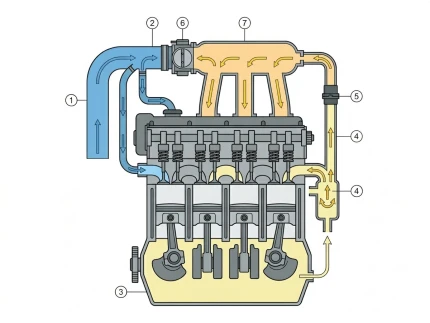
1 — Air inlet, 2 — Ventilation hose, 3 — Oil sump, 4 — Oil separator, 5 — PCV valve, 6 — Throttle valve, 7 — Intake manifold
Complex causes
These are related to wear in the bottom end (pistons/cylinders) and the cylinder head. Repairs are usually expensive.
Worn valve stem seals. These seals on the valves harden over time and stop removing oil from the valve stems. Oil drains into the cylinders and burns. Symptom: blue smoke when starting the engine after it has been sitting or when revving. Replacing the seals is sometimes possible without removing the cylinder head, but requires skill. It is recommended to choose quality parts (Elring, Victor Reinz, Corteco, or genuine parts).
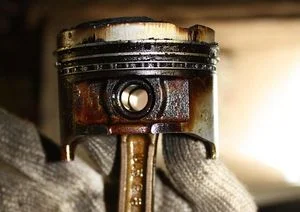
Stuck or worn piston rings. Oil control rings can become 'coked' (stuck) due to overheating or infrequent oil changes, or simply wear down mechanically. Oil remains on the cylinder walls and burns. Sign: constant blue smoke from the exhaust pipe and a characteristic smell of burning.
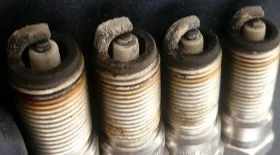
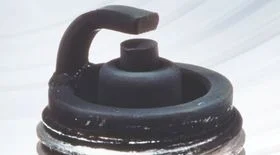
Oil in the combustion chamber often leads to the formation of black oily soot on the spark plugs.
If the rings are simply stuck, an engine flush/de-coking procedure might help. If they are worn, the only solution is replacement, involving engine disassembly.
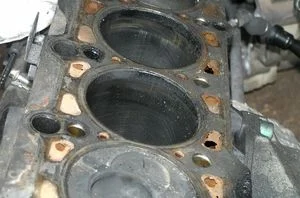
Scoring and cylinder wall wear. With high mileage, cylinders lose their shape (become oval), and scoring appears. The rings cannot fit tightly against the walls, and oil blows by into the combustion chamber. Repair involves re-boring the block to an oversize or re-sleeving.
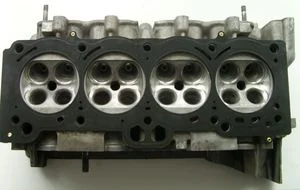
Blown head gasket. If the gasket fails between an oil channel and a cylinder or a coolant channel, oil will be lost. Signs: emulsion in the coolant (mixing of oil and antifreeze, often looking like mayonnaise) or oil leaks at the junction of the block and head. Requires cylinder head removal, skimming (resurfacing), and gasket replacement observing torque settings.
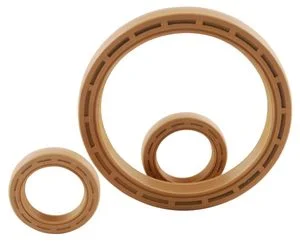
Oil seals
Leaking crankshaft and camshaft oil seals. The front crankshaft seal leaks externally (visible by drips at the front of the motor). The rear main seal leaks at the junction of the engine and gearbox (oil drops underneath at the bell housing). Camshaft seals can also leak, which is dangerous if oil gets onto the timing belt.
Oil on the timing belt rapidly degrades the rubber, which can lead to the belt snapping and bent valves. If a leak is found near the timing belt, repair is mandatory!
Why diesels consume oil
Diesel engines, in addition to piston and turbo wear, have their own specific issues. In particular, wear on the plunger pairs of the High-Pressure Fuel Pump (on older pump types), which are lubricated by oil, is possible. However, the problem usually lies with the turbo or crankcase ventilation.
Important: burning oil in a diesel is also accompanied by blue or grey smoke. Thick black smoke from a diesel usually indicates a fault in the fuel system (over-rich mixture, lack of air), not oil consumption, although these problems can occur simultaneously.
You can check for oil in the exhaust by holding a sheet of white paper against the tailpipe of a running, warmed-up engine. Oil droplets will leave greasy marks that do not dry (unlike condensation).
A few words about turbos
The turbocharger is lubricated and cooled by engine oil. If the bearings and shaft seals wear out, oil begins to be driven into the intake (intercooler) or directly into the exhaust system. Oil consumption in this case can be colossal — from a litre per 1000 km to completely draining the sump in a short drive if the shaft fails.
Also, if the crankcase ventilation system is blocked, the turbo cannot drain oil back into the engine properly (due to backpressure), and it begins to be forced out through the turbo seals, even if the turbo itself is in good condition.
Excessive oil consumption in new cars
For new engines or after a rebuild, there is a bedding-in process (running-in). During this period (usually the first 2000-5000 km), increased oil consumption is normal. The piston rings and cylinder walls are 'seating' themselves, and the surface micro-profile is smoothing out.
Do not forget that during the running-in period, you must drive gently, avoiding sudden acceleration, high RPMs, and lugging the engine. After running-in, it is recommended to change the oil and filter.
Conclusion
Checking the oil level is the car owner's responsibility. If you notice that the engine has started consuming lubricant beyond the norm, do not limit yourself to just topping it up. Find the cause of the leak or burn-off to avoid expensive repairs in the future.
Was this article useful?
Your feedback helps us improve our content.

Discussion (0)
No comments yet!