How to check spark plugs

If the engine starts running unevenly (misfiring) or loses power, suspicion often falls on a faulty spark plug. This is especially noticeable at idle. Increased fuel consumption also suggests that it is worth checking the plugs.
Reasons for spark plug failure
- Natural wear and ageing (average lifespan is 30,000–50,000 km). If a plug fails too quickly, the cause may lie in poor quality fuel or oil additives. Accelerated wear occurs with detonation (knocking) and engine overheating.
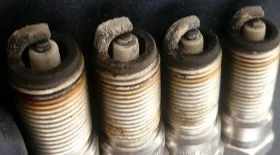
- Carbon fouling on electrodes. The result of an unbalanced air-fuel mixture or poor quality fuel.
- Oil fouling on electrodes. Causes: excess oil in the sump, worn piston rings, pistons, cylinder block, or valve guides. On turbocharged engines, a turbocharger fault is possible.
- Glazing (lacquer deposits). Caused by additives in fuel or oil.
- Ash deposits. The result of burning oil additives.
- Centre electrode failure. Causes: incorrect ignition timing, deposits in the combustion chamber, valve faults, low-quality fuel, or incorrect tightening torque.
- Melting. Occurs due to pre-ignition (auto-ignition of deposits), faulty valves, or poor quality fuel.
- Connector wear. Contact oxidation or overheating.
How to test spark plugs
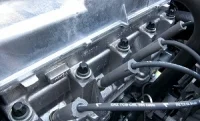
Spark plugs with HT leads
Method 1. Disconnecting leads one by one.
The essence of the method: with the engine running, remove the leads from the spark plugs one by one. Listen to the sound of the engine – if the engine note does not change after removing a wire, then that specific plug (or cylinder) is not working.
Method 2. The «spark test». Unscrew the plug, attach the HT lead to it, rest the threaded part (skirt) of the plug against the metal part of the engine block («earth») and crank the engine with the starter. A functional plug will show a clear, bright spark.

Spark plug tester gun
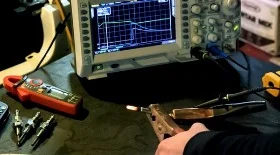
Method 3. Testing with a «gun» tester. Spark plugs can be checked with a special diagnostic tool. The plug is inserted into the device, and the trigger is pulled. If there is no spark, the plug is faulty. However, the presence of a spark does not guarantee full functionality, as the spark may fail inside the cylinder under pressure.
Method 4. Piezo lighter. The principle is the same as the previous method, but the device can be made yourself using a piezo element from a lighter. The wire from the module is extended and attached to the terminal of the removed plug. The block is pressed against the plug body, and the button is pressed. If there is no spark between the electrodes, the plug needs replacing.
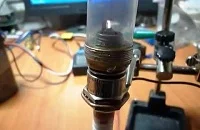
Pressure testing a plug in a DIY rig
Method 5. Pressure testing. Using a device made from a syringe (20 ml) and a threaded adapter, you can create pressure close to operating levels and perform a more accurate test.
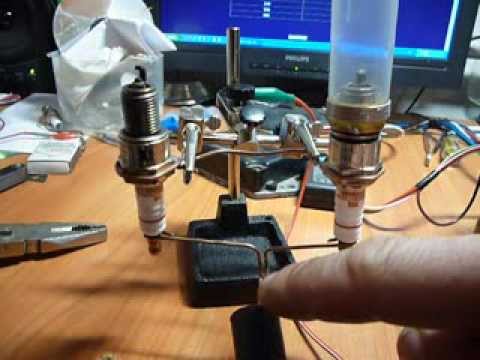
How to pressure test spark plugs yourself
How to check a spark plug with a multimeter
Using a multimeter, you can check the circuit continuity and the condition of the built-in resistor. This is a safe and accurate diagnostic method.
- Switch the multimeter to resistance measurement mode (20 kOhm range).
- Place one probe on the top terminal of the plug (where the lead attaches) and the other on the centre electrode at the spark gap end.
- A functional plug should show a resistance in the range of 2.5 to 10 kOhm (exact values depend on the plug brand).
If the instrument shows «infinity» (1), the circuit is broken, and the plug is faulty. If the resistance is zero, the suppression resistor is missing or shorted.
Remember that spark plugs have a specified replacement interval. The frequency depends on the type of plugs and the engine, but standard nickel plugs are recommended to be changed every 30,000 km.
Was this article useful?
Your feedback helps us improve our content.



Discussion (0)
No comments yet!