Castrol vs Mobil: Which Oil is Better?
Both manufacturers — Castrol and Mobil — hold leading positions in the lubricants market. Often, negative reviews about one brand or the other are linked not to the quality of the original product, but to the vast number of counterfeits on the market. It is counterfeit products that cause engine failures, not the choice between these two giants.
Let's break down the technologies, features, and specifications of the oils to understand which one is better suited for your vehicle.
Castrol
The Castrol engine oil range is regularly updated. The manufacturer focuses on adaptation to difficult operating conditions, including low temperatures and city traffic.
Features
Key focuses in Castrol oils:
- Cold start protection. Special additives are designed to protect the engine from the very first seconds of operation, before the oil reaches operating temperature.
- 'Start-Stop' operation. Improved protection indicators for frequent idling and traffic jams.
- Engine cleanliness. Additive packages prevent the formation of high-temperature deposits.
Technology
One of Castrol's key technologies is 'Intelligent Molecules' (in the Magnatec range). The essence of the technology is that oil molecules have the property of 'clinging' to the metal surfaces of the engine, forming a protective film that does not fully drain into the sump even during long periods of inactivity.
Viscosity
Castrol produces oils for a wide variety of engine types. Below are the main viscosity options and their intended use.
| SAE Viscosity | Series / Brand | Application |
| 0W-40 | Castrol EDGE Titanium FST | For modern engines requiring high protection |
| 5W-30 | Castrol Magnatec AP | For vehicles from Asian manufacturers (Japan, Korea) |
| 5W-30 | Castrol Magnatec A5 | Specifically for Ford engines |
| 5W-30 | Castrol EDGE Professional | Reinforced oil film |
| 5W-40 | Castrol Magnatec A3/B4 | Universal oil for petrol and diesel internal combustion engines |
| 10W-40 | Castrol Magnatec Diesel | Semi-synthetic, oriented towards diesel engines |
| 10W-60 | Castrol EDGE Supercar | For sports engines and extreme loads |
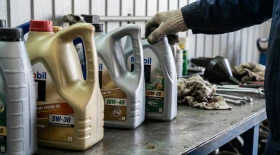
Mobil
Mobil (ExxonMobil) is one of the oldest and most technologically advanced players on the market. The company actively collaborates with car manufacturers at the engine development stage.
Key advantages of original Mobil oils:
- Stability at different temperatures. The synthetic base ensures easy pumping in winter and viscosity retention in summer.
- Cleaning properties. Mobil oils are known for their ability to effectively hold soot and deposits in suspension, preventing them from settling on parts.
- Fuel economy. Modern oil ranges with reduced viscosity (Advanced Fuel Economy) contribute to lower fuel consumption.
Production Technologies
Mobil uses advanced base oil synthesis methods (including PAO and GTL technologies), allowing for a product with a very stable molecular structure. This gives the oil high resistance to oxidation and thermal breakdown.
Viscosity
Mobil oil categories by viscosity and application:
| SAE Viscosity | Brand |
| 0W-20 | Mobil 1 Advanced Fuel Economy (energy-conserving, for Japanese and American cars) |
| 0W-30 | Mobil 1 FE (for modern petrol and diesel engines) |
| 0W-40 | Mobil 1 FS (universal oil for heavy-duty conditions, excellent cleaning properties) |
| 5W-30 | Mobil Super 3000 XE (suitable for many European cars) |
| 10W-40 | Mobil Super 2000 (semi-synthetic for higher mileage engines) |
| 5W-50 | Mobil 1 FS (for engines with high mileage and high load) |
Summing Up
The choice between Castrol and Mobil often comes down to personal preference and the recommendations of the specific vehicle manufacturer. For example, Castrol is often recommended for VAG group cars, while Mobil specifications are excellently suited for many Japanese and American vehicles.
Debunking common myths:
- "Castrol burns off quickly." High oil consumption is more often linked to piston group wear or incorrect viscosity selection, rather than the brand. This effect is also observed when using counterfeits.
- "If oil gets dark quickly, it's bad." This is a misconception. If the oil darkens, it means the detergent additives are working, dissolving deposits and holding dirt in suspension.
Conclusion: Both brands produce products of the highest quality. The main task for the car owner is to correctly select the viscosity and approval rating according to the car's manual and to buy 100% genuine oil.
Was this article useful?
Your feedback helps us improve our content.



Discussion (0)
No comments yet!