Why Spark Plugs Turn Black
The appearance of black carbon deposits on spark plugs can tell a car owner a lot about the problems existing within their vehicle. Causes of this phenomenon can range from poor quality fuel and ignition faults to an incorrect air-fuel mixture or a poorly adjusted carburettor. All these issues can be diagnosed quite easily, simply by looking at the black spark plugs.
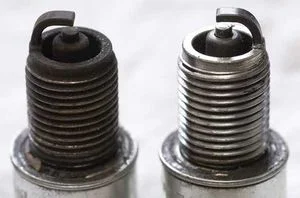
Possible Causes of Carbon Build-up
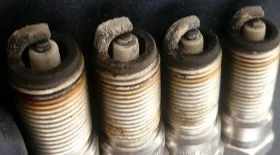
Before answering the question of why spark plugs are black, it is necessary to determine exactly how they blackened. The direction of your troubleshooting depends on this. Specifically, the plugs might all turn black together, or perhaps only one or two from the set. Also, a plug might blacken only on one side, or across the entire diameter. There is also a distinction between so-called “wet” and “dry” fouling.
It should be noted that the speed of appearance and the character of the deposits depend directly on existing faults (if any):
- Deposits on new plugs begin to form after a minimum of 200–300 km of driving. It is advisable to drive on the motorway at an approximately constant speed and engine load. This way, the plugs will operate in an optimal mode, allowing for a more objective assessment of the vehicle's condition.
- The amount and type of deposit depend on the quality of fuel used. Therefore, try to fill up at reputable petrol stations rather than using low-quality fuel substitutes. Otherwise, establishing the true cause of the deposits (if present) will be difficult.
- In a carburettor engine, the idle speed must be set correctly.
Now let's move directly to the question of why black carbon appears on spark plugs. There can be 11 main reasons:
- If you notice blackening only on one side, it is most likely caused by a burnt valve. That is, the carbon hits the plug from below onto the side electrode (rather than the central one).
- A burnt valve can also be the cause of black plugs generally. The situation is similar to the previous one. Deposits may penetrate onto the lower electrode.
- An incorrectly selected heat range for the plug causes not only damage during further operation but also uneven blackening initially. If the number is too low, the shape of the deposit cone will change. If it is too high, only the tip of the cone will blacken, while the body remains white.The heat range is a value characterising the time it takes for the plug to reach pre-ignition (glow ignition). With a higher heat range number, it heats up less (a cold plug), and with a lower number, it is hot. Always install plugs with the heat range specified by the manufacturer.
- Uniform black soot on the plugs indicates retarded ignition timing.
- Black plugs on an injection or carburettor engine may appear because the air-fuel mixture being produced is too rich. Regarding the former, there is a high probability of a malfunction in the Mass Air Flow (MAF) sensor, which provides information to the ECU about the mixture composition. It is also possible that the fuel injectors are leaking, causing petrol to enter the cylinders even when the injector is closed. Regarding the carburettor, causes may include: an incorrectly adjusted fuel level, a leaking needle valve, the fuel pump creating excessive pressure (the drive pushrod protrudes too far), a leaking float, or the float catching on the chamber walls.
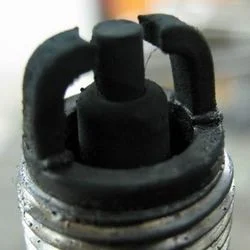
«Dry» carbon fouling
- Significant wear or leakage of the economiser ball valve on carburettor engines. This means a larger amount of fuel enters the engine not only during high-load modes but also during normal driving.
- A clogged air filter can cause a black spark plug. Be sure to check its condition and replace it if necessary. also, check the choke mechanism operation.
- Problems with the ignition system — incorrectly set ignition timing, damaged insulation on HT leads, a cracked distributor cap or rotor arm, ignition coil faults, or problems with the plugs themselves. These factors can lead to misfires or a weak spark. Consequently, not all fuel burns, and black soot forms on the plugs.
- Problems with the engine valve mechanism. Specifically, this could be burnt valves or incorrect valve clearances (tappets). The result is incomplete combustion of the air-fuel mixture and carbon formation on the plugs.
- On fuel-injected cars, the fuel pressure regulator may have failed, causing excessive pressure in the fuel rail.
- Low compression in the cylinder corresponding to the black plug. You can read how to check compression in another article.
Typically, with retarded ignition and a rich air-fuel mixture, the following consequences arise:
- misfiring (error P0300 appears on injection engines);
- problems starting the engine;
- unstable engine operation, especially at idle, resulting in increased vibration levels.
Next, we will explain how to rectify these faults and how to clean spark plugs.
What to Do When Carbon Appears
First and foremost, remember that oil contamination and overheating, which result in soot on spark plugs, are very harmful to the ignition system. Overheating is particularly dangerous as it creates a risk of electrode failure without the possibility of restoration.
If only one blackened plug appears in your car, you can diagnose the fault simply by swapping the plugs. If the new plug in that position also turns black, and the old one cleans up, the issue lies with the cylinder, not the plugs. If nothing changes, questions arise regarding the functionality of the spark plug itself.
Oil Deposits
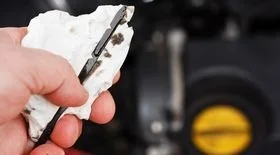
In some cases, plugs may be wet and black. Most often, the cause is oil entering the combustion chamber. Additional symptoms of this fault include:
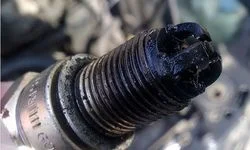
Oil on the plug
- difficult engine starting;
- misfiring in the corresponding cylinder;
- engine juddering during operation;
- blue smoke from the exhaust pipe.
Oil can enter the combustion chamber in two ways — from below or from above. In the first case, it passes through the piston rings. This is a very bad sign, as it often threatens a major engine overhaul. In rare cases, engine decarbonisation (decoking) might help. If oil enters the combustion chamber from above, it comes from the cylinder head via the valve guides. The reason for this is worn valve stem seals. To fix this, you simply need to select new, high-quality seals and replace them.
Deposits on the Insulator
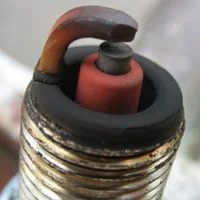
Red deposits on plug
In some instances, carbon naturally formed in the combustion chamber can detach from the piston at high engine speeds and stick to the spark plug insulator. The consequence will be misfiring in that cylinder. The engine will run roughly (misfire). This is the most harmless situation regarding why spark plugs turn black. It can be remedied simply by cleaning their surface or replacing them with new ones.
If black and red plugs appear in your engine, it means you are using fuel with an excessive amount of metal-based additives. You should not use this fuel for long because, over time, metallic deposits form a conductive coating on the plug insulator. Spark generation will deteriorate, and the plug will soon fail.
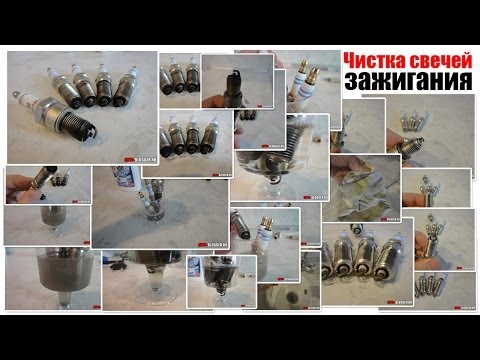
Cleaning spark plugs
Cleaning Carbon Deposits from Spark Plugs
Cleaning plugs must be done regularly, just like inspecting their condition. It is recommended to do this approximately every 8,000...10,000 kilometres. It is very convenient to do this when changing the engine oil. However, if the symptoms described above occur, it can be done sooner.
It is worth mentioning straight away that the old-school method of using sandpaper to clean electrodes is not recommended. The issue is that this creates a risk of damaging the protective layer on them. This is particularly relevant for iridium plugs. Their central electrode is thin and coated with iridium, which is a semi-precious and rare metal.
To clean spark plugs, you will need:
- a cleaning agent to remove limescale and rust;
- disposable plastic cups (must be disposed of after the cleaning procedure; do not use for food afterwards);
- a thin brush with stiff bristles or a toothbrush;
- a rag or cloth.
The cleaning procedure is performed according to the following algorithm:

Cleaning procedure
- Pour the cleaning agent into the prepared cup to a level that fully submerges the plug electrodes (without the insulator).
- Submerge the plugs in the cup and leave for 30...40 minutes (a chemical cleaning reaction occurs during the process, visible to the naked eye).
- After the specified time, remove the plugs from the cup and remove deposits from the plug surface using the brush or toothbrush, paying special attention to the electrodes.
- Rinse the plugs in warm running water, removing the chemical compound and dirt from their surface.
- After washing, wipe the plugs dry with the prepared cloth.
- The final stage is to dry the plugs on a radiator, in an oven (at a low temperature of +60…+70°C), or using a hairdryer or fan heater (the main thing is that any remaining water evaporates completely).
Perform the procedure thoroughly, cleaning and removing all dirt and deposits present on the surface. Remember that washed and cleaned plugs work 10...15% more efficiently than dirty ones.
Summary
The appearance of a black spark plug on a carburettor or injection engine can be caused by various reasons. Typically, there are several at once. For example, incorrectly selected plugs, prolonged engine operation at high RPM, incorrectly set ignition timing, faulty valve stem seals, and so on. Therefore, we recommend that you check the condition of the spark plugs in your car periodically, and especially if the symptoms described above appear.
This way, you will not only extend the engine's service life but also maintain power and driving comfort. You can find additional information on how to diagnose a car engine by the colour of spark plug deposits separately.
Was this article useful?
Your feedback helps us improve our content.




Discussion (0)
No comments yet!