Brake pads squeak when braking
There are six main reasons why a car's brake pads squeak. The simplest and most common is wear and tear. However, apart from that, the squeaking can be caused by the brake discs, wheel bearings, incorrectly selected brake pads, or the ingress of dust, dirt, moisture, or small debris into the braking system.
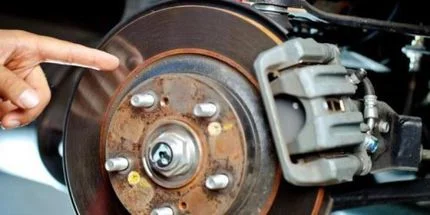
Typically, to eliminate these issues, you need to inspect the specified components and mechanisms. You can do this yourself, provided you have experience with similar repair work and the appropriate tools. Naturally, fixing the cause of squeaky brake pads yourself will save you money on labour costs. However, remember that you must be confident in the final roadworthiness of the vehicle's braking system, as it is a safety-critical assembly that directly affects the safety of all road users.
Causes of squeaking
First of all, it is worth noting that in 90% of cases (perhaps even more), it is the front pads that squeal. Therefore, inspection should start with them. The explanation is simple: during braking, the car's weight transfers forward, the nose dips slightly, and the rear rises. Consequently, the front pads experience a much higher load compared to the rear ones. The sharper the braking, the more intense the work of the front pads.
Caliper and guide pins
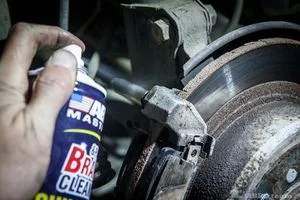
In this case, we are talking about the dust boot of the main piston, as well as the guide pins (sliders). Often, the boot tears due to mechanical damage or simply old age, allowing dirt, sand, moisture, and debris to get inside. Naturally, during driving and braking, this mixture rubs against the metal surfaces, wearing them down.
The consequence of this can be that the guide pins and the piston itself may simply seize. In turn, this causes the pads not to return to their original position after braking. That is, they remain in contact with the disc, heating it up and impeding the car's movement. Often, this is accompanied by a squeak caused by the overheating of the disc and pads, and their accelerated wear. By the way, this causes significant wear on the brake disc; a malfunction can often be indirectly identified by its appearance (discolouration or 'bluing' from high temperature).
Brake pads
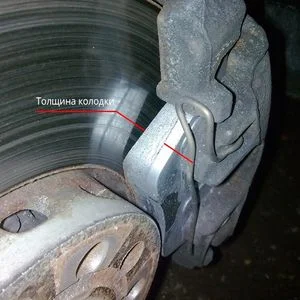
Even if the brake pads are not heavily worn, or possibly even new, there are objective reasons why they might squeak or whistle after replacement. The first reason is purchasing poor-quality aftermarket pads. Usually, an original part is of higher quality, and such a pad will not squeak (with very rare exceptions). Manufacturers of cheap aftermarket consumables typically economise on materials.
Specifically, budget pads often use a low-quality friction material which wears down unevenly. It can be of two types — soft and hard. Soft material wears out faster (approximately after 15,000 kilometres / 9,000 miles), but is gentler on the disc and usually does not cause squeaking. However, if the pad has a hard friction layer, it wears the brake disc much more aggressively and is often the cause of squealing. The advantage of such pads, however, is their longevity — lasting up to 30,000 kilometres (18,000 miles) or more.
Another reason for squeaks can be the absence of chamfers or slots on the pad surface. The issue is that during braking, the pad surface does not adhere perfectly to the disc (depending on the pad type and installation process), even if the system is working correctly. Therefore, during braking, the interaction between the pad and disc surfaces creates an acoustic resonance, which the human ear perceives as a squeak.
Some types of brake pads come from the factory with so-called anti-squeal shims. As the name suggests, they serve to prevent squealing and vibration of the pad during braking, and also help to dissipate heat. Consequently, in their absence, the pad may emit unpleasant sounds.
Brake discs
During braking, due to friction, heat is generated on the surface of the brake disc, and the disc itself heats up. Upon reaching a critical temperature (depending on the specific disc and the metal alloy), the disc may emit unpleasant sounds resembling a squeak or squeal. Old, solid (non-ventilated) discs are particularly prone to this. They lack internal channels for heat dissipation, so they heat up faster and retain heat longer.
However, there are cases where ventilated discs also squeal. But this usually happens in the event of significant wear or after intensive (e.g., emergency) braking, when they similarly overheat.
Acoustic wear indicators
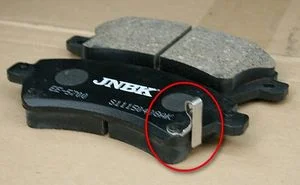
Mechanics often refer to these as "squealers". These are special metal tabs installed on some brands of brake pads. Their purpose is to touch the disc when the pads reach critical wear, emitting a piercing squeal to alert the vehicle owner of the need to replace the brake pads.
Wheel bearing
This refers to significant wear of the wheel bearing. Due to the resulting play, brake disc runout occurs, causing the disc to brush against the pads even without pressing the brake pedal. This causes a rhythmic squeak or chirp. Note that in the case of critical wear, the bearing will start to hum constantly, and the drone increases with speed.
External factors
In this case, we are talking about dirt, grit, small debris, moisture, and so on. These elements, when driving in wet or frosty weather, or on mud and sand, can get into the gap between the pad and the disc and cause squeaking. In some cases, a frozen friction layer can also make unpleasant sounds.
How to stop the squeak
The methods for eliminating brake pad squeak depend on the causes listed above.
Caliper and guide pins
First of all, check the condition of the dust boot and its integrity. If it is packed with dirt, it needs to be serviced or replaced. While doing this, don't forget to check the free movement of the caliper and its piston. They should move freely and not prevent the brake pads from returning to their original position.
To check, you can simply simulate braking by hand, pressing on the piston to clamp the pads to the disc. Afterwards, they should freely return to their place. If this does not happen, you need to service the caliper and its components. Don't forget to use special high-temperature brake grease for calipers and guide pins. Very often, the problem with squealing is solved by a simple caliper service, lubricating the pins and the contact points on the back of the pads.
Brake pads
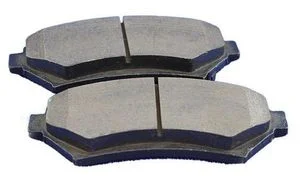
Anti-squeal slots on new pads
regarding the first cause mentioned, the recommendation is simply to buy reasonably high-quality (not necessarily original manufacturer) brake pads. That is, those with a medium-soft friction material.
Acoustic resonance can be eliminated in various ways. The first is also to recommend buying pads that have special slots and chamfers (bevelled edges) on the surface, designed precisely for this purpose. Most quality products have these by default.
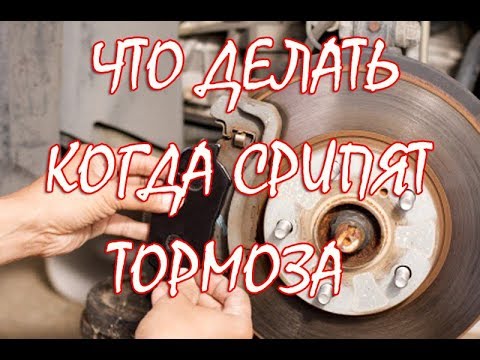
How to chamfer a brake pad
Resonance can also be eliminated using anti-squeal shims. These are sold separately in shops and installed onto the brake pads. The instructions will show how to do this. If you decide to buy anti-squeal shims, do not forget to use the special grease usually included in the kit (or copper/ceramic paste) when installing them, which should be applied to the back of the pad (not the friction side!). Most manufacturers include these metal plates with their pads, but some come without them.
Another function of anti-squeal shims is to dissipate heat from the brake disc. This helps extend its service life. It is worth noting that reviews on the use of anti-squeal shims from various car owners are quite mixed. The summary is that if the friction material of the pads is good, the shims can help, but if the pad is inherently poor quality, no amount of anti-squeal shims will help.
Brake discs
Depending on the condition of the discs, there are different ways to eliminate squeaks. The most correct one is to select a high-quality replacement for the standard disc.
Another option is to analyse the condition of the brake disc. If it is heavily worn, it can be skimmed (resurfaced) or replaced with a new one. An indirect sign that the disc is "warped" is if the car judders when braking. Skimming the disc is only possible if the wear is minor and there is enough thickness left to remove a layer of metal using a lathe. However, the best solution in this case is to replace the disc with a new one. This will protect you from breakdowns and dangerous situations on the road in the future.
Wheel bearing
It makes no sense to repair a wheel bearing, and indeed it is usually impossible. Driving with a faulty one is very dangerous, as there is a risk that the wheel could seize up completely at speed, which could lead to a fatal accident. Therefore, the only solution in this case is a complete replacement of the bearing.
External factors
In most cases, this is a temporary phenomenon. Usually, squeaking in such cases appears when driving through mud, sand, or in frosty weather shortly after setting off after a long stop. Typically, after 5...10 minutes of driving in normal conditions, the squeak stops.
Acoustic wear indicators
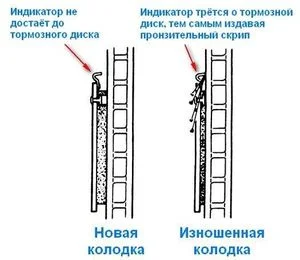
Wear indicator mechanism
In this case, the only solution is to replace the pads with new ones. Remember that they must be changed as an axle set (both front wheels or both rear wheels). Regardless of the condition of the other pad, leaving it would mean it wears out much faster, and its braking efficiency will be lower than that of the newly installed one, causing uneven braking.
Interesting facts
Some new brake pads have a so-called bedding-in layer. It sits on top of the main friction material. After installing such a new pad, a squeak may occur during the first 30-60 miles (50-100 km) related to the bedding-in of the pads and the wearing off of this initial layer. This is why new pads sometimes squeak after replacement. Treat this calmly and accept it as normal. However, to save your nerves, before buying brake pads, check if they have this bedding-in coating.
Sometimes squealing also occurs on drum brakes. A prime example is the popular Renault Logan (and Dacia variants). It has a common issue where, during heavy braking, the shoes (especially new ones) can catch on the backplate. The fix for this flaw, preventing the shoes from catching and squeaking, consists of sanding the contact points with emery paper.
Additionally, occasionally, metal filings can become embedded in disc or drum brake pads. This causes a quiet squeak and also reduces braking efficiency. To get rid of this, you need to remove the pads and clean off this layer using fine sandpaper. Note that you need to work carefully so as not to damage the pad and its working surface.
Conclusion
The search for reasons why brake pads are squeaking should always start with checking their condition. Most often, especially on cars with high mileage, owners simply forget to replace them, and the pads create a squeal due to excessive wear. Remember to change pads in accordance with your vehicle manufacturer's requirements. Often, they can be used until critical wear is reached, but on other cars, pads must be changed after a certain mileage (e.g., every 18,000-20,000 miles).
If the pads are fine, then you need to carefully check the components and elements of the braking and suspension systems listed above. Remember that repairs must be carried out responsibly to ensure the car's brakes work faultlessly in the future!
Was this article useful?
Your feedback helps us improve our content.
Related Materials

Discussion (0)
No comments yet!