Brake Caliper and Guide Pin Grease
Grease for calipers and guide pins facilitates the operation of the braking system, which operates under arduous conditions. There are several types of lubricants, and it is critical not to confuse their intended purposes to ensure the brakes do not seize.
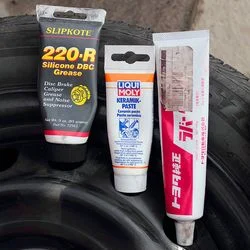
Types of grease
Types of grease
Manufacturers divide lubricants into pastes and sprays. Under aggressive driving conditions, the caliper temperature can reach +300°C. The grease must be:
- Safe for rubber (dust boots). This is the most crucial point. Most modern dust boots are made of EPDM rubber, which is destroyed by mineral oils.
- Resistant to washout by water and brake fluid.
- High-temperature resistant (working at +180°C and above).
Modern lubricants are divided into three main groups:
First group — Mineral or semi-synthetic pastes with metals (anti-seize). Operating range up to +1100°C. Composition: oil, thickener, and powder of copper, aluminium, graphite, or molybdenum.
Examples: HUSKEY 2000, Loctite No. 8060, copper pastes (Liqui Moly Kupfer-Paste, Mannol, etc.), pastes with ceramics (Textar Cera Tec).
Second group — Pastes based on mineral oil (bentonite). They do not have a dropping point and work from -45°C to +180°C. Example — Teroson VR500. Suitable only for guide pins in systems where this is explicitly permitted by the manufacturer (usually older car models), and the metal does not contact EPDM-type rubber.
Third group — Greases based on synthetic oil (polyalkylene glycol — PAG). This is the best choice for guide pins. They are neutral towards EPDM rubber, do not wash off with water, and do not coke. Temperature range from -40°C to +300°C.
Examples of correct greases for guide pins: Molykote AS-880N, Permatex Ultra Disk Brake Caliper Lube, SLIPKOTE 220-R, TRW PFG110.
Copper grease (high-temperature)
This is a high-temperature anti-seize paste. It consists of finely dispersed copper and oil (usually mineral).
Advantages: wide temperature range, protection against seizing. It is ideal for threaded connections, hub seating surfaces, and the back of brake pads.
Review of greases for calipers and guide pins
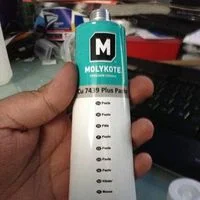
Molykote Cu-7439 Plus
Molykote Cu-7439 Plus. A quality paste based on copper powder and semi-synthetic oil.
- Operating range: -30°C...+600°C.
- Protects against seizing and corrosion.
Excellent for assembling brake mechanisms, lubricating carriers and pads. Due to the copper filler, it is not recommended to place it inside floating-type guide pins.
MC-1600 caliper grease, comparison with analogues.
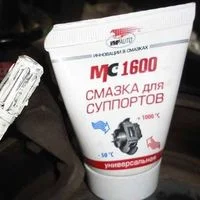
MC-1600
MC-1600. A universal high-temperature paste. Operating range -50°C...+1000°C. Stated to be safe for rubber parts. Suitable for the contact surfaces of pads and piston treatment. The manufacturer positions it as a grease for guide pins as well, however, due to high viscosity in severe frost, some users have reported issues.
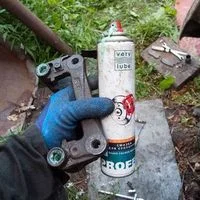
XADO VeryLube
XADO VeryLube. Lithium grease spray. Operating temperature up to +400°C. A good option for external springs and mechanisms.
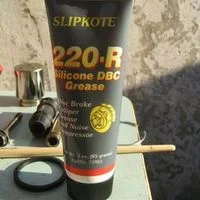
SLIPKOTE 220-R DBC
SLIPKOTE 220-R DBC. Specialized silicone grease for calipers. Considered the reference choice for guide pins.
- Range: -46 to +299°C.
- Absolutely safe for all types of rubber (EPDM, neoprene).
- Does not wash out or coke.
The Toyota equivalent is 08887-80609 (or the pink Rubber Grease 08887-01206). This is the best option for long caliper life.
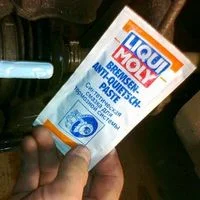
LIQUI MOLY Bremsen-Anti-Quietsch-Paste
LIQUI MOLY Bremsen-Anti-Quietsch-Paste. Important to know: this is an anti-squeal paste. The manufacturer themselves state: 'Not recommended for lubricating caliper guide pins or placing inside dust boots'. Use it only for pads and plates.
Which caliper grease is best?
Each part requires its own composition:
- For guide pins (under the dust boot): Only synthetic polyalkylene glycol (PAG) or silicone greases (Slipkote 220-R, TRW PFG110, Toyota Rubber Grease, Febi 31942). No copper or mineral oil!
- For pads, carriers, and plates (anti-squeal): Copper and ceramic pastes, MC-1600, Liqui Moly Anti-Quietsch.
- For the piston (under the seal): Special assembly pastes based on PAG (e.g., ATE Bremszylinder-Paste).
Caliper grease reviews
Below are reviews from car owners. Please note: the experience of using unsuitable greases (e.g., copper in guide pins) may give a short-term effect but lead to seizing after six months.
Slipkote 220-R DBC
| Positive | Negative |
| I use SLIPKOTE 220R for lubricating the cylinder and on the guide pins... Which I advise all my friends to do. | None noted |
| After lubricating the caliper on a Toyota Camry with SLIPKOTE 220R DBC, there isn't even a hint of a squeak. |
Molykote Cu-7439 Plus
| Positive | Negative |
| Used Molykote Cu-7439 Plus for pads and carriers. Holds up excellently, doesn't wash out. | Molykote Cu-7439 Plus is not suitable for guide pins. It is a copper paste, just like LIQUI MOLY Bremsen-Anti-Quietsch-Paste or Permatex Copper. |
MC-1600
| Positive | Negative |
| Normal feel from the grease. I liked that the squeaking disappeared immediately. | Stated characteristics cause doubts, lack of international approvals. |
| Tried MC-1600, it's affordable and the quality is acceptable. | It is very thick. I packed MC 1600 into the sliders. In winter, the grease dried out and turned into plasticine. Better to have specialized greases for specific parts than one universal one. |
Was this article useful?
Your feedback helps us improve our content.
Related Materials
Discussion (0)
No comments yet!