Why the ABS Warning Light is On: Causes and Solutions

Some drivers worry that if the ABS light is on, the entire braking system is compromised. They start frantically searching the internet for answers on why the ABS light is on and what to do. But do not panic: your car's brakes should still work; only the anti-lock system (and brake force distribution, if equipped) will be disabled.
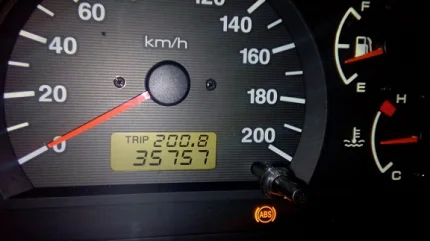
Let's look at what happens if you drive with a faulty anti-lock braking system. We will examine all common causes of malfunctions and methods for resolving them. To understand how the system works, we recommend reading up on the principles of ABS.
Can you drive when the ABS light is on?
When the ABS light comes on while driving, problems may arise during emergency braking. The system works by intermittently applying pressure to the brake pads. If any component of the system fails, the wheels will lock up, just as they typically do when you slam the brakes on older cars. The system shuts down completely if the self-test detects an error when the ignition is turned on or while driving.
The operation of the electronic stability programme (ESP/VSA) may also be compromised, as this function depends directly on the proper functioning of the ABS.
Difficulties can also arise when avoiding obstacles. In such cases, system faults accompanied by an illuminated ABS indicator lead to the wheels locking fully during braking. A car with locked wheels becomes uncontrollable and continues to slide due to inertia, making it difficult to steer around an obstacle.
It is worth noting separately that stopping distances may change when the ABS is not working. Tests show that a vehicle with a functioning ABS system brakes more effectively and maintains steerability on uneven or slippery surfaces:
- wheel lock (without ABS) often leads to skidding and increased stopping distances on ice or wet roads;
- with ABS, the driver retains control of the vehicle.
Why does the ABS warning light come on?
There are many reasons why the ABS light appears on the dashboard. Most often, contact is lost at one of the sensors, wires break, the magnetic ring (or tone ring) on the hub becomes dirty or damaged, or the ABS control unit fails.
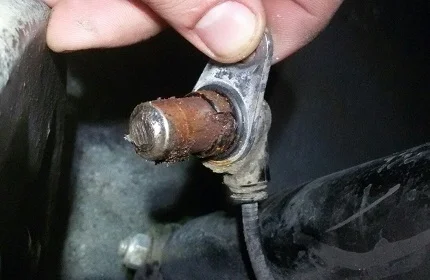
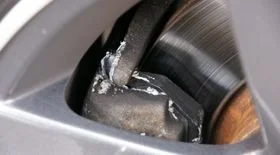
Corrosion on the ABS sensor
The system may report an error due to the poor condition of the sensor itself. Constant exposure to moisture and dust leads to corrosion over time, and dirt can shield the signal.
Additionally, if the suspension is faulty, constant vibration and shocks can damage the internal wiring of the sensor or cause it to shift (if the design allows for adjustment).
The simplest reasons for the ABS light coming on are a blown fuse or issues with the electrical system (low voltage).
Quite often, the wheel sensor connector oxidises, or wires in the wheel arch wear through. If the ABS icon lights up after changing brake pads or a hub, the first logical assumption is that the sensor connector was not reconnected. If a wheel hub bearing was changed, it might have been installed incorrectly. On some hub bearings, the magnetic ring (encoder) that the sensor reads is only on one side. If the bearing is installed the wrong way round, the system will not work.
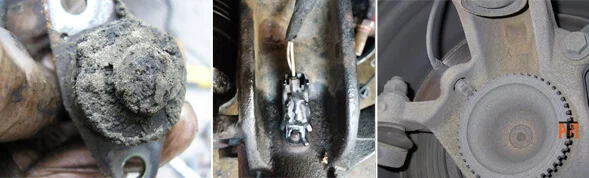
Main reasons why the ABS light is on
Depending on the technical features of the vehicle and the symptoms of the fault, let's look at the main problems.
Causes of the ABS error
The main possible reasons for the ABS light staying on constantly on the dashboard are:
- loss of contact in the connection plug;
- loss of communication with one of the sensors (broken wire);
- ABS sensor failure (requires diagnostics with a multimeter or scanner);
- damaged or dirty reluctor ring (tone ring) or magnetic ring on the hub;
- failure of the ABS control unit.
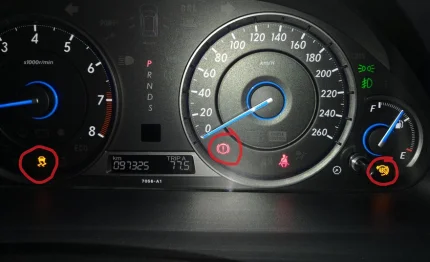
VSA, ABS and Handbrake errors displayed on the panel
Several accompanying icons may appear on the dashboard simultaneously with the ABS light. Depending on the nature of the fault, the combination of these errors may vary. For example, in the case of a valve failure in the ABS block or pump power issues, three icons may light up at once: VSA (Vehicle Stability Assist), ABS and Handbrake (exclamation mark).
It is common to see “BRAKE” and “ABS” displayed simultaneously. On vehicles with four-wheel drive, the “4WD” icon may also light up, as the all-wheel-drive system often disengages when wheel speed sensors malfunction.
ABS light on dashboard at engine start
Normally, the ABS light should stay on for a few seconds when the ignition is switched on. After this, it goes out — this means the on-board computer has successfully tested the system's electrical circuits.
If the indicator stays on a little longer or lights up during a voltage drop (for example, in freezing weather), this may indicate a weak battery. The ABS system is sensitive to the on-board network voltage: if it drops below normal (about 10.5–11 V), the control unit shuts down and triggers an error. As soon as the alternator restores the charge, the icon may go out.
However, if the ABS light does not go out at all, this indicates an active error (broken wire, sensor failure, module fault).
It also happens that after starting the engine, the light goes out and then starts coming on again when moving off (usually after 5–20 km/h). This is a sign that the static test was passed, but the system is not receiving a correct speed signal from one of the wheels.
ABS light comes on while driving
When the ABS lights up while driving, it indicates a fault occurring during operation:
- loss of connection with one of the wheel sensors (wire rubbed through, contact came loose);
- mechanical damage to the tone ring (cracked, clogged with mud);
- voltage spikes.
Why is the ABS light flashing on the dashboard?
A situation often occurs where the ABS light flashes rather than staying on constantly. Intermittent signals from the light indicate one of the following faults:
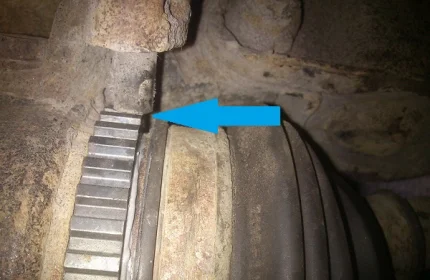
Gap between ABS sensor and tone ring
- unstable signal from the sensor (damaged wiring, loose contact);
- worn terminals on connectors or connectors covered in dirt;
- problems with the ABS unit (internal faults).
What to do if the ABS light is on
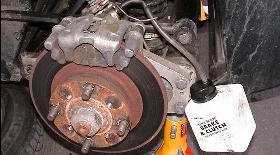
The system is working normally if the ABS icon lights up when the ignition is switched on and goes out after a couple of seconds. The first thing to do if the ABS light stays on is to check the brake fluid level and system fuses, as well as inspect the wheels and wires leading to the sensors for breaks.
The table below shows examples of faults and error codes. Please note: error codes may differ depending on the car make (VAG, Toyota, Nissan, etc.).
| Nature of fault / Example code | How to fix |
|---|---|
| Error code C10FF (Peugeot), P1722 (Nissan) or other sensor open circuit codes | Check cable integrity. The wire may have broken inside the insulation or come loose from the connector. |
| Code P0500 (Speed Sensor Error) | The error indicates no speed signal. Check the sensor itself, its wiring and connector. On older cars, check the speedometer drive. |
| Solenoid valve or pump errors (С0065, С0070, etc.) | You need to check the power supply to the ABS unit and the (high-amperage) fuses. If there is power, the problem is inside the hydraulic unit (repair or replacement of the unit is required). |
| Power circuit fault (Low Voltage) | Check the alternator and battery, as well as the ABS circuit fuses. |
| No communication via CAN bus (U-codes) | Contact a service centre for CAN bus wiring diagnostics. This is a serious problem affecting all car modules. |
| ABS sensor light on after replacing wheel hub bearing |
|
| After replacing hub or sensor light does not go out | Check wire integrity. Ensure the sensor seating area is cleaned of rust (rust pushes the sensor away from the ring). Important: on most modern cars, the gap is not adjustable. If the design is older (with a toothed tone ring), check the gap with a feeler gauge. |
| Icon stays on or flashes after changing brake pads | |
| ABS light on after replacing sensor (signal mismatch error) | There are 2 options:
|
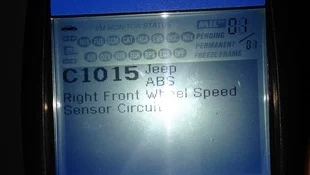
Example of an error during ABS diagnostics
Quite often, car owners are alarmed by the appearance of an orange ABS icon after prolonged wheelspin (for example, in snow). In this case, do not worry: the system detected different wheel rotation speeds and switched off. You need to drive a little on a flat road or restart the engine — the error should clear.
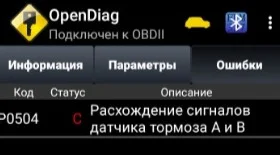
When the ABS light stays on constantly, it is recommended to carry out computer diagnostics. Without a scanner, finding the cause is difficult, as there are four sensors and the wiring is hidden.
Summary
If a simple check for damaged wires and fuses reveals nothing, you will need diagnostics (reading OBDII error codes) to identify the specific component. Replacing sensors by guesswork without checking the error code often leads to unnecessary expense.
Was this article useful?
Your feedback helps us improve our content.


Discussion (0)
No comments yet!