Hard Starting When Cold: Causes and Solutions

Cold start problems manifest with various symptoms, but the root causes are usually typical for each fuel system: petrol (fuel injection, carburettor) or diesel. In this article, we will look at the most common faults that prevent a normal engine start in the morning.
Typical Situations
It is important to distinguish the conditions under which the problem occurs:
- the car starts poorly when hot;
- it starts poorly after standing for a long time, once it has cooled down (especially in the morning);
- it refuses to start in severe frost.
Each situation has its own nuances. We will analyse the causes leading specifically to difficult starting of a cooled engine at moderate temperatures. A healthy car typically requires 1–2 turns of the starter motor to fire up.
Table of Main Causes
| Causes | Carburettor | Fuel Injection | Diesel |
|---|---|---|---|
| Poor fuel quality |  | | |
| Fuel pump malfunction | | | |
| Clogged fuel filter | | | |
| Low fuel pressure |  | | |
| Low fuel level in float chamber | | | |
| Faulty fuel pressure regulator | | | |
| Air leak (Vacuum leak) | | | |
| Poor condition of spark plugs | | | |
| Faulty HT leads or coils | | | |
| Dirty throttle body | | | |
| Contaminated IAC (Idle Air Control) | | | |
| Faulty MAF/MAP sensor | | | |
| Coolant Temperature Sensor glitch | | | |
| Incorrect valve clearances | | | |
| Weak battery charge | | | |
Primary Diagnostics
On petrol engines, the spark plug often serves as a key indicator. Remove and inspect it: "wet" means fuel flooding (ignition issues, leaking injectors); "dry" means a lean mixture (vacuum leak, fuel pump, filters). This method helps narrow down the search without dismantling unnecessary components.
For diesel engines, the main cause of poor cold starting (assuming the glow plugs are working) is low compression. The second most common cause is fuel quality and freezing (waxing), and the third is the glow plugs themselves.
Tips for Engine Starting in Cold Weather
- Keep the tank full — this prevents condensation from forming and entering the fuel system.
- On a fuel-injected car, after turning the key, wait a few seconds for the fuel pump to build pressure in the rail, and only then engage the starter.
- On a carburettor car with a mechanical pump, use the manual priming lever (if equipped) to pump petrol, but do not overdo it to avoid flooding the plugs.
- Vehicles with LPG systems must never be started from cold on gas — always begin warming up on petrol.
Fuel Injection Hard Start When Cold
In injection systems, the electronics control the mixture formation. If sensors send incorrect signals, the ECU prepares the wrong mixture, making starting difficult. Common culprits include:
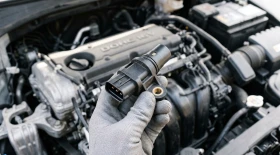
- Coolant Temperature Sensor (CTS). It tells the control unit that the engine is cold, and the ECU enriches the mixture. If the sensor gives a false reading (indicates "warm"), the mixture will be too lean for a cold start.
- Throttle Position Sensor (TPS).
- Mass Air Flow (MAF) sensor or Manifold Absolute Pressure (MAP) sensor.
If the sensors are fine (checked with a multimeter or scan tool), check the mechanics and hydraulics:
- Fuel Pressure Regulator (FPR). If it doesn't hold pressure, fuel drains back into the tank, and you have to crank the starter for a long time to repressurise the system.
- Leaking injectors. In cold weather, a dripping injector floods the cylinder overnight. In the morning, such an engine will misfire ("run on three cylinders") upon starting until the excess petrol burns off. This is checked on a test bench or with a pressure gauge (checking for pressure drop in the rail after stopping the engine).
- Air leak (vacuum leak) in the intake manifold. Excess air leans out the mixture, making the cold engine start unstable.
On older systems (e.g., mechanical injection on older Audis), the cold start valve (fifth injector) must be checked.
Carburettor Hard Start When Cold
The main causes of starting problems with a carburettor are related either to the ignition system or fuel delivery adjustment. The first action is to remove the spark plugs. If they are wet, there is an issue with the spark or flooding.
Typical faults:
- Weak spark (coil, ignition module, distributor cap, tracking on the rotor arm).
- Incorrectly tuned carburettor (choke gaps).
- Damaged pull-down diaphragm (choke unloader).
If the engine is "flooded" with petrol (wet plugs, smell of petrol), use the "clear flood" mode: smoothly press the accelerator pedal to the floor, crank the starter for 5–10 seconds, and release the pedal. With the throttle fully open, the cylinders are aired out.
Diagnostics by behaviour:
- Starter turns but no firing — no spark or no petrol arriving.
- Fires but does not start — ignition timing off, flooding, or lean mixture.
- Starter does not turn — flat battery or poor earth connection.
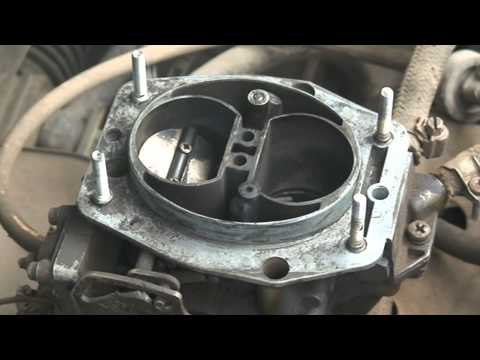
Why a cold carburettor is hard to start
For a quick search, specialists recommend checking in this order: spark plugs, HT leads, the carburettor choke mechanism, and then the ignition timing and fuel pump operation.
Diesel Hard Start When Cold
Diesel ignition occurs through compression, which heats the air in the cylinder. If there is no compression or the air is not warm enough, combustion will not happen. Three main areas to investigate:
- Insufficient compression.
- Non-functioning glow plugs.
- Fuel supply issues (air ingress, freezing/waxing).
Low compression is a frequent cause of poor starting "from cold" while performing normally "when hot". If the car only starts with a tow in the morning, and blue/grey smoke follows the start, this indicates wear in the piston group.
Glow plugs are essential for pre-heating the combustion chamber. If even one or two plugs fail, starting in freezing conditions becomes extremely difficult. Causes of failure:
- burnt-out plug element;
- faulty glow plug relay (not clicking);
- oxidised contacts on the glow plug power rail.
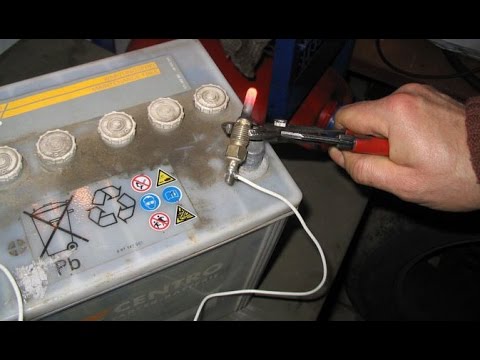
3 ways to check glow plugs
To check the plugs, use a multimeter (ohmmeter mode) or a test light. The resistance of a working plug should match the manual (usually around 0.6–1.0 Ohm). An open circuit indicates a fault.
Fuel equipment. Worn injectors can have high back-leakage ("leak-off"), causing the high-pressure pump to fail to build the necessary pressure for starting. Air ingress into the fuel line is also critical — the diesel starts and stalls, or requires extensive priming.
Fuel seasonality. Summer diesel crystallises (waxes) in frost, clogging the filter. In such cases, only a warm garage, filter replacement, and the addition of anti-gel (before the fuel clouds, not after) will help.

10 Reasons Why a Diesel Starts Poorly When Cold
- Weak battery or faulty starter (low cranking speed).
- Low compression in cylinders.
- Faulty glow plugs or relay.
- Worn injectors (excessive leak-off, poor spray pattern).
- Air ingress in the fuel system.
- Incorrect injection timing.
- Waxed fuel or clogged filter.
- Incorrect valve clearances.
- Blocked exhaust system (rare).
- Faulty high-pressure fuel pump (plunger wear).
These points will help localise the problem. Start checking with simple elements (battery, plugs, filters) before moving on to removing injectors or measuring compression.
Was this article useful?
Your feedback helps us improve our content.
Related Materials
Discussion (0)
No comments yet!