CV Joint Clicking: Diagnosis and Causes
When a CV joint makes a crunching or clicking noise during a turn, it is essential to quickly identify which specific component has failed. Front-wheel drive vehicles have four joints: two inner and two outer. It is also important to ensure that the source of the sound is indeed the joint and not another suspension element. Let's look at the diagnostic algorithms and solutions to the problem.
Types and Construction of CV Joints
To understand the cause of the failure, we need to recall the design of the assembly. The task of any Constant Velocity (CV) joint is to transmit torque between shafts located at different angles. A front-wheel drive car is equipped with four joints:
- Two inner joints: Transmit torque from the gearbox to the driveshaft. Structurally, this consists of a housing ('cup') with a tripod (needle bearings). These fail less frequently.
- Two outer joints: Transmit torque from the driveshaft to the wheel. Based on a ball and cage mechanism. They operate at large angles, which is why they fail and start clicking more often.
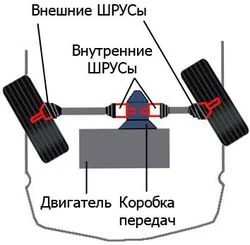
Types and location of CV joints
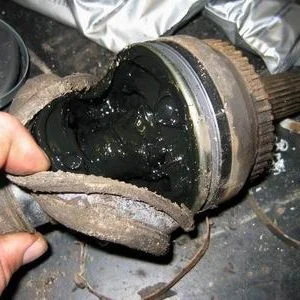
The main condition for long service life is the presence of grease and the integrity of the CV boot (gaiter). If the boot tears, dirt gets inside and acts as an abrasive, destroying the mechanism.
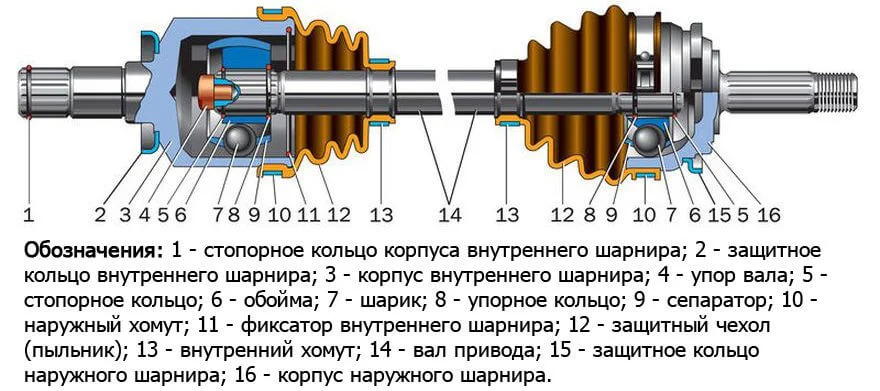
Inner and outer CV joint pair
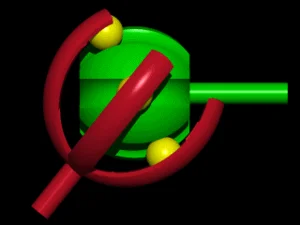
Outer CV joint operation
How to Identify a Faulty CV Joint
Primary diagnosis is straightforward: a characteristic crunching or clicking sound when turning points to the outer CV joint. Knocking or vibration when driving in a straight line (especially under load or over bumps) is a sign of a faulty inner joint.
Identifying Outer CV Joint Noise
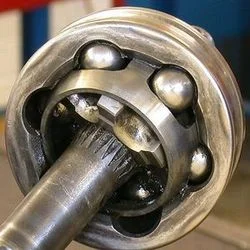
Outer CV joint construction
Find a flat area, such as an empty car park. Turn the steering wheel to full lock in one direction and move off sharply (but without wheelspin). The maximum angle of the joint under load will provoke a sound if the unit is worn.
Diagnostic rule:
- When turning left, the right outer CV joint is loaded and will click.
- When turning right, the left one is loaded.
This is because the car's weight shifts to the outer side of the turn, loading the corresponding wheel. However, the opposite can sometimes occur, so for accuracy, ask an assistant to listen for the sound from the outside near each wheel.
How an Inner CV Joint Sounds
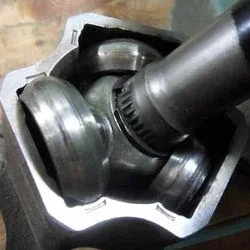
Inner CV joint construction
Diagnosing inner joints is more difficult. Symptoms include:
- Crunching or clunking when driving over deep potholes (when the suspension travels significantly up and down).
- Vibration and shuddering of the vehicle when accelerating at speeds of 80–100 km/h, which disappears if you release the accelerator pedal.
To test, you can heavily load the rear axle (carry passengers or heavy cargo) so that the front end lifts, changing the operating angle of the inner CV joints. If a crunching sound appears when driving in this position, the issue lies with the inner joint.
Universal Diagnostic Method

Diagnosing an inner CV joint fault
This method allows you to precisely localize the fault but requires strict adherence to safety precautions.
- Jack up one front wheel. Ensure the handbrake is applied and place chocks under the rear wheels.
- Start the engine, engage 1st gear, and gently release the clutch. The wheel will begin to rotate.
- Slowly apply the foot brake to create load. If a knocking sound is heard, the inner CV joint on this side is faulty. If it is quiet, the engine will simply start to stall.
- Turn the steering wheel left/right and apply the brake in the same way. The appearance of a clicking or crunching sound indicates a faulty outer CV joint.
- Repeat the procedure for the other side.
Why Does a CV Joint Start Clicking?
The joint is a reliable component capable of lasting for years. The main causes of failure are:
- Torn CV boot. The most common cause. Water and grit get inside, turning the grease into sandpaper. The unit will fail within a few hundred miles.
- Aggressive driving style. Sharp starts with wheels turned (drifting, U-turns with wheelspin) create critical stress on the cage and ball bearings.
- Natural wear or defect. Over time, wear patterns (grooves) appear at the contact points of the balls and the race. The balls rolling over these irregularities create the crunching sound.
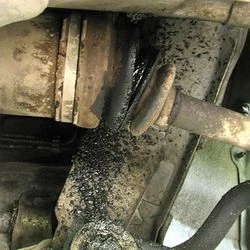
Torn CV boot and leaking grease
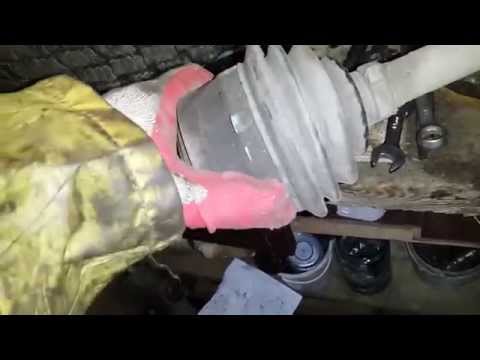
Detecting play in the CV joint
Consequences: Can You Still Drive?
Driving with a clicking CV joint is not recommended. The noise means the metal is already disintegrating. Consequences of ignoring this include:
- Wheel jamming. If the cage shatters at speed, the wheel may lock up. This is a direct risk of a serious accident.
- Driveshaft failure. The car will come to a halt because the differential will transmit rotation to the broken half-shaft. The only way forward is on a recovery truck.
Repair or Replacement?
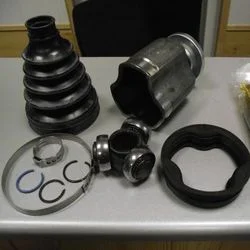
New inner CV joint
Many drivers wonder if the clicking can be 'cured' by changing the grease. The answer is: no.
If you hear clicking, it means there is already mechanical wear — pitting or spalling — on the working surfaces (balls, races). No amount of new grease, even with additives, will restore the metal. Grinding or polishing the surfaces is also dangerous and futile, as it removes the cemented (hardened) layer of metal.
What to do if you hear noise:
- If the boot is torn but there is no clicking yet: immediately remove the CV joint, thoroughly clean out the old grease and grit, pack with new grease, and install a new boot. This will save the part.
- If the clicking is already present: the only reliable solution is a complete replacement of the CV joint.
Conclusion
CV joints are durable components if you keep an eye on the boots. Clicking is a signal of irreversible destruction. Do not try to fix it with 'miracle additives' or grinding. Timely replacement of the joint is a matter of your safety on the road.
Was this article useful?
Your feedback helps us improve our content.
Related Materials
Discussion (0)
No comments yet!