Check Engine Light

The phrase «check engine» literally translates as a command to check the engine. The «check» icon is present on the dashboard of most modern cars, but its meaning remains unclear to many. Therefore, if this icon — a yellow or orange engine symbol — appears and does not disappear (or simply flashes), an inexperienced driver naturally asks: «what does this mean?». Below, we will try to find out the reasons why the check engine light has illuminated on your car's dashboard, as well as how to get rid of it.
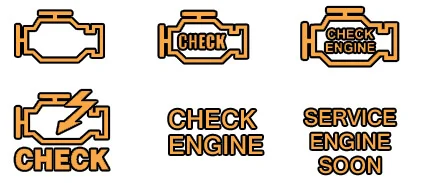
Originally, this light indicated problems with the carburettor, but now that cars are equipped with full-fledged on-board computers, the message can indicate various malfunctions. For example, a «check engine» error may report problems with the quality of the air-fuel mixture or ignition faults, as well as many other things. The messages can be caused by minor breakdowns or critical ones.
Thus, when the «check engine» light is on, it is only clear that the ECU (Electronic Control Unit) has detected a malfunction in one of the vehicle's systems. Only a diagnostic scan can give a complete picture. Next, we will analyse the main reasons why the «check engine» light glows, and what needs to be done about it.
Top 10 causes for the Check Engine light
- Fuel cap is open. Check if it is closed tightly.
- Poor quality petrol. The system may react to the quality of the fuel. The solution is to drain the petrol and fill up with higher quality fuel.
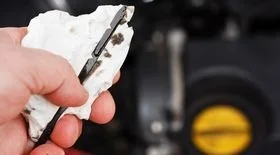
- Oil level. First, check the level with the dipstick. Also, look for cracks in the block and oil leaks.
- Problems with the fuel pump or the strainer in the tank. Check if the pump is running smoothly and not making strange noises.
- Clogged injectors. Remedied by cleaning the injectors.
- Faulty HT leads (high-tension leads) or coils.
- Problem with spark plugs. The icon also lights up when there are problems with the plugs. It is worth checking the performance of the spark plugs and replacing them if necessary.
- No spark in one of the cylinders (Misfire).
- Faulty Lambda sensor. The problem is eliminated only by replacing this unit with a new one or installing a spacer; cleaning helps occasionally.
- Catalytic converter failure. Also solved by replacing the catalytic converter.
Only the main causes and ways to solve them are listed here. In reality, there are many more. Diagnostics via the on-board computer, which monitors all vehicle systems, can give a more complete picture of the situation.
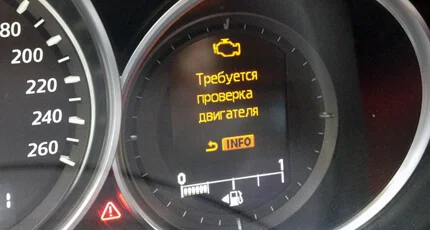
The Check Engine light is clearly visible on the Mazda CX-5 dashboard
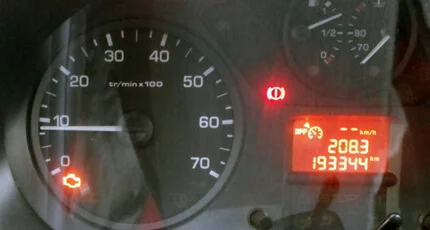
Check engine on the Peugeot Partner dashboard is tucked away in the left corner
How to reset the check engine light
Let's dwell in more detail on the steps that must be taken first in order to get rid of the illuminated Check Engine indicator. The algorithm of priority actions will be as follows:
- Check if the fuel cap is closed. This situation is particularly relevant if you have just left a petrol station, and shortly after that, the check engine icon lit up. This means that either the tightness of the fuel system has been compromised due to a loosely tightened tank cap, or the quality of the fuel leaves much to be desired.
- Check the condition of the spark plugs. To do this, unscrew them and visually assess their condition. Very often, spark plugs are the reason for the activation of the Check Engine indicator. In particular, the reason may be that they begin to leak current due to carbon deposits on the electrodes. Such a coating is formed as a result of a high content of metals or other conductive substances in the fuel. Also, an error can occur if the gap between the electrodes on the plug exceeds 1.3 mm.
- Oil level. If the check engine icon lights up only when the engine is hot, stop and listen; you may hear strange noises in the motor's operation. Check the engine oil level with the dipstick, and top up if necessary. Also, look for oil leaks.
- If your car is equipped with cleanliness sensors for technical fluids (engine oil, fuel, etc.), the indicator may light up if the corresponding indicators exceed the permissible norm. The solution is to replace the corresponding filters or completely change the fluids if they do not meet the standards.
- Disconnect the negative terminal from the battery (15...20 seconds). After that, the Check Engine light should go out, and the clock on the computer should reset. This method may be relevant in two cases. The first is a banal ECU «glitch». The second is if a large number of minor errors have accumulated in the memory of the electronic unit that were not cleared (usually caused by the use of low-quality petrol, the presence of harmful impurities in the air-fuel mixture, moisture on electrical contacts, etc.).
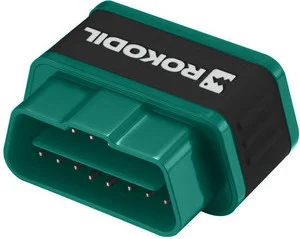
The Check Engine light is on — what should I do next?
You can try to find out the cause yourself by counting the number of flashes of the «check» light and checking the technical documentation for the designation of such an error code. Different cars have different intervals between flashes and different codes by which they are interpreted.
Most errors reported by the indicator are not critical. Diagnostics can be performed in two ways — independently or by visiting a garage. The fact is that to obtain information in this case, special equipment or at least software for a smartphone is required.
But first of all, you need to find out how the car's behaviour has changed after the error appeared. This is done to determine whether it is safe to drive with the check engine light glowing on the dashboard, or whether it is better not to do so in order not to aggravate the problem.
| Car behaviour | Icon is on continuously | Icon is flashing |
|---|---|---|
| Engine power and response to the accelerator pedal remain the same | You can continue driving | |
| No additional warning lights appeared on the instrument panel. | ||
| The motor has become less responsive, revs do not rise above a certain value (engine operating in limp mode) | You can continue driving | You must NOT continue driving |
The car has sharply changed its behaviour:
| You must NOT continue driving | |
Together with the check engine icon, another indicator lit up:
| ||

When is the Check Engine light on?
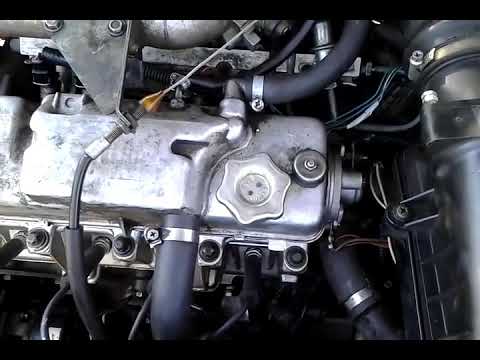
Finding out the reason why the check light is on
The error code can be read using a laptop with special software. The computer is connected to the car's ECU via a cable to perform diagnostics. Also, using a laptop, additional external commands can be entered into the control unit, or existing errors can be corrected (reset).
A simpler method is to download an app for ECU communication and analytics to your Android smartphone (for example, TORQUE, which has free and paid versions). A Bluetooth adapter (OBD2 scanner) is connected to the electronic unit, which allows information to be read from the device. If you do not have a laptop or simply do not want the hassle of installing additional software, you can delegate the described procedures to garage workers. They have all the necessary equipment and programs.
It must be remembered that every car (and sometimes even every ECU on identical cars but of different years of manufacture) has a different list of error definitions. Therefore, after receiving the information, you must have a standard set of Diagnostic Trouble Codes (DTC). You can find this in additional literature on diagnostics or on the internet (for example, on thematic forums dedicated to your car model).
Another common cause for injection engines is problems with the operation of the injectors. In particular, the appearance of a significant amount of sediment on them. The solution to this problem lies in cleaning the injectors. When problems appear with spark plugs, injectors, as well as an activated check engine indicator, the following symptoms may occur:
- weak engine traction;
- high fuel consumption;
- jerking when gaining speed or unstable engine operation;
- «fluctuating» engine speed at idle.
The next step is to check the pressure in the fuel system. To do this, you need to use a pressure gauge. The standard pressure for most non-tuned cars is 3 bar (atmospheres). However, check this information in your vehicle's technical manual. If the pressure is significantly lower, then the problem may lie in a faulty fuel pump or clogged injectors. If the pressure is constantly low — check the fuel pump. If it is normal at first but drops shortly after starting the engine — check the injectors. Also, pay attention to the strainer in the fuel tank.
It is also worth checking the insulation of high-tension leads. It is better to do this not visually, but using a tester switched to ohmmeter mode. The minimum value of the wire insulation must be at least 0.5 MΩ. Otherwise, the wire must be replaced.
How to drive to a garage with the Check Engine light on
When driving to the service centre, try to observe a gentle driving mode. In particular:
- do not exceed a speed of 60 km/h;
- do not exceed engine speeds of more than 2500 rpm;
- turn off the air conditioning (heater), multimedia system, and other equipment not needed at the moment that creates additional load on the engine;
- avoid sudden starts and braking, drive smoothly.
You can return to normal driving mode only after diagnostics and elimination of the identified errors.
Summary
Remember that when the illuminated Check Engine indicator appears, you should not panic. In most cases, the reasons for its activation are not critical. However, it is necessary to perform priority diagnostics consisting of the 5 steps listed above. Also, check if the car's behaviour on the road has changed and if other indicators have lit up additionally. If minor defects are identified, they need to be corrected. If the Check Engine light does not go out after this, conduct additional diagnostics using an electronic device. It will give you an error code indicating the cause of the breakdown.
Was this article useful?
Your feedback helps us improve our content.
Related Materials

Discussion (0)
No comments yet!