Engine Misfires When Cold

Drivers occasionally face a problem where the engine misfires on a cold start while idling. Specifically: after starting, the RPM drops, the exhaust is uneven, there is a smell of unburnt fuel, and the engine starts to 'stutter'. As the engine warms up, the car starts running smoothly, with no obvious signs of engine trouble.
What should you do, and where should you start looking for the problem? In this case, you should search for the reason why the car misfires when cold by following the instructions below.
7 Causes of Cold Engine Misfiring
- First, remove the spark plugs and check for carbon deposits. Any experienced mechanic knows that the condition of the plugs (the colour on the tip) can reveal a lot and help form a diagnosis.
- Also, check the compression in the cylinders, both 'dry' and with oil added to the cylinders (if it rises, the piston rings are worn; if not, it indicates misadjusted valves).
- Check the High Tension (HT) leads; if possible, swap them for a different set to see if the result changes.
- To be thorough, clean the throttle body and the IAC (Idle Air Control) valve; this procedure is never a waste of time.
- Often, the problem of the engine misfiring on a cold start is linked to a faulty Mass Air Flow (MAF) sensor, so this is also one of the first things to check.
- It is possible that a simple air leak (vacuum leak) between the cylinder head and the intake manifold is playing a key role in the misfire.
- Modern fuel-injected cars often suffer from poor quality fuel, so flushing the injectors and changing your petrol station would be relevant steps.
Why Diesel Engines Misfire When Cold
The problem of a diesel engine misfiring when cold is just as familiar as it is for petrol counterparts, but the circle of potential causes is somewhat narrower. In this case, engine misfiring is often accompanied by blue or white smoke from the exhaust.
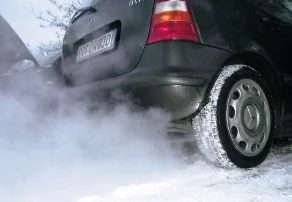
Firstly, it could be an air lock in the fuel system.
Secondly, a problem may have arisen with the glow plugs.
Thirdly, a cold injector could be sticking.
These are the three main and most common problems that can cause a diesel engine to misfire when cold. However, incorrect valve clearances and incorrectly set timing marks or injection pump timing cannot be ruled out.
Why LPG Cars Misfire
Quite often, a problem arises where a car running on LPG misfires when the engine is cold, but works normally when switched to petrol. There are only a few reasons for such a fault. The most frequently encountered are:
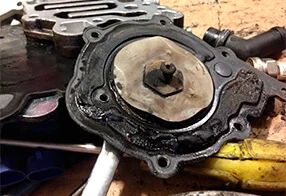
Damaged diaphragm in the reducer
- clogged gas filters;
- leaking or loose connections in the LPG system hoses;
- faults in the gas reducer — a damaged or dirty diaphragm, poor quality or worn seals;
- partially or fully inoperative gas injectors. As a rule, the main cause of their failure is contamination;
- incorrect LPG system tuning.
Identifying the Non-Working Cylinder
When a car misfires on a cold engine, identifying the non-working cylinder can help rectify the fault. The diagnostic method differs for various engine types.
On injection engines, the safe way to calculate the problematic cylinder is by disconnecting the power connectors from the fuel injectors one by one. If the engine operation does not change when a connector is disconnected, that cylinder is not working. If the engine starts running even worse (or stalls), the cylinder is working correctly.
On older carburettor cars with a mechanical distributor, the method of removing spark plug caps one by one is permissible. If the sound of the engine does not change when a lead is removed, the cylinder is not working.
On a diesel, the non-working cylinder is determined differently. The check must be performed on a cold engine! To do this, start the engine and then carefully feel the exhaust manifold pipes by hand one by one. On working cylinders, they will gradually heat up; on a non-working one, it will remain noticeably cooler.
Was this article useful?
Your feedback helps us improve our content.
Discussion (0)
No comments yet!