Humming Noise in the Car
A humming noise in the car while driving can arise for various reasons — a failed wheel bearing, wheel imbalance, gearbox issues, and others. It is important to distinguish the origin of these noises, as the underlying causes can be critical. For instance, if a wheel bearing fails (which is the most common cause of a humming noise while moving), driving the car is highly undesirable until the faulty unit is replaced. It is simply unsafe for the driver, passengers, and other road users.
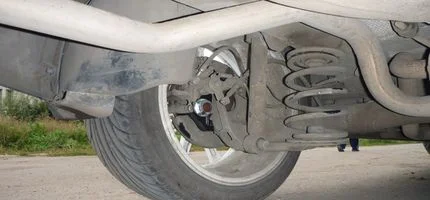
Causes of Natural Noises
Before discussing the possible reasons for a loud hum in the car at speed, we must define our terms. Depending on the level of sound insulation in different vehicles, the driver and passengers will always hear some sounds coming from outside the cabin. Therefore, noises can be loosely divided into three groups: natural, unnatural, and others. Natural and "other" noises are generally nothing to worry about, whereas sources of unnatural noises require further diagnosis as they signal malfunctions.
Causes of natural noises include:
- Strong headwind or crosswind when driving on the motorway. This is particularly relevant at high speeds and for smaller vehicles. To eliminate the hum in this case, simply reduce your speed slightly.
- Engine operation. Any internal combustion engine makes sound when running. However, if the engine suddenly starts running much louder than before, additional diagnostics are required.
- Driving on poor roads. specifically, driving on coarse tarmac (rough asphalt) always creates more noise than driving on a smooth surface.
- Open windows. Driving at high speed with windows open will also result in increased cabin noise.
None of the listed causes pose a threat to the car, driver, or passengers, so there is no need to worry. The causes of so-called "other" noises are also generally safe phenomena. Among them:
- Plastic squeaking in the interior. Often called a "rattle" or "squeak". This can be eliminated by various methods, one of which is using silicone spray.
- A roof rack. This applies to standard metal grid racks installed on the car roof (newer aerodynamic models do not suffer from this). It is noted that the hum starts to appear at speeds of 60 km/h (approx. 37 mph) and above. The situation is similar if the rack is loaded with cargo. In this case, the hum may be even louder.
Causes of Humming Noises in the Car
The causes listed above are not critical, and by and large, can be ignored. However, drivers are more often concerned about noises caused by the failure of a specific component in the vehicle. Let's break them down in order.
Wheel Bearing Failure
Statistically, this is the most common reason for a humming noise in the car under various conditions — moving, turning, or driving on different surfaces. Signs of a failing front wheel bearing may include:
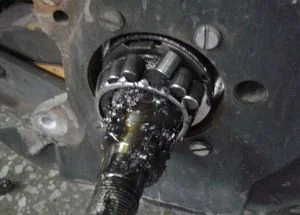
Broken wheel bearing
- The level of hum from the front or rear increases as the car accelerates;
- The hum intensifies when turning the steering wheel one way or the other, and decreases again when the wheels are straightened (the sharper the turn and the higher the speed, the higher the probability that it is indeed the wheel bearing, indicating its degree of wear);
- At high speeds (60 km/h / 40 mph and above), the noise becomes "like an aeroplane", i.e., very loud, increasing with speed;
- When picking up speed, vibration in the steering wheel appears alongside the hum (in neglected cases, vibration of the entire car, especially noticeable on smooth roads).
The reason the hum gets louder when turning is that the car's weight shifts by inertia onto one of the front wheel bearings, increasing the load on it (turning left loads the right bearing, turning right loads the left). Consequently, the noise from it intensifies.
Checking a wheel bearing is quite simple and can be done yourself without visiting a garage. You need to jack up the car under the wheel you suspect needs checking. First, put the car in neutral so the wheel spins freely (this is not necessary if checking front wheels on a rear-wheel-drive car). Also, apply the handbrake or use wheel chocks (do not apply the handbrake if you plan to check the rear wheel bearings).
Spin the suspended wheel by hand, trying to get it to a high speed so that the hum, if present, is clearly audible. Also, rock the wheel vertically (push top away and pull bottom towards you). If there is play and the wheel deviates from a strictly vertical position, the wheel bearing has failed.
You can also diagnose a bearing failure by vibration (if no clear hum is heard when spinning). Spin the wheel in question and hold onto the nearest suspension element with your hand. On the front axle, the spring cup on the strut or the protruding parts of the steering knuckle work best. For rear axle bearings, hold the shock absorber element, the trailing arm, or the nearest part of the beam. If you feel vibration on these elements while the wheel is spinning, the bearing is faulty.
Diagnosing bearings on four-wheel-drive (4WD) vehicles is more difficult. The car must be put on a lift. The procedure is similar, but in some cases, a mechanic's stethoscope is needed.
However, there are many cases where a "DIY diagnosis" fails to reveal faults in the wheel bearing. If you've checked it by hand but the hum still bothers you while driving, try checking it on the road. Choose a safe stretch of road (or a large lot) where you can accelerate and try entering turns sharply. If the hum increases during these manoeuvres, the issue is indeed the wheel bearing. In the worst case, you can always seek professional diagnostic help at a garage.
If a faulty bearing (or bearings) is identified, it must be replaced as soon as possible. Driving with a faulty wheel bearing is very dangerous, especially with significant wear. Furthermore, a damaged bearing can be difficult to remove. It may seize onto the steering knuckle or even the driveshaft due to heat generated while driving. This seizing is stronger the more worn the bearing is and the longer the car has been driven in that condition.
Loose Alternator or A/C Compressor Belt
A loose belt makes a sound like a squeal or whistle. It usually appears during acceleration and/or when the engine is idling. This situation is unpleasant but not critical. However, this sound differs from a low-pitched hum, so terms must be clearly defined.
Brake Pad Squeal
Brake pads may squeak or squeal when braking. However, this sound is distinct from a hum and is specifically a high-pitched squeal. The cause may be worn brake pads or a damaged/worn brake disc (or drum).
Inner CV Joint
The Constant Velocity (CV) joint can be outer or inner. Damage to the inner CV joint often causes a hum from under the car, as it is part of the transmission system transferring torque to the driven wheels. The sound is more like a crunching or clicking, which increases firstly when cornering (especially at high speed) and secondly at high speeds generally. This can make it sound like a hum. Causes for noise from the inner CV joint include:
- Lack of grease in the part or poor quality lubricant.
- Use of defective parts during manufacturing or damage to the CV boot (gaiter) during operation.
- Significant wear of the CV joint. This can be caused by simple ageing or aggressive driving, leading to excessive wear and reduced lifespan.
Most often, replacing the grease and the CV boot helps. Before doing so, old grease must be thoroughly removed and the joint inspected.
Power Steering Pump
This situation can occur if the power steering fluid has thickened significantly in cold weather (severe frost). For a short time after starting the engine (usually two to three minutes), a hum is heard from the power steering pump at idle. It is trying to pump the thick fluid through the system. This is actually dangerous, as the pump is working under high stress, significantly reducing its lifespan, and it may fail completely. Therefore, you should replace the power steering fluid with one that withstands lower temperatures, and check the pump to prevent failure.
Power Steering Hoses
This happens in some cases where the engine idles; at the slightest increase in RPM, the hum and vibration disappear. The issue may lie with the power steering hoses, for example, if they are routed incorrectly, transmitting vibration and hum. Incorrect installation can happen after repairs in the engine bay. You can diagnose this by turning the steering wheel left and right. If the sound changes, it makes sense to check the hose routing (they should not be kinked anywhere).
Owners of Mercedes-Benz cars may face a similar problem with the Active Body Control (ABC) suspension system found on some models. This also involves many hoses and pipes. If they are routed incorrectly and under mechanical tension, a hum may arise. This can be diagnosed by driving slowly over uneven roads or rocking the car while parked. The character and intensity of the hum will change.
Water Pump Bearing
Like any other bearing, this element wears out over time and can emit a hum from the engine bay at a certain stage. If it partially fails, the water pump will not function properly, leading to increased engine temperature (and coolant temperature) with all the ensuing consequences. This situation must not be allowed; the fault must be diagnosed and the bearing or the entire pump replaced as soon as possible.
Alternator Bearing
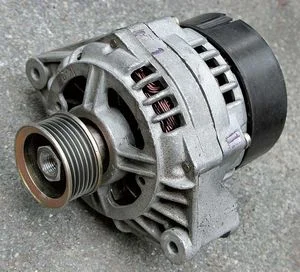
Significant wear of the alternator bearing will also cause a hum from the engine bay, which will only get louder over time. Bearing wear is dangerous because the alternator cannot work normally, meaning the correct voltage will not be maintained in the car's electrical system.
This can lead to engine management failures, electronics glitches in the cabin, and battery undercharging. Consequently, the alternator bearing must be replaced immediately upon failure.
Input Shaft Bearing
If a hum appears from under the car, the cause could be the input shaft bearing located in the gearbox. It also wears out over time. Diagnosing this is quite simple. Just shift into neutral while moving. If the troubling sound disappears, the bearing is faulty and needs replacement. It is noted that the hum will be louder the higher the vehicle speed (during acceleration). Replacing the bearing should only be done at a garage, as DIY replacement is unlikely due to the complexity of removing and disassembling the gearbox. Special tools and equipment are often required.
Clutch Release Bearing
If the hum appears the moment you press the clutch pedal, the release bearing has likely failed. Accordingly, the clutch must be dismantled, the bearing inspected, and replaced if necessary. Often, the entire clutch kit is replaced at this time (unless the bearing itself was defective).
In reality, many bearings in a car can be sources of humming. Here are the main ones prone to this:
- Propshaft support bearing (Centre bearing);
- Transfer box bearing;
- Drive axle bearing;
- Intermediate shaft bearing;
- Gearbox bearings.
Determining exactly which bearing is making the unpleasant sound is quite difficult. Therefore, if you cannot establish the cause yourself, it is recommended to perform additional diagnostics at a garage.
Low Gearbox Oil Level
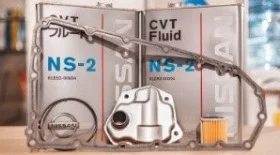
If the oil level in the gearbox is low (whether manual or automatic), there is a chance the unit will make noise while driving. The higher the speed and/or load on the gearbox, the louder the noise. The hum is usually heard from under the floor. This is a serious problem, as running a gearbox "dry" drastically reduces its lifespan. Accordingly, check the gearbox fluid level and top it up or perform a full change if necessary.
Rear Differential
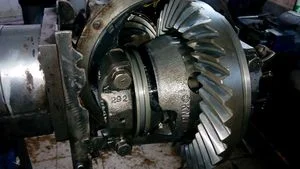
In rear-wheel-drive or four-wheel-drive vehicles, the rear differential can wear out over time. This creates a hum from the rear of the car. The hum increases as the car picks up speed (shaft RPM increases). There are two possible reasons. First, the lubricant in the differential has evaporated or degraded. It needs to be replaced with new oil containing additives, after inspecting the unit. The second reason is partial failure of the differential itself. In this case, it needs repair or replacement. Similar logic applies to a front differential.
Propshaft Universal Joint Wear
The hum will be heard from the rear of the car while driving. The higher the speed and/or load on the rear axle, the louder the sound. To check, you need a inspection pit or a lift to ensure proper access. Grab the propshaft with one hand and hold the drive pinion flange of the differential with the other. Then slowly, while holding the flange, try to twist the propshaft and flange in opposite directions. If you cannot do this, there is no wear; if you can, there is wear. You can try to prevent the hum by applying specific grease to the universal joint (UJ).
Loose Engine Mounts
If these components are worn or their fixings have loosened, vibration and noise often occur. This increases on rougher roads and at higher speeds. This fault is not critical; simply tightening the mountings is often enough. In severe cases, the faulty mount(s) must be replaced.
Gearbox Mount Rubber
Another specific case is when the rubber on one of the gearbox mounts deliminates. A hum from under the car is felt at speeds of around 60 km/h (37 mph) and above. To diagnose this, inspect the underside of the car using a pit or lift. The problem is solved simply by replacing the relevant mount.
Faulty Hydraulic Pulsation Dampers
Some cars (e.g., certain Mercedes-Benz models) are fitted with hydraulic pulsation dampers. They work in active suspension systems and other systems using hydraulic drive (fluids, oil). When they fail, hum and vibration may be observed in the operation of these systems. Depending on where they are installed, additional diagnostics are required. Typically, pulsation dampers are not repaired but replaced entirely.
Using Winter Tyres in Summer
Winter tyres usually have a deeper tread, and some are even studded. Driving with such tyres on warm tarmac is accompanied by extra noise. Not only does a hum arise, but other negative factors occur: studs and tread are damaged and wear out heavily. In rare cases, steering wheel vibration may occur. Solving this is simple — replace the tyres with summer ones according to the season. However, do not change them in winter just for a short warm spell; do it in spring when constant warm weather sets in! Don't forget to balance the wheels after changing tyres.
Incorrect Wheel Balancing
Unbalanced wheels cause car vibration while moving. The higher the speed, the greater the vibration amplitude. This causes discomfort for the driver and passengers and creates a hum. The more unbalanced the wheels, the greater the vibration and hum. Therefore, simply have the wheels balanced at a tyre shop to eliminate this.
Incorrect Tyre Installation
On forums, you can sometimes find descriptions of situations where noise while driving and braking arises even with over-inflated tyres or tyres installed rotating in the opposite direction to that intended (most modern tyres have a directional arrow indicating rotation).
Accordingly, to fix this, simply inflate the tyre to the correct pressure and check if the tyre is mounted correctly on the wheel.
Exhaust Pipe
Another rare case is when a hum appears under the car in a specific engine RPM range. Check the exhaust pipe fixings. It may be resting closely against other car elements. This is explained by physical resonance. When the vibration frequencies of the engine and pipe match, the pipe oscillates significantly and may hit other parts of the car. This is perceived as a rattle or hum.
Conclusion
Remember that there are natural noises which are not signs of any breakdown, and there is humming that signals a need for repair. In any case, if a noise appears in the cabin (especially a loud one), diagnose the components listed above. The sooner this is done, the safer your driving will be, and you can avoid expensive repairs.
Was this article useful?
Your feedback helps us improve our content.



Discussion (0)
No comments yet!