Coolant Compatibility
Coolant compatibility ensures the safe mixing of different cooling fluids (antifreeze). Specifically, this concerns various classes, colours, and specifications. However, topping up or mixing different coolants must be done in strict accordance with the coolant compatibility table. If you ignore this information, at best, the resulting mixture will not meet standards and will fail to protect the engine cooling system from overheating. At worst, it leads to corrosion of system components, a reduction in engine oil life by 10–20%, increased fuel consumption by up to 5%, the risk of water pump failure, and other unpleasant consequences.
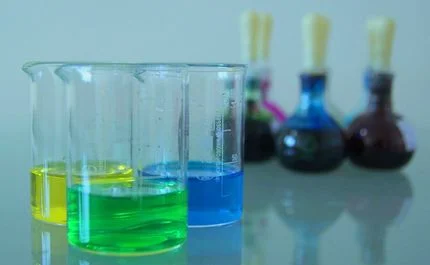
Varieties of Antifreeze and Their Features
To understand whether you can mix antifreeze, strictly speaking, you need to understand the physical and chemical processes that accompany the mixing of these fluids. All coolants are divided into ethylene glycol and propylene glycol based. In turn, ethylene glycol coolants are also divided into subtypes.
One of the most common specifications used to distinguish coolants across Europe is the document issued by Volkswagen, code TL 774. According to this, coolants used in VAG vehicles are divided into types — C, F, G, H, and J. This coding is often seen in shops as G11, G12, G12+, G12++, and G13. This is how many car owners choose antifreeze for their vehicles, although it is worth remembering that this classification is not a mandatory international standard and officially applies only to the VAG group cars.
Different countries have their own standards. In the USA, it is ASTM D 3306, ASTM D 4340, ASTM D 4985 (ethylene glycol-based) and SAE J1034 (propylene glycol-based), which are often considered international. For the UK, it is BS 6580:2010 (often comparable to the mentioned G11 from VW), for Japan — JIS K 2234, for France — AFNOR NF R 15-601, for Germany — FVV Heft R 443, for Italy — CUNA, and for Australia — ONORM.
So, ethylene glycol coolants are divided into several subtypes. Specifically:
- Traditional (with inorganic corrosion inhibitors). According to the Volkswagen specification, these are designated as G11. Their international designation is IAT (Inorganic Acid Technology). They are used on cars with older engine types (mainly those with parts made largely of copper or brass). Their service life is 2–3 years (rarely longer). These types of coolants are usually green or blue. However, the colour does not have a direct bearing on the properties of the antifreeze. Consequently, the shade is only a partial guide and should not be taken as the absolute truth.
- Carboxylate (with organic inhibitors). In the Volkswagen specification, they are designated VW TL 774-D (G12, G12+). As a rule, they are dyed bright red, rarely lilac-violet (VW TL 774-F / G12+ specification, used by the firm since 2003). The international designation is OAT (Organic Acid Technology). The service life of such coolants is 3–5 years. A feature of carboxylate coolants is that they are used in modern cars designed specifically for this type of fluid. If you plan to switch to carboxylate antifreeze from an older type (G11), you must flush the cooling system first with water, and then with a concentrate of the new antifreeze. Seals and hoses in the system should also be checked or replaced.
- Hybrid. Their name comes from the fact that these coolants contain both salts of carboxylic acids and inorganic salts — usually silicates, nitrites, or phosphates. Regarding colour, various options are possible here, from yellow or orange to blue and green. The international designation is HOAT (Hybrid Organic Acid Technology) or simply Hybrid. Although hybrids are sometimes considered inferior to carboxylate fluids, many manufacturers use exactly these coolants (for example, BMW and Chrysler). Specifically, the BMW specification N 600 69.0 largely coincides with G11. BMW also uses the GS 94000 specification. For Opel — Opel-GM 6277M.
- Lobrid (international designation — Lobrid, Low hybrid, or SOAT — Silicon enhanced Organic Acid Technology). They contain organic corrosion inhibitors combined with silicon compounds. They are the most modern and possess the best performance characteristics. Furthermore, the lifespan of such coolants is up to 10 years (which often means the entire service life of the car). They meet specifications VW TL 774-G (G12++) and TL 774-J (G13). As for colour, original VAG fluids of these classes are usually violet or lilac.
However, the most modern and advanced coolants today are those based on propylene glycol (G13). This alcohol is safer for the environment and humans.
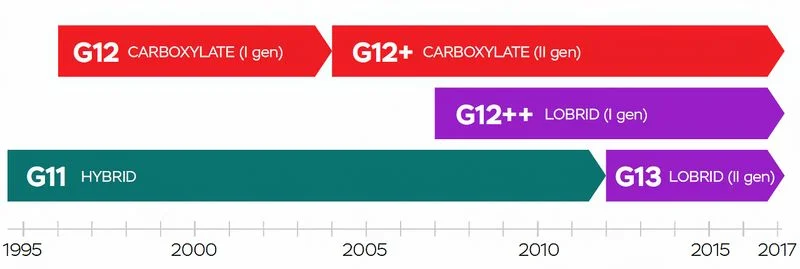
Validity years of various coolant standards
Compatibility Between Coolants
Having sorted out existing specifications and their features, we can move to the question of which coolants can be mixed, and why some of the listed types strictly cannot be combined. The most basic rule to remember is: it is permissible to top up (mix) coolants belonging not only to the same class but also produced by the same manufacturer (brand). This is because, despite the similarity of chemical elements, different factories use different technologies, processes, and additives. Therefore, mixing them may trigger chemical reactions that neutralise the protective properties of the resulting mixture.
| Antifreeze for topping up | Antifreeze in the cooling system | ||||
| G11 | G12 | G12+ | G12++ | G13 | |
| G11 |  |  | | | |
| G12 | | | | | |
| G12+ | | | | | |
| G12++ | | | | | |
| G13 | | | | | |
Note that some classes of antifreeze are fundamentally incompatible with each other! For example, you cannot mix G11 and G12 fluids. At the same time, mixing G11 with G12+ is permitted, as is G12++ with G13. It should be added that topping up with coolants of different classes is only permissible for short-term operation of the mixture. That is, in cases where the correct replacement fluid is not available. A universal tip is to top up with G12+ type antifreeze or distilled water. But at the first opportunity, you should flush the cooling system and fill it with the coolant recommended by the manufacturer.
Many people also ask about the compatibility of traditional IAT coolants (often old-school blue fluids) and modern antifreeze. The answer is straightforward — you MUST NOT mix these traditional inorganic fluids with modern carboxylate fluids (G12). Important: traditional blue coolants (sometimes referred to as generic IAT) are designed for copper and brass radiators. Their composition (inorganic additives) is incompatible with the organic additives of carboxylate antifreezes and can be harmful to modern aluminium radiators.
Do not forget that it is not recommended to drive for a long time on any mixture, even one that does not immediately harm the engine cooling system. This is because the mixture does not perform the protective functions assigned to the antifreeze. Therefore, over time, the system and its individual elements may become covered with rust or gradually wear out prematurely. Consequently, at the earliest opportunity, replace the coolant, having first flushed the cooling system with appropriate agents.
Continuing the topic of flushing the cooling system, it is worth briefly mentioning the use of concentrate. Some automotive manufacturers recommend performing a multi-stage cleaning using concentrated antifreeze. For example, after flushing the system with cleaning agents, MAN recommends performing a clean with a 60% concentrate solution at the first stage, and a 10% solution at the second. After that, fill the cooling system with the working 50% coolant mixture.
Technically, it is more correct to use and mix coolants that meet the manufacturer's approvals for your car (rather than just those adopted by Volkswagen which have become practically a standard). The difficulty here lies, firstly, in finding these specific requirements. And secondly, not all antifreeze packaging indicates that it supports a specific specification, although it might. But whenever possible, be guided specifically by the rules and requirements set by your vehicle manufacturer.
Coolant Compatibility by Colour
Before answering the question of whether you can mix antifreeze of different colours, we need to return to the definitions of coolant classes. Recall that there are no strict rules regarding what colour a particular fluid must be. Moreover, individual manufacturers have their own differentiation in this regard. However, historically, most G11 class antifreezes are green (or blue), G12, G12+, and G12++ classes are red (pink), and G13 is violet (lilac).
Therefore, further actions should consist of two stages. First, you must ensure that the antifreeze colour corresponds to the class described above. Otherwise, refer to the information in the previous section. If the colours correspond, the reasoning is similar. That is, you cannot mix green (G11) with red (G12). As for other combinations, mixing is often possible (observing the rules in the table above). However, there is a nuance: G12+ and G12++ coolants also have a red (pink) colour, but they can generally be mixed with both G11 and G13.
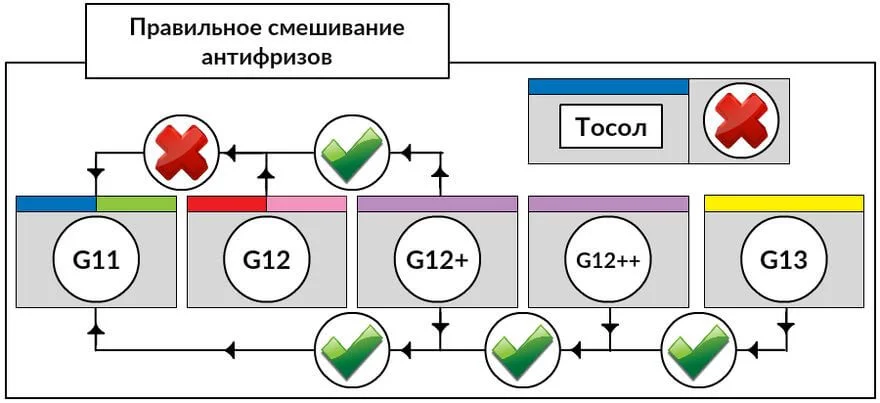
Coolant compatibility
A separate mention regarding traditional inorganic coolants. In their classic form, they can be blue or red (for specific industrial or heavy-duty uses). Naturally, in this case, mixing fluids is not allowed, even if the colour matches a modern equivalent.
Try to mix antifreezes that not only belong to the same class but are also released under the same brand name. This additionally ensures the absence of dangerous chemical reactions. Also, before directly topping up the cooling system of your car, you can perform a test and check these two fluids for compatibility.
How to Check Antifreeze Compatibility
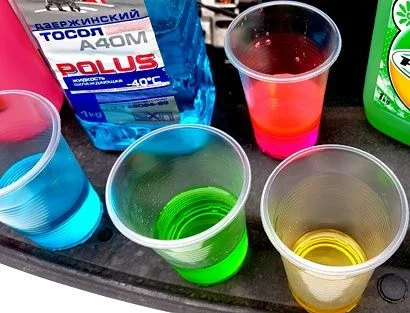
Checking the compatibility of different types of antifreeze is quite simple, even in home garage conditions. The method described below will not give a 100% guarantee, but visually you can still assess how well one coolant will work in a mixture with another.
Specifically, the verification method involves taking a sample of the fluid currently in the car's cooling system and mixing it with the one you plan to add. You can take a sample using a syringe or use the drain plug.
Once you have a container with the fluid being checked, add approximately the same amount of the antifreeze you plan to add to the system, and wait a few minutes (about 5–10 minutes). If no violent chemical reaction occurs during mixing, no foam appears on the surface, and no sediment falls to the bottom, then most likely the coolants do not conflict with each other. Otherwise (if at least one of the listed conditions appears), you should abandon the idea of using that antifreeze for topping up. For a more reliable compatibility test, you can heat the mixture to 80–90 degrees Celsius.
General Recommendations for Topping Up Coolant
Finally, here are several general facts regarding topping up that will be useful for any car enthusiast.
- If the car uses a copper or brass radiator with cast iron engine blocks, simple traditional antifreeze (usually green or blue, e.g., G11 type) must be poured into its cooling system. Excellent examples of such cars are older classic vehicles.
- In cases where the radiator and other elements of the engine cooling system are made of aluminium and its alloys (which most modern cars are), more advanced coolants belonging to classes G12 or G12+ must be used. Usually, they are pink or orange in colour. For the newest cars, especially sports and luxury models, lobrid antifreezes of types G12++ or G13 can be used (verify this information in the technical documentation or manual).
- If you do not know which coolant is currently filled in the system, and its level has dropped significantly, you can top up with either up to 200 ml of distilled water or G12+ brand antifreeze. Fluids of this type are compatible with all the coolants listed above.
- Generally speaking, for short-term operation, you can mix almost any antifreeze, except for traditional inorganic types with carboxylate coolant (G12), and you cannot mix G11 and G12. Their compositions differ, so chemical reactions arising from mixing can not only neutralise the protective actions of the coolants but also destroy rubber seals and/or hoses in the system. And remember that driving for a long time with a mixture of different antifreezes is not allowed! At the first opportunity, flush the cooling system and fill with the antifreeze recommended by your vehicle manufacturer.
- The ideal option for topping up is using fluid from the same bottle. That is, you buy a container with a large capacity, but pour only part of it into the system (as much as the system needs). Keep the rest of the fluid in the garage or carry it in the boot. This way, you will never go wrong with the choice of antifreeze for topping up. However, when the container runs out, it is recommended to flush the engine cooling system before using a new antifreeze.
Observing these simple rules will allow you to keep the engine cooling system in working order for a long time. Furthermore, remember that if the antifreeze does not perform its functions, it is fraught with increased fuel consumption, reduced engine oil life, and the risk of corrosion on the internal surfaces of cooling system parts, up to their destruction.
Was this article useful?
Your feedback helps us improve our content.
Related Materials

Discussion (0)
No comments yet!