Kia Sportage 4 Coolant Replacement
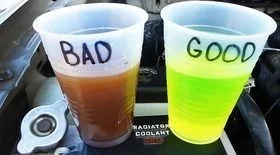
Coolant replacement on the Sportage 4 with all engine types is carried out according to the schedule during the 8th service, once every 120,000 kilometres or eight years of vehicle operation. The instructions below demonstrate the coolant change on a Kia Sportage 4 2.0 MPI, but the procedure is similar for other engines.
Which Coolant to Use in Kia Sportage 4
Regardless of the engine, the Sportage QL cooling system requires original coolant with part number 0710000400 (Crown LLC A-110). It is worth noting that if your vehicle was assembled in Russia, the factory initial fill uses coolant with part number R9000AC001K (Coolstream A-110), which can also be used.
Among the alternatives, consider the following coolants:
- Ravenol HJC (part number 4014835755819);
- Miles AFGR001;
- Coolstream A-110 (part number CS010501).
How Much Coolant is Needed for the Sportage 4
The table below presents data on the coolant volume in the cooling system for engines installed on the fourth-generation Sportage.
| Engine | Fluid volume, litres | |
|---|---|---|
| with AT | with MT | |
| 1.6 GDI | 7.3 | 7.5 |
| 1.6 T-GDI | 7.3 | |
| 2.0 MPI | 6.9 | 7.1 |
| 2.4 GDI | 7.1 | |
| 1.7 TCI | 7.5 | |
| 2.0 TCI | 8.5 | 8.7 |
DIY Kia Sportage 4 Coolant Replacement
The replacement procedure does not require special equipment; a standard set of tools and a container for draining are sufficient.
- Place the vehicle on a level surface (using an inspection pit or a ramp is advisable).
- Remove the plastic sump guard (if installed) to access the bottom of the radiator.
- Unscrew the radiator filler cap (only when the engine has cooled down).
- Place a container under the radiator drain plug (located at the bottom of the radiator tank).
- Carefully unscrew the drain plug and wait for the fluid to drain completely.
- Screw the drain plug back in.
- Using a syringe with a tube or a suction bulb, pump out the old coolant from the expansion tank. If there is sediment inside, it is recommended to remove and wash the tank with water.
- Slowly pour new coolant into the radiator filler neck up to the very top.
- Pour fluid into the expansion tank up to the 'F' (Full) mark.
- Start the engine and warm it up to operating temperature (until the cooling fan turns on), periodically checking the level in the radiator and topping up as air escapes.
- Close the radiator cap.
Was this guide useful?
Your feedback helps us improve our content.
Discussion (0)
No comments yet!