Cooling fan runs constantly
A situation where the cooling fan runs constantly can be caused by several factors: a faulty coolant temperature sensor (CTS) or its wiring, a failed fan activation relay, damaged motor wiring, malfunctions in the electronic control unit (ECU), and a few others.
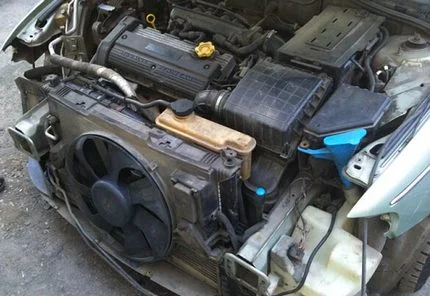
To understand how the cooling fan should operate correctly, it is necessary to know the temperature programmed into the control unit for its activation. Alternatively, check the specifications on the fan switch located in the radiator. Usually, this falls within the range of +87…+95 °C.
In this article, we will examine all the main reasons why the engine radiator fan operates not only when the coolant temperature reaches 100 degrees, but continuously, or even when the ignition is switched off.
| Reason for fan activation | Conditions for activation |
|---|---|
| Faulty CTS or damaged wiring | Engine running in 'limp home' (emergency) mode |
| Short circuit to earth (ground) | Engine running; fan may cut out if contact is intermittent |
| Short to earth with two CTSs installed | Engine running (first sensor) or ignition on (second sensor) |
| Faulty fan activation relay | Engine running in emergency mode |
| ECU malfunctions | Various modes, depends on the specific ECU |
| Impaired radiator heat dissipation (dirt) | Engine running, during long journeys |
| Faulty refrigerant pressure sensor | With air conditioning switched on |
| Low cooling system efficiency | Engine running |
Why the cooling fan runs constantly
If the engine fan runs constantly, there are usually 7 likely reasons.
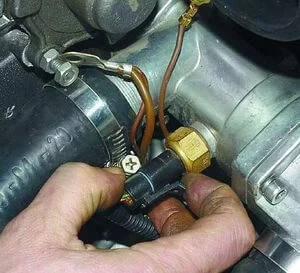
Coolant Temperature Sensor
- Failure of the coolant temperature sensor (CTS) or its wiring. If incorrect data flows from the sensor to the ECU (signal too high/low, no signal, short circuit), the ECU registers errors. Consequently, the control unit puts the engine into emergency mode, where the fan spins at full speed constantly to prevent engine overheating. You can identify this fault by difficult engine starting when it is still cold.
- Short circuit to earth. Often, the fan runs constantly if the negative wire chafes against the chassis. Depending on the engine design, this can happen in various locations. If the engine design includes two CTSs, a break in the 'negative' of the first sensor will cause the fan to spin when the ignition is on. In the event of insulation damage to the second CTS wires, the fan runs constantly while the engine is running.
- Faulty fan activation relay. In most vehicles, the fan power supply consists of a 'positive' from the relay and a 'negative' control from the ECU based on the CTS temperature. The 'positive' is supplied constantly, while the 'negative' is triggered when the coolant reaches working temperature.
- ECU malfunctions. Incorrect ECU operation can be caused by software glitches (e.g., after remapping) or moisture ingress inside the casing. This moisture could simply be coolant that has leaked into the ECU (a known issue for the Chevrolet Cruze, where coolant enters the ECU via a ruptured throttle body heater pipe located near the unit).
- Dirty radiator. This applies to both the main radiator and the air conditioning condenser. Often, the fan runs constantly when the AC is on.
- AC refrigerant pressure sensor. If this fails or if there is a refrigerant leak, the system 'sees' that the radiator is overheating and attempts to cool it down by keeping the fan on. Some motorists find the cooling fan runs constantly when the AC is switched on. This should not happen continuously, as it indicates either a clogged (dirty) radiator or issues with the pressure sensor (or a refrigerant leak).
- Low cooling system efficiency. Faults can be related to low coolant levels, leaks, a faulty thermostat, water pump failure, or depressurisation of the radiator cap or expansion tank. With such problems, the fan may not run constantly but for extended periods or cycle frequently.
What to do if the cooling fan runs constantly
When the engine cooling fan runs constantly, you should look for the fault by performing a few simple diagnostic steps. Checks should be carried out sequentially, starting with the most probable causes.
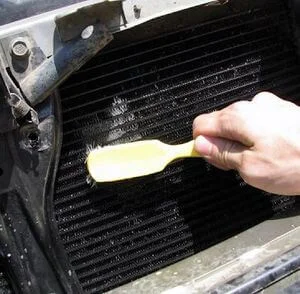
Cleaning the radiator
- Check for errors in the ECU memory. For example, error code P2185 indicates that the 'earth' is missing on the CTS, and a range of others (from P0115 to P0119) relate to other faults in its electrical circuit.
- Check wiring integrity. Depending on the engine design, individual wires related to the fan drive can get damaged (usually insulation chafing), causing a short circuit. Therefore, you simply need to find the spot where the wire is damaged. This can be done visually or using a multimeter. Alternatively, you can back-probe the connector contacts. If the wires are intact, the ECU might simply report an engine overheating error.
- Check the CTS. If the wiring and sensor power supply are fine, it is worth checking the coolant temperature sensor itself. Along with the sensor, check the contacts on its connector and verify the locking mechanism is secure (ensure the tab/clip is not broken). If necessary, clean oxidation from the contacts.
- Check relay and fuse. Verify if power reaches the fan from the relay using a multimeter (terminal numbers can be found in the wiring diagram). There are cases where the relay contacts 'stick' (weld together); in this case, it must be replaced. If there is no power, check the fuse.
- Cleaning radiators and the cooling system. If the main radiator or the AC condenser is covered in debris, they must be cleaned. Engine radiator blockages can also form internally, requiring the entire cooling system to be flushed with special agents, or the radiator to be removed and washed separately.
- Check cooling system operation. The fan may run constantly due to poor efficiency of the cooling system and its individual components. Therefore, it is advisable to check the system and, if faults are found, repair or replace the affected parts.
- Check refrigerant level and pressure sensor operation. For these procedures and to fix the root cause, it is best to visit a service centre.
- Check the ECU. This is a last resort when all other components have been checked. Generally, the control unit needs to be removed and the casing opened. Then, check the condition of the internal circuit board and its components; if necessary, clean off any coolant or debris with alcohol.
Conclusion
Most often, the radiator cooling fan spins constantly due to a short circuit in the activation relay or its wiring. Other problems are less frequent. Accordingly, diagnostics should begin with checking the relay, wiring, and checking for error codes in the ECU memory.
Was this article useful?
Your feedback helps us improve our content.

Mikhail Samsonov
I’ve been working in automotive repair since 1996. My experience includes suspension and chassis work, engine and component replacement, and in-depth repair of automotive air conditioning systems. I’m skilled in TIG (argon) welding, MIG welding, and Dimet metal restoration. I previously owned and operated my own auto repair shop.
Related Materials



Discussion (0)
No comments yet!