Water Pump Malfunctions
Water pump malfunctions manifest as significant play in the shaft, seal leakage, or wear (corrosion or breakage) of the impeller. All these defects prevent the car's water pump from operating correctly, failing to maintain the necessary pressure in the cooling system. This, in turn, leads to an increase in coolant temperature, potentially causing it to boil. Usually, the old pump must be replaced with a new one.
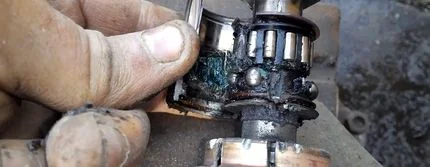
Signs of Water Pump Failure
There are six main signs of a 'dying' pump indicating that the unit has partially (or even completely) failed and requires replacement. These symptoms include:
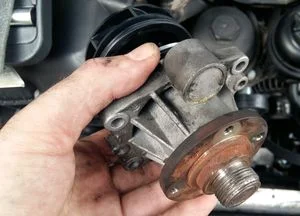
- Strange noises. A partially faulty cooling system water pump often makes unhealthy whining or screeching sounds during operation. These can be caused by significant bearing wear and/or the pump impeller touching the housing as it rotates. This also occurs due to partial bearing failure.
- Pulley play. This arises due to damage or natural wear of the rotation bearing. Diagnosis in this case is quite simple: just wiggle the pump shaft from side to side with your fingers. If there is play, it will be clearly felt. Note that the development of play brings closer the moment when the pump seal will fail and start leaking coolant.
- Leaks. Antifreeze may leak from the seal as well as from other places, such as the housing or impeller. Coolant in this case can be seen on the pump housing, its mounting point, some elements of the engine bay under the pump (depending on the specific car's design), or simply on the ground under the vehicle.
- Smell of coolant. Specifically, this can be smelt not only in the engine bay (when opening the bonnet) but also inside the cabin, as fumes can enter through the ventilation system. Coolant has a sweetish smell, sometimes with a hint of alcohol.
- Mounting misalignment. Particularly in relation to the timing drive gears and tensioner pulleys. This can be seen visually, or by placing a flat object (like a ruler) in the same plane as the pulleys and the pump. In this case, it is common for the belt to wear unevenly or get 'chewed up'.
- Significant rise in engine temperature. Not only the engine but also the coolant temperature will rise, indicated by the warning light on the dashboard. In critical cases, the coolant will boil, and steam will come from the radiator. This situation is critical, and driving the car is prohibited!
If at least one of the listed signs of a car water pump malfunction appears, additional diagnostics of both the pump and the cooling system must be performed. When the first signs of a failing pump appear, you can still drive, but it is unknown for how long, and it is better not to tempt fate. In some cases, the car might last 500...1000 kilometres, while in others, it won't even manage a hundred. In any case, the cooling system should not be taken lightly, and diagnostics and repairs must be carried out on time and in full.
Depending on the brand and quality of the cooling system water pump, regulations typically prescribe its replacement after approximately 60,000 kilometres (this depends on each specific case and is prescribed by the vehicle manufacturer; relevant information can be found in the manual).
Causes of Water Pump Failure
What are the possible causes of water pump failure? This question interests not only beginners but also quite experienced motorists. Below are the main causes, from the most common to the more 'exotic'. They include:
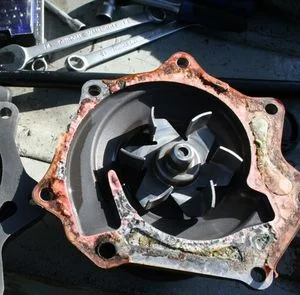
- Faulty bearing. This component wears out naturally over the course of its operation. However, accelerated wear is possible due to additional negative factors. One such factor, for example, is incorrect (excessive) belt tension, which places greater force on the bearing. Another reason for significant wear is coolant entering the friction pairs due to seal failure and leaks.
- Seal failure. The pump has two seals — an oil seal and a rubber cuff/gasket. It is the seal (gasket) that fails most often. This happens for two reasons: natural wear (hardening of the rubber) and the use of low-quality cheap antifreeze without appropriate protective additives, or even just water. In the long run, these fluids corrode the gasket, causing it to leak, which leads firstly to a drop in the coolant level in the system, and secondly to antifreeze or water entering the bearing, washing out the grease and causing the troubles described above.
- Mounting misalignment. This is possible for two reasons: incorrect installation and manufacturing defects. However, incorrect installation is quite rare, as the housing has pre-drilled mounting holes that are hard to miss. Another reason is uneven contact with the engine block (due to dirty, rusty, or warped mating surfaces). Unfortunately, manufacturing defects, especially in budget pumps, are not that rare. Misalignment causes the pulley to rotate at an angle, which in turn leads to accelerated wear of the loaded part of the belt, as well as bearing wear. In the most critical cases, the belt may snap, resulting in a collision between valves and pistons. Sometimes misalignment occurs as a result of a car accident where specific body and/or engine elements were shifted.
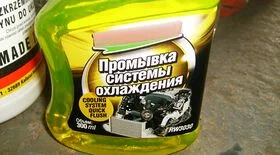
Often, a decrease in pump performance and, consequently, a drop in cooling system pressure is observed after using sealant to fix a radiator leak. Its composition mixes with the coolant and clogs the radiator core (channels), and also sticks to the pump impeller. If this happens, it is necessary to drain the antifreeze, remove the pump, and then flush the cooling system using special or improvised means.
How to Identify a Water Pump Fault
Checking the car engine water pump for faults is quite simple. The easiest method is to check by touch whether there is play in the pump shaft or not. To do this, simply grasp the pump shaft with your fingers and wiggle it from side to side perpendicular to the shaft itself. If the bearing is in order, there should be no play. If even a small amount of play is present, the pump needs changing.
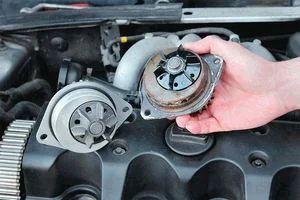
However, a more thorough check without removing the pump is performed using the following algorithm:
- Warm up the engine to operating temperature. That is, the coolant temperature should be around +90°C.
- With the engine running, squeeze the thick hose carrying coolant from the radiator by hand.
- If the pump is working, you should feel pressure in it. If there is no pressure or it is pulsating, this means the pump has partially or completely failed. Most likely, the impeller has sheared on the shaft.
Also, to check the pump, you need to visually inspect its mounting location. To do this, remove the timing belt cover to gain access directly to the pump (designs differ between cars, so there may not be a cover, or it may not need removing). Then carefully inspect the pump housing, its seal, and the mounting surface.
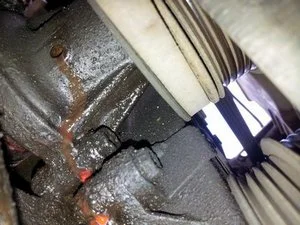
You must look for coolant leaks from under the gasket. Ideally, it shouldn't necessarily be wet at the moment of inspection. If the mounting surface and seal are dry, but there are dried (yet fresh) traces of leaks in the mounting area, this means the seal allows coolant to pass under high pressure. Leak traces are reddish or brownish in colour, or in some cases grey (depending on the colour of the coolant used in the system).
Before removing the pump for further diagnosis (checking the impeller and bearing), ensure that the cooling system thermostat is working properly and there is no air lock in the system. Otherwise, these issues must be rectified.
If the pump is removed, you must inspect the condition of the impeller. Specifically, the integrity of the blades, as well as their shape.
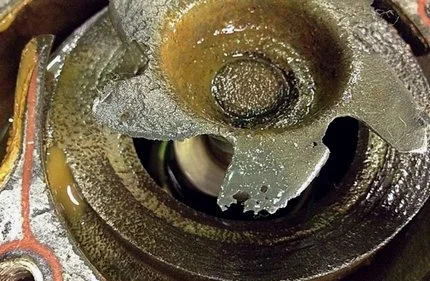
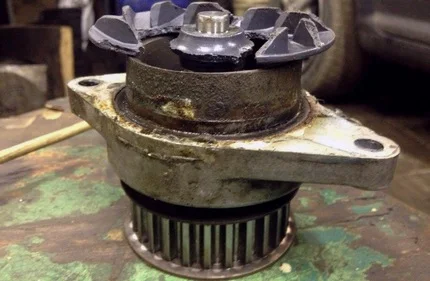
You also need to inspect the area where the pump mates with the engine block. Ideally, there should be no coolant leaks from the weep hole (drainage hole). However, if there are minor (strictly minor!!!) leaks, you might not need to change the pump immediately, but try to eliminate them temporarily by replacing the seal and using sealant.
To check if it is indeed the pump bearing making the noise and whistling, simply remove the belt from the pump pulley and spin it by hand, preferably as fast as possible.
If the bearing is faulty, it will make a humming noise and feel rough or uneven when rotating. However, this method is suitable for pumps driven by an auxiliary belt. If it is driven by the timing belt, you will need to loosen the tension to check its operation under such conditions.
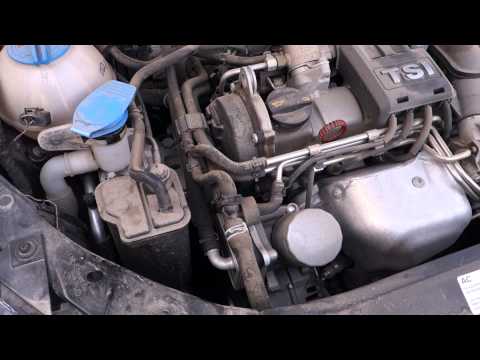
What a faulty water pump sounds like
Many car enthusiasts are interested in whether to repair an old pump or buy and install a new one. There is no single answer, as it depends on the pump's condition, wear, quality, brand, and price. However, practical experience shows that repair is usually only viable if replacing the rubber gasket. In other cases, it is better to replace the pump with a new one, especially if it has been in use for a long time. When replacing the pump, the coolant should also be changed.
Was this article useful?
Your feedback helps us improve our content.
Related Materials
Discussion (0)
No comments yet!