What to use to flush the engine cooling system?
The question of what to use to flush the engine cooling system is of interest to car owners facing issues with cleaning the cooling jacket. There are both home remedies (citric acid, whey, Coca-Cola, and others) and modern high-tech compounds. We will look at both options in more detail.
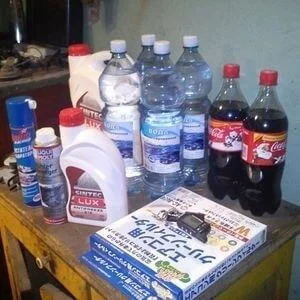
Agents for cleaning the cooling system from oil, rust, and deposits
How often to flush
Before we move on to the description of specific agents, it is worth reminding you how important it is to flush the car's cooling system regularly. Depending on the coolant used, rust, oil deposits, antifreeze decomposition products, and limescale accumulate on the walls of the tubes that make up the radiator. All this leads to impeded coolant circulation and reduced heat transfer. This inevitably affects engine performance negatively and increases the wear of individual parts, risking premature failure.
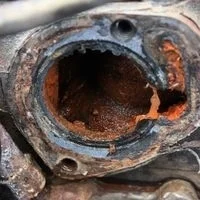
Dirty radiator
It is worth noting that system flushing can be internal or external (external cleaning involves washing the radiator from the outside to remove dirt, dust, and insects from its surface). It is recommended to perform an internal flush of the cooling system at least once a year. It is best to do this in spring when the frosts have passed and a hot summer lies ahead.
On some cars, the dashboard has a light with a radiator symbol; if it lights up, it may indicate not only a low antifreeze level but also that it is time to change it. This can serve as a signal that it is time to clean the cooling system. There are also several indirect signs indicating the need for such cleaning:
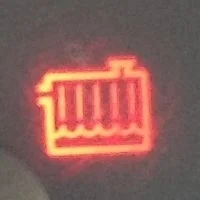
Radiator icon signalling malfunctions in the cooling system
- frequent engine overheating;
- problems with the water pump operation;
- slow response to rheostat signals (inertia);
- high temperature readings from the corresponding sensor;
- problems with the heater (heater matrix) operation;
- the fan is always running at high speeds.
If the engine heats up significantly, it is time to choose a product to flush the cooling system and find the time and opportunity to do so.
Home remedies for flushing the cooling system
As mentioned above, there are two types of flushing agents — home remedies and specialised products. Let's start with the former, as they are cheaper and time-tested.
Citric acid
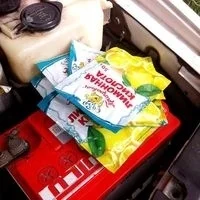
Using citric acid to clean the cooling system
Ordinary citric acid, diluted in water, can clean radiator tubes of rust and dirt. It is particularly effective if plain water has been used as a coolant, as acidic compositions are effective against rust, while alkaline ones are effective against limescale. However, remember that a citric acid solution cannot remove significant contamination.
The solution composition is as follows: dissolve 20-40 grams of the substance in 1 litre of water. If the contamination is severe, the amount of acid per litre can be increased to 80-100 grams (larger volumes are created in the same proportion). The ideal scenario is when, upon adding acid to distilled water, the pH level is around 3.
The cleaning procedure itself is simple. You need to drain all the old fluid and pour in the new solution. Then, warm up the engine to operating temperature and leave it for a few hours (or better yet, overnight). Next, drain the solution from the system and check its condition. If it is very dirty, the procedure needs to be repeated 1-2 more times until the liquid is sufficiently clear. After this, you must flush the system with water. Finally, pour in the agent you plan to use as a coolant.
Acetic acid (Vinegar)
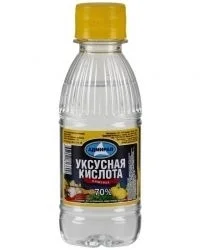
Using acetic acid to clean the cooling system
The action of this solution is similar to that described above. An acetic acid solution is excellent for flushing rust from the cooling system. The proportions are half a litre of vinegar per bucket of water (10 litres). The cleaning procedure is similar: drain the old fluid, pour in the new one, and warm the car up to operating temperatures. Then leave the car with the engine running for 30-40 minutes to allow chemical cleaning to take place in the radiator. Next, drain the cleaning fluid and check its condition. Repeat the procedure until the liquid becomes clear. Then flush the system with boiled or distilled water, after which you pour in the coolant you plan to use permanently.
Fanta

Using Fanta to clean the cooling system
Similar to the previous point. However, there is an important difference here. Unlike Coca-Cola, which uses phosphoric acid, Fanta uses citric acid, which has a milder cleaning effect. Therefore, some car owners pour it in instead of antifreeze to clean the cooling system.
As for the time you need to drive like this, it depends on the degree of system contamination. specifically, if it is not very dirty and the cleaning is done more for prevention, it is enough to let the engine run for 30-40 minutes at idle. If you want to wash out stubborn dirt well, you can drive like this for 1-2 days, then pour distillate into the system, drive some more, drain it, and check its condition. If the distillate is dirty, repeat the procedure until the system is clean. In the end, do not forget to flush it thoroughly with water and pour in new antifreeze.
Lactic acid or whey
An excellent option for flushing a car engine cooling system is lactic acid. However, a significant problem is that pure lactic acid is very difficult to obtain nowadays. But if you manage to get this substance, you can pour it into the radiator in its pure form and drive with it for a while (or let the car stand with the engine running).
A more accessible alternative to lactic acid is whey. It has similar properties for cleaning the radiator and other elements of the cooling system. The algorithm for using whey is as follows:
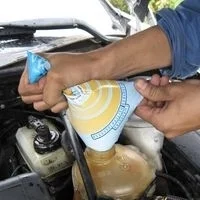
Using whey
- prepare about 10 litres of whey in advance (preferably homemade, not store-bought);
- strain the entire purchased volume 2-3 times through cheesecloth to filter out large pieces of fat;
- drain the existing coolant from the radiator and pour in the whey;
- drive for about 50-60 kilometres (30-40 miles);
- the whey must be drained while hot so that the dirt does not stick back to the tube walls (exercise caution while doing this!);
- let the engine cool down;
- pour pre-boiled water into the radiator;
- start the engine, let it warm up (about 15-20 minutes); drain the water;
- let the engine cool down;
- pour in the antifreeze you plan to use permanently;
- bleed the air from the system, topping up with more coolant if necessary.
Caustic soda
This substance is known by various names — sodium hydroxide, caustic soda, or lye.
According to the official instructions from copper radiator manufacturers, you should proceed as follows:
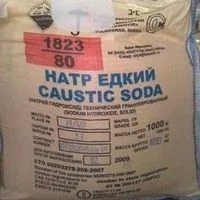
Caustic soda
- remove the radiator from the car;
- rinse its insides with plain water and blow it out with compressed air (not exceeding a pressure of 1 kgf/cm2) until clean water flows out of the radiator;
- prepare about 1 litre of a 10% caustic soda solution;
- heat the composition to at least +90°C;
- pour the prepared composition into the radiator;
- let it sit for 30 minutes;
- drain the solution;
- rinse the radiator internals with hot water and blow with hot air alternately for 40 minutes (pressure must not exceed 1 kgf/cm2) in the direction opposite to the pump flow.
As a result of the chemical reaction, white foam may appear from the radiator tubes. If this happens, do not be alarmed; it is a normal phenomenon. Checking the cooling system for leaks after cleaning should be done on a cold engine, as hot water evaporates quickly, making it difficult to find the suspected leak.
What is NOT recommended for flushing the cooling system
Among the so-called home remedies, there are several that are not recommended for use, despite the fact that some car owners still use them, and they may even help in isolated cases. Here are a few examples.
Coca-Cola
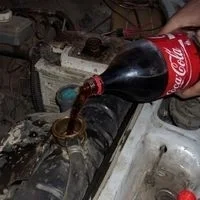
Using Coca-Cola as a cleaner
Some motorists use Coca-Cola to flush the cooling system of oil, emulsion, scale, and rust. This is because it contains phosphoric acid, which can easily remove the mentioned contaminants. However, besides the acid, this liquid contains a large amount of sugar and carbon dioxide, which can lead to certain problems.
If you decide to use Cola as a cleaning fluid, it is better to release the carbon dioxide beforehand so that it does not damage individual engine components during expansion. As for the sugar, after using the liquid, the cooling system must be thoroughly flushed with plain water.
Fairy (Washing-up liquid)
Some car enthusiasts use popular household grease removers like Fairy or similar washing-up liquids to flush oil from the cooling system. However, its use is associated with a number of problems. Firstly, its composition is designed to fight food grease, and it simply won't cope with engine oil. And even if you try to pour it into the radiator, you will have to fill and "boil" the engine dozens of times to get rid of the foam.
Calgon and similar products
Calgon, drain unblockers, and similar products are not recommended for cleaning radiators, as their primary purpose is to remove limescale from water pipes or washing machines.
Bleach
The specific feature of bleach is that it contains sodium hypochlorite, which corrodes aluminium. And the higher the temperature of the liquid and the working surface, the faster the corrosion occurs (exponentially). Therefore, under no circumstances should you pour various stain removers into the system, especially those containing chlorine and chlorine-based compounds.
Drain Cleaners
Heavy-duty drain cleaners are often based on caustic soda. Accordingly, they cannot be used to treat aluminium radiators and other surfaces. They are only suitable for cleaning copper radiators (specifically heater radiators) and only if removed from the vehicle. If you run such a cleaner through the system, you will destroy all rubber seals and gaskets.
Other mixtures
Some car enthusiasts use a mixture of citric acid (25%), soda (50%), and vinegar (25%) for cleaning. However, we do not recommend doing this, as it is very harsh and corrodes rubber and plastic parts.
Special fluids for radiator flushing
The agents listed above can, of course, be used to flush the radiator and car cooling system, but they are becoming obsolete both morally and technologically. Currently, automotive chemical manufacturers offer consumers a wide range of various cleaning agents at reasonable prices, making them accessible to the average car owner.
Types of fluids
There are several types of radiator cleaning fluids, which are divided by chemical composition. Specifically:
- Neutral. These fluids do not contain aggressive substances (specifically alkalis and acids). Therefore, they are not capable of washing away significant contamination. Typically, neutral compositions are used for prevention.
- Acidic. As the name suggests, their composition is based on various acids. Such fluids are excellent for cleaning inorganic compounds.
- Alkaline. Here the base is alkalis. They are excellent for eliminating organic contaminants.
- Two-component. They are produced based on both alkalis and acids. Thus, they can be used as a universal cleaning agent to flush the cooling system of limescale, rust, antifreeze breakdown products, and other compounds.
Popular fluids
We present an overview of some popular fluids for flushing the car cooling system, as well as some reviews from car enthusiasts who have used them. We hope the information below will be useful to you, and you will know what is best to use for flushing.
TOP 3 best fluids for flushing the cooling system
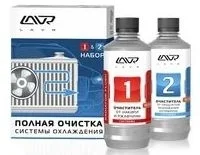
LAVR Radiator Flush LN1106
LAVR Radiator Flush Classic. LAVR is a well-known brand of automotive chemicals. LAVR Radiator Flush Classic is an excellent solution for flushing the cooling system of any vehicle. The catalogue number is LN1103. The product is widely available in varying bottle sizes.
A 430 ml bottle is sufficient for use in a cooling system with a total volume of 8...10 litres. The composition is poured into the system, and warm water is added up to the MIN mark. After that, the engine should run for about 30 minutes at idle. Then the agent is removed from the system, and it is flushed with distilled water for 10...15 minutes with the engine running at idle. After that, new antifreeze can be poured in.
Useful properties of the agent include extending the service life of antifreeze by 30...40%, effective removal of limescale, antifreeze decomposition products, rust, and dirt. It contains a corrosion inhibitor and increases the service life of the pump and thermostat.
| Positive reviews | Negative reviews |
| I simply used the LAVR flush because shortly before that I had used a piston ring decarboniser of the same name and saw the result, so I decided not to tempt fate and use a product from the same company... | No negative reviews found. |
| I also used LAVR on my Lada back in the day. Only positive impressions. But I flushed it every two years. So I never had dirt in the cooling system. | . |
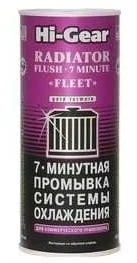
7-minute Hi-Gear Radiator Flush
Hi-Gear Radiator Flush — 7 minute. Produced in the USA by Hi-Gear. Sold in Europe, America, and many other regions. Hi-Gear cooling system flush is a very popular product among motorists worldwide. Part number — HG9014.
A 325 ml can is sufficient to flush a cooling system with a volume of up to 17 litres. The agent can be used for cleaning cooling systems of cars and trucks. A distinctive feature is the short operating time, namely 7 minutes.
Useful properties include increasing radiator efficiency by 50...70%, eliminating overheating of cylinder walls, restoring coolant circulation, reducing the likelihood of engine overheating, and protecting the pump seal. The agent does not contain acids, does not require neutralisation, and is not aggressive towards plastic and rubber parts.
| Positive reviews | Negative reviews |
| I used the Hi-Gear (USA) flush. I've been using products from this company since I bought my first car, never had any complaints, especially with the "injector cleaners". | I liked the XADO flush more. |
| After a cheap flush, it didn't get any better, but Hi-Gear helped. | . |
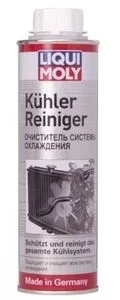
LIQUI MOLY Kuhler-Reiniger
LIQUI MOLY Kuhler-Reiniger. This is a popular product from a famous German manufacturer of automotive chemicals. It can be used in any cooling and heating system. It does not contain aggressive alkalis or acids. Part number — 1994.
Excellent for car owners wishing to flush the engine cooling system of oil, emulsion, and rust. A 300 ml can is enough to create 10 litres of cleaning fluid. The agent is added to the coolant, and the engine is left running for 10...30 minutes. After that, the system is cleaned, and new antifreeze is poured in.
The cleaning agent dissolves grease, oil, and lime deposits, removes contaminants and sludge. The substance is neutral to plastics and rubber and is compatible with any coolants. It does not contain aggressive acids or alkalis.
| Positive reviews | Negative reviews |
| To be honest, I was surprised by the result; it washed the oil out of the hoses. I ran my finger inside the hose, and there wasn't even a hint of oil left. | I washed with Liqui Moly and it didn't do anything, but the foam in the tank is still there. The info said it even removes rust, but it was the exact opposite. |
| After replacing the heater matrix, I filled it with distilled water, it flushed well. I say well because my old coolant was basically clean, it was just time to change it, but after flushing, a little limescale came out. I poured in new coolant afterwards, and now it's crystal clear. | Tried Liqui Moly on an old car — seemed like rubbish to me. |
This is far from a complete list of products for cleaning car cooling systems sold in stores. However, we have focused only on the more popular ones, as they have proven themselves better than others. Any of the listed agents can be used to flush the system, for example, when oil has got into the antifreeze.
Conclusions
As you can see, the choice of agents for cleaning the cooling system is quite wide. We recommend that you use professional products, rather than various home remedies used to flush the engine cooling system in a DIY setting when it is not possible to buy special agents. This way, you will protect the cooling and other systems of your vehicle from possible breakdowns and extend their service life. This is because various acids corrode not only the sediment but also some components and parts of the cooling system.
Also, remember that if you want to switch from one brand of antifreeze to another, you must definitely flush the cooling system with clean distilled water. This is the simplest and cheapest method of preventative system cleaning.
Was this article useful?
Your feedback helps us improve our content.
Related Materials

Discussion (0)
No comments yet!