Knocking Sound When Turning the Steering Wheel

A knocking sound when turning the steering wheel indicates issues within the vehicle's steering system. Causes can include faults in the constant velocity joint (CV joint), ball joints, wear in the track rod ends, strut top mounts, anti-roll bar links, and other defects. In any case, if you hear a strange sound when turning the wheel, you must perform diagnostics as soon as possible, as steering system faults can lead to dangerous situations.
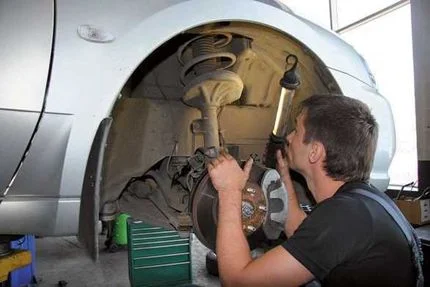
Causes of Knocking When Turning the Wheel
There are a number of reasons why a knocking sound may be heard when turning the steering wheel. To more accurately identify the fault, pay attention to three factors:
- Type of sound. Single or repetitive, dull or metallic, crunching or knocking.
- Location. At the wheel, in the suspension, or in the steering column.
- Circumstances. Whilst driving, when turning the wheel whilst stationary, on full lock, or when turning only in one direction.
Based on this data, you can pinpoint the source of the sound.
| Location of Knock | Causes of Knock |
|---|---|
| Knocking at the wheel | Wear in the Constant Velocity (CV) joint, play in track rod ends/tie rods, ball joint failure, shock absorber strut (spring clunking), anti-roll bar links. |
| Steering rack knock | Damage to the rack shaft, play in the bush and/or shaft bearings, worn teeth, wear in the steering column universal joint (UJ). |
| Knocking in the steering wheel | Play in the steering rack, shaft corrosion, wear in the steering shaft UJ crosses, issues with the EPS (Electric Power Steering) worm drive wear. |
| Steering Position | Causes of Knock |
| On full lock (left/right) | Possible contact with the subframe arm (after poor quality repair), loose suspension mountings, worn outer CV joints. |
| Turning whilst stationary | Faulty steering rack, UJ cross, loose mountings, strut top mount bearings. |
| Turning whilst driving | Same causes as when stationary, plus anti-roll bar links, shock absorbers, and CV joints. |
Let's look at the main causes in more detail below.
Constant Velocity Joint (CV Joint)
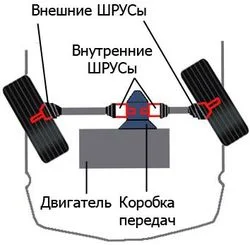
With the wheels turned to one side under load, the CV joint is the most frequent culprit (making a characteristic "crunching" noise, which may be felt through the steering wheel). When turning left, the right outer CV joint usually crunches, and when turning right, the left one does (as the load is on the outer wheel). Inner CV joints typically cause vibration or knocking when driving straight over bumps.
Track Rod Ends and Steering Tie Rods
Due to natural wear and tear (wear on the ball stud in the joint), track rod ends and tie rods begin to develop play and make knocking sounds when turning and driving over bumps. To diagnose track rod ends, you need to jack up the car and wiggle the wheel in the horizontal plane (holding it at the 9 and 3 o'clock positions). The presence of play and a knocking sound indicates a fault.
Knocking can also appear after poor quality repairs if the mechanic failed to tighten the lock nut on the tie rod after adjusting the wheel alignment (tracking).
Steering Rack
Steering rack faults are one of the most common causes of knocking. This manifests both whilst driving and when turning the wheel whilst stationary. Main causes:
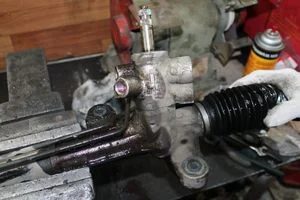
- Mounting bolts securing the rack to the body/subframe are loose.
- Wear in the shaft support bush (play appears on the right side).
- Play in the shaft bearings or the "pinion-rack" engagement.
- Wear in the pressure piece (yoke).
To diagnose, switch off the engine and ask an assistant to sharply rock the steering wheel left and right, while you inspect the rack and rods from underneath the vehicle. A faulty rack will make a distinct metallic clunk.
Steering Column UJ
If the knock is heard directly from the steering column (inside the cabin or under the bonnet near the bulkhead), the steering column universal joint (UJ) or "knuckle" is to blame. The problem often arises due to wear in the cross or the splined connection.
On many vehicles, play develops in the UJ shaft over time. There are two solutions: replacing the entire unit or replacing the cross spider (if the design allows). When purchasing a new part, it is important to check that the joint moves smoothly, without binding ("catching") or play.
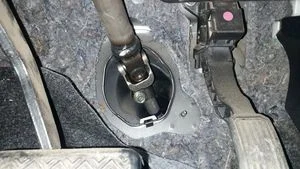
Some car owners prefer to replace needle bearings with custom bushes to increase lifespan, but a standard replacement with a high-quality aftermarket part (GMB, Toyo, etc.) is a more reliable solution.
Shock Absorber Struts and Ball Joints
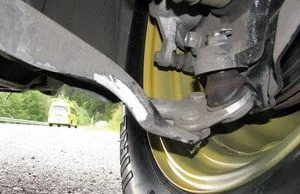
Worn moving parts of the strut can also cause suspension knocking when turning.
Ball Joint (pictured right). This is the joint connecting the suspension arm and the steering knuckle. When the grease dries out and the liner wears, the pin begins to rattle in the housing. This causes a dull thud when driving over bumps and, in severe cases, squeaking or clicking when turning the wheel.
Strut Top Mount Bearing and Spring. If a "springy" sound (twang/ping) or crunching is heard in the upper part of the strut when turning the wheel whilst stationary, the top mount bearing is faulty. Because it seizes, the spring begins to twist in jerks, making a characteristic sound. A broken coil spring can also be the cause.
Anti-roll Bar Link
A worn anti-roll bar link (drop link) makes a frequent dull knocking sound when driving over small bumps, which intensifies during turns (when the body rolls and loads the anti-roll bar). An indirect sign is increased body roll when cornering.
Subframe (Atypical Situations)
Sometimes knocking is caused by non-standard situations. For example, a stone getting trapped between the subframe and steering components or the sump guard. When turning, the parts shift, hitting the foreign object.
It is also worth checking the tightness of the subframe and wishbone mounting bolts. A loose bolt allows parts to shift with a loud click or crack when the load vector changes (turning, braking).
Conclusion
Ignoring a knocking sound when turning the steering wheel is dangerous. A failure of a ball joint or track rod end can lead to a wheel detaching whilst driving. If strange sounds appear, perform diagnostics yourself or contact a garage.
Was this article useful?
Your feedback helps us improve our content.

Discussion (0)
No comments yet!