Which Power Steering Fluid Should You Use?
Which fluid should be used in the power steering system? This question often arises for car owners when changing fluids, buying a used car, or preparing for the cold season. Japanese manufacturers often allow Automatic Transmission Fluid (ATF) to be used in the power steering system. European manufacturers, however, more frequently specify special liquids (PSF - Power Steering Fluid). Externally, they differ in colour, but choosing a fluid based solely on shade is a serious mistake. We will look at the main signs and specifications to help you decide which fluid to put in your power steering.
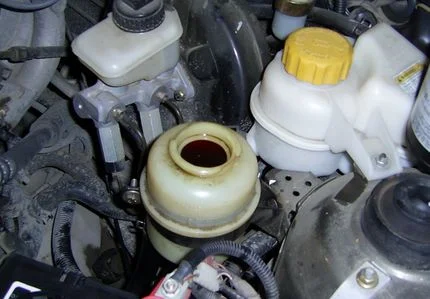
Types of Power Steering Fluids
Before answering the question of which oil to put in the power steering, we need to define the existing types. Historically, motorists have distinguished them by colour, although this is not entirely correct. Technically, it is more accurate to pay attention to specifications and the base composition. The main characteristics are:
- viscosity;
- mechanical properties;
- hydraulic properties;
- chemical composition (base type);
- temperature characteristics.
Therefore, when choosing, you must primarily pay attention to the manufacturer's requirements, not the colour. By base type, oils are divided into:
- Mineral. Often used in systems with many rubber parts. The mineral base is neutral towards rubber, preventing seals from drying out and cracking.
- Synthetic. Modern fluids with improved characteristics. Previously, it was thought that synthetics were aggressive towards rubber, but modern compositions contain additives that protect rubber seals (provided the rubber is designed for synthetics). Their usage is constantly growing. When buying, be sure to check the service booklet to see which oil to put in the power steering.
Let's list the advantages and disadvantages of each type. The advantages of mineral oils include:
- gentle effect on rubber components in older systems;
- low cost.
Disadvantages of mineral oils:
- viscosity increases in frost;
- shorter service life compared to synthetics.
Advantages of synthetic oils:
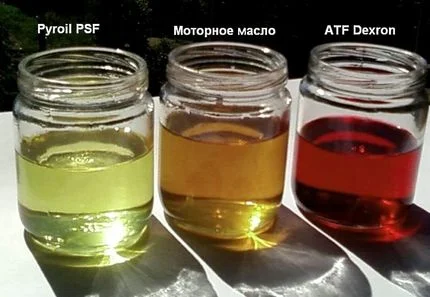
Colour differences in various fluids
- long service life;
- stable operation in all temperature regimes (relevant for winter);
- low viscosity;
- high anti-corrosion and lubricating properties.
Disadvantages of synthetics:
- cannot be used in systems designed only for mineral oil (risk of leaks);
- higher cost.
Regarding the common classification by colour, the following fluids are found on the market:
- Red. Traditionally associated with Dexron (ATF family). They can be both mineral (Dexron II) and synthetic (Dexron III, VI). Used in automatic gearboxes and many power steering systems.
- Yellow. Most often, these are PSF fluids on a mineral or synthetic basis. Frequently used in Daimler (Mercedes-Benz) vehicles.
- Green. Usually, these are special hydraulic fluids (e.g., Pentosin). Most often synthetic, but mineral variants also exist.
Many car manufacturers use the same oil for the automatic transmission and the power steering (especially in Japan). European manufacturers more often require a specialised fluid (PSF). Regardless of the type, they all perform similar tasks.
Functions of Power Steering Fluids
The functions of power steering fluids include:
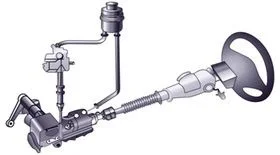
- transmitting pressure from the pump to the steering mechanism;
- lubricating power steering components and mechanisms;
- protection against corrosion;
- cooling the system.
Hydraulic oils for power steering contain additives:
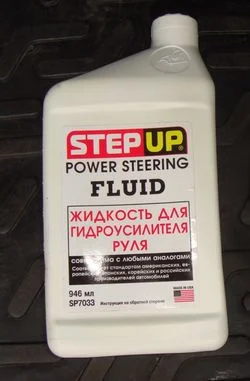
PSF Fluid for Power Steering
- anti-friction (reducing friction);
- viscosity stabilisers;
- anti-corrosion substances;
- anti-foaming additives;
- protection for rubber parts (oil seals).
ATF oils perform the same functions, but differ in the presence of additives for automatic transmission friction clutches (increasing static friction), which is not a mandatory requirement for power steering but does not hinder its operation.
Any Power Steering Fluid (PSF) is created based on a base oil and a package of additives.
What to Put in the Power Steering
The answer is simple — the fluid recommended by your vehicle's manufacturer. Experimentation is unacceptable here. If you constantly use oil that is unsuitable in terms of viscosity or base type, the power steering pump or the rack may fail.
When choosing, consider:
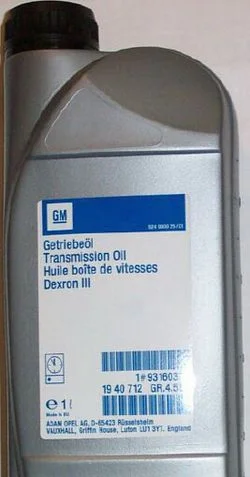
GM ATF Dexron III
- Recommendations in the car manual (handbook).
- Base type (mineral or synthetic).
- Regional temperature regime (synthetics are better for cold winters, if permissible).
- Service life. Usually, replacement is carried out every 40–80 thousand kilometres or every 2–3 years.
Can you put transmission oil in the power steering? If referring to ATF (for automatics) — yes, if the manufacturer allows it (often 'ATF Fluid' is written on the reservoir cap). Pouring engine oil is strictly forbidden.
The most common standards are Dexron and PSF (Power Steering Fluid). Dexron is a General Motors development, available in various generations (II, III, VI), differing in viscosity and temperature properties. Daimler (Mercedes) and VAG (Audi/VW) have their own approvals.
Car and Fluid Compatibility
Here is a table of approximate matches. Attention: always verify data with the instruction manual for your specific vehicle, as approvals may change depending on the year of manufacture.
| Car Make | Power Steering Fluid |
| FORD FOCUS Mk2 | Green — WSS-M2C204-A2, Red — WSA-M2C195-A |
| RENAULT LOGAN (Dacia Logan) | Elf Renaultmatic D3 or Elf Matic G3 |
| Chevrolet CRUZE | Green — Pentosin CHF202, CHF11S, Red – Dexron 6 GM |
| MAZDA 3 | Original ATF M-III or D-II |
| LADA (VAZ) | Pentosin Hydraulik Fluid CHF 11S-TL (or equivalents) |
| OPEL / VAUXHALL | Dexron of various types (II, III, VI) |
| TOYOTA | Dexron or original PSF |
| KIA / HYUNDAI | PSF-3, PSF-4 (depends on year) |
| AUDI / VW / SKODA (VAG) | VAG G 004 000 M2 (usually green Pentosin) |
| HONDA | Only original PSF, PSF II / PSF-S (Do NOT use ATF!) |
| BMW | Pentosin CHF 11S (most often), check sticker on reservoir |
If you did not find your car brand in the table, check our article on the best power steering fluids or contact an authorised dealer.
Can You Mix Power Steering Fluids?
What should you do if the level has dropped and there is no original fluid available?
Mixing is permissible only as a temporary measure (to reach a garage). In this case, you need to rely on the composition, not just the colour:
- Red and Yellow are often compatible if they have the same base (e.g., both are mineral).
- Green oils (often synthetic) usually cannot be mixed with red or yellow ones.
Below are conditional compatibility groups. Please note: this is general information; modern additives may conflict even within groups.
Group 1: Conditionally compatible mineral oils (light). Red (Dexron) and yellow mineral oils can often be mixed in emergencies.
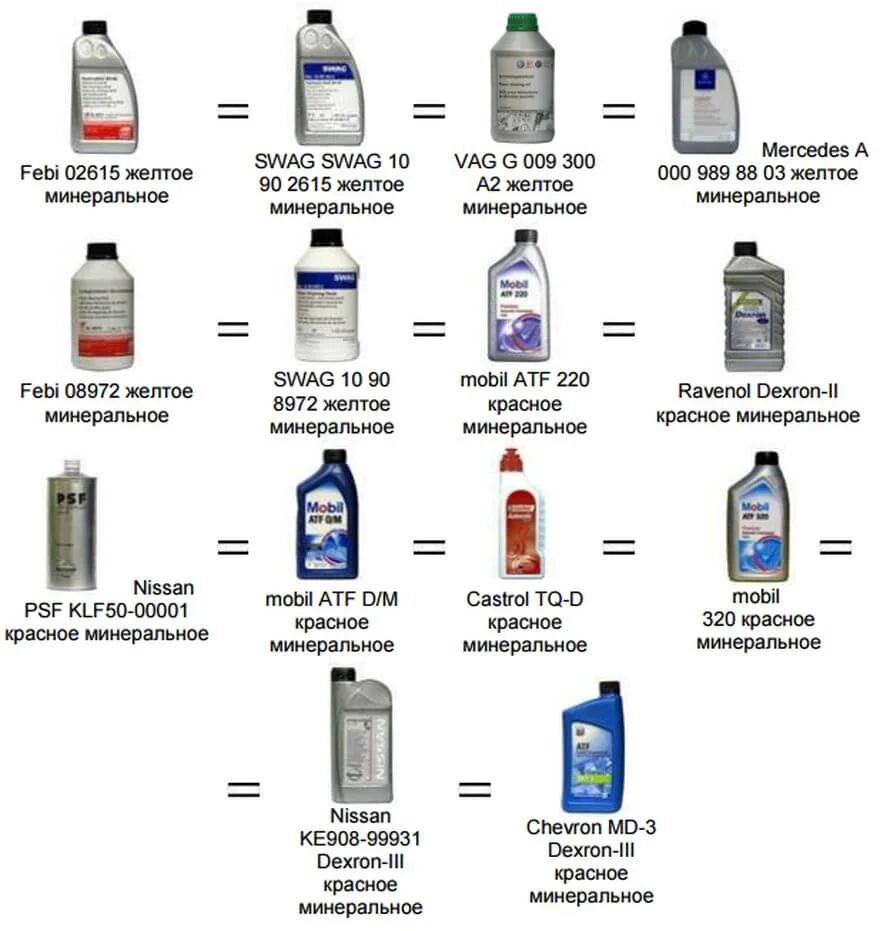
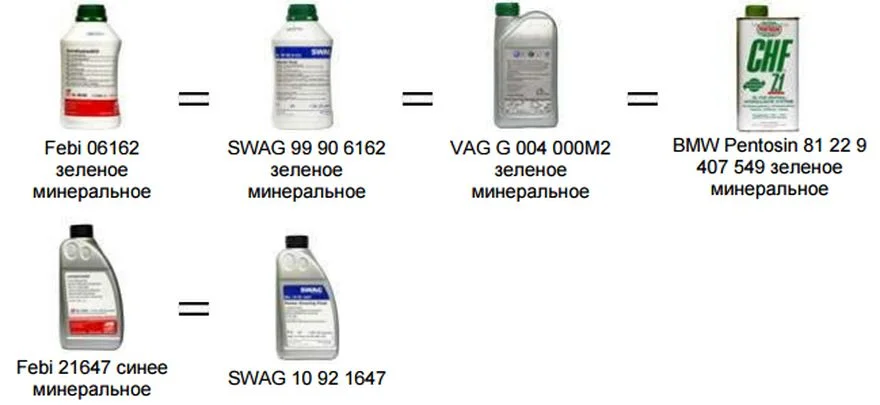
Group 2: Green fluids. Most often these are synthetic or semi-synthetic. It is recommended to mix them only with each other. Do not top up red/yellow mineral fluid with them.
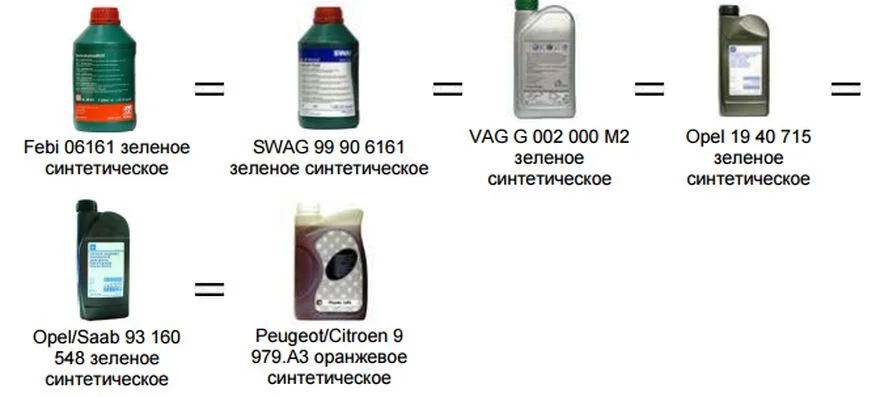
Group 3: Synthetics. Can only be mixed with synthetics of a similar specification.
Signs of Power Steering Fluid Leakage
The need for topping up or repair is indicated by the following signs:
- fluid level in the reservoir is below the MIN mark;
- leaks on the steering rack, pump, or hoses;
- whining or groaning noise from the pump (especially when turning the wheel);
- stiff steering;
- play in the steering wheel.
If these symptoms appear, check the fluid level.
Summary
The answer to the question of which power steering fluid is best to use is — the one specified by the manufacturer. Do not blindly rely on the colour of the fluid: red Dexron can be mineral, while green Pentosin can be synthetic. Mixing different compositions is permitted only in extreme cases and only if the base type matches ('mineral' with 'mineral', 'synthetic' with 'synthetic').
Was this article useful?
Your feedback helps us improve our content.



Discussion (0)
No comments yet!